
Penny Dreadfuls, 1854 · page 280 of 399
Joseph Wilmot, or, The Memoirs of a Man-Servant — page 280: what you’re looking at
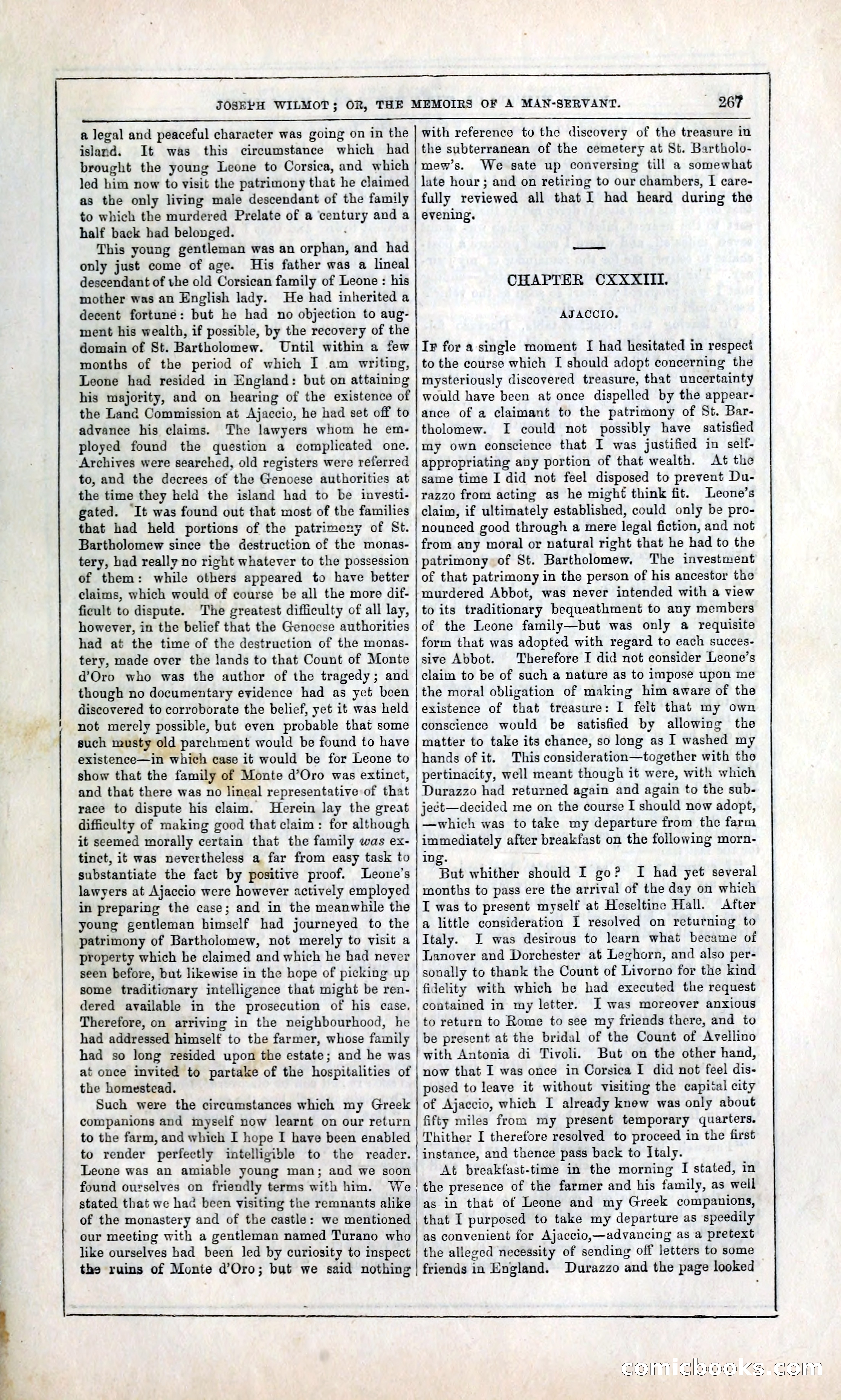
A restored page from Penny Dreadfuls, 1854. Page through the whole issue in the reader above.
📄 Transcribed text from this page (OCR, searchable)
Machine-transcribed from the original scan — historical spelling and the odd misread are preserved.
JOSEPH WILMOT; OR, THE MEMOIRS OF A MAN-SERVANT. 267 a legal and peaceful character was going on in the island. It was this circumstance which had brought the young Leone to Corsica, and which led him now to visit the patrimony that he claimed as the only living male descendant of the family to which the murdered Prelate of a century and a half back had belonged. This young gentleman was an orphan, and had only just come of age. His father was a lineal descendant of the old Corsican family of Leone : his mother was an English lady. He had inherited a decent fortune: but he had no objection to aug- ment his wealth, if possible, by the recovery of the domain of St. Bartholomew. Until within a few months of the period of which I am writing, Leone had resided in England: but on attaining his majority, and on hearing of the existence of the Land Commission at Ajaccio, he had set off to advance his claims. The lawyers whom he em- ployed found the question a complicated one. Archives were searched, old registers were referred to, and the decrees of the Genoese authorities at the time they held the island had to be investi- gated. It was found out that most of the families that had held portions of the patrimeny of St. Bartholomew since the destruction of the monas- tery, bad really no right whatever to the possession of them: while others appeared to have better claims, which would of course be all the more dif- ficult to dispute. The greatest difficulty of all lay, however, in the belief that the Genoese authorities had at the time of the destruction of the monas- tery, made over the lands to that Count of Monte d’Oro who was the author of the tragedy; and though no documentary evidence had as yet been discovered to corroborate the belief, yet it was held not merely possible, but even probable that some such musty old parchment would be found to have existence—in which case it would be for Leone to show that the family of Monte d’Oro was extinct, and that there was no lineal representative of that race to dispute his claim. Herein lay the great difficulty of making good that claim: for although it seemed morally certain that the family was ex- tinct, it was nevertheless a far from easy task to substantiate the fact by positive proof. lLeone’s lawyers at Ajaccio were however actively employed in preparing the case; and in the meanwhile the young gentleman himself had journeyed to the patrimony of Bartholomew, not merely to visit a property which he claimed and which he had never seen before, but likewise in the hope of picking up some traditionary intelligence that might be ren- dered available in the prosecution of his case, Therefore, on arriving in the neighbourhood, he had addressed himself to the farmer, whose family had so long resided upon the estate; and he was at once invited to partake of the hospitalities of the homestead. Such were the circumstances which my Greek companions and myself now learnt on our return to the farm, and which I hope I have been enabled to render perfectly intelligible to the reader. Leone was an amiable young man; and we soon found ourselves on friendly terms with him. We stated that we hac been visiting the remnants alike of the monastery and of the castle: we mentioned our meeting with a gentleman named Turano who like ourselves had been led by curiosity to inspect the ruins of Monte d’Oro; but we said nothing ee ee eee i I with reference to the discovery of the treasure in the subterranean of the cemetery at St. Bartholo- mew’s. We sate up conversing till a somewhat late hour ; and on retiring to our chambers, [ care- fully reviewed all that 1 had heard during the evening. —— CHAPTER CXXXIILI. AJACCIO. If for a single moment I had hesitated in respect to the course which I should adopt concerning the mysteriously discovered treasure, that uncertainty would have been at once dispelled by the appear- ance of a claimant to the patrimony of St. Bar- tholomew. I could not possibly have satisfied my own conscience that I was justified in self- appropriating avy portion of that wealth. At the same time I did not feel disposed to prevent Du- razzo from acting as he might think fit. Leone’s claim, if ultimately established, could only be pro- nounced good through a mere legal fiction, and not from any moral or natural right that he had to the patrimony of St. Bartholomew. The investment of that patrimony in the person of his ancestor the murdered Abbot, was never intended with a view to its traditionary bequeathment to any members of the Leone family—but was only a requisite form that was adopted with regard to each succes- sive Abbot. Therefore I did not consider Leone’s claim to be of such a nature as to impose upon me the moral obligation of making him aware of the existence of that treasure: I feit that my own conscience would be satisfied by allowing the matter to take its chance, so long as I washed my hands of it. This consideration—together with the pertinacity, well meant though it were, with which Durazzo had returned again and again to the sub- jeét—decided me on the course I should now adopt, —which was to take my departure from the farm immediately after breakfast on the following morn- ing. But whither should I go? I had yet several months to pass ere the arrival of the day on which I was to present myself at Heseltine Hall. After a little consideration I resolved on returning to Italy. JI was desirous to learn what became of Lanover and Dorchester at Leghorn, and also per- soually to thank the Count of Livorno for the kind fidelity with which he had executed the request contained in my letter. J was moreover anxious to return to Rome to see my friends there, and to be present at the bridal of the Count of Avellino with Antonia di Tivoli. But on the other hand, now that I was once in Corsica I did not feel dis- posed to leave it without visiting the capital city of Ajaccio, which I already knew was only about fifty miles from my present temporary quarters. Thither I therefore resolved to proceed in the first instance, and thence pass back to Italy. At breakfast-time in the morning I stated, in the presence of the farmer and his family, as well as in that of Leone and my Greek companions, that I purposed to take my departure as speedily as convenient for Ajaccio,—advancing as a pretext the alleged necessity of sending off letters to some friends in England. Durazzo and the page looked Giook (EO)