
Penny Dreadfuls, 1854 · page 301 of 399
Joseph Wilmot, or, The Memoirs of a Man-Servant — page 301: what you’re looking at
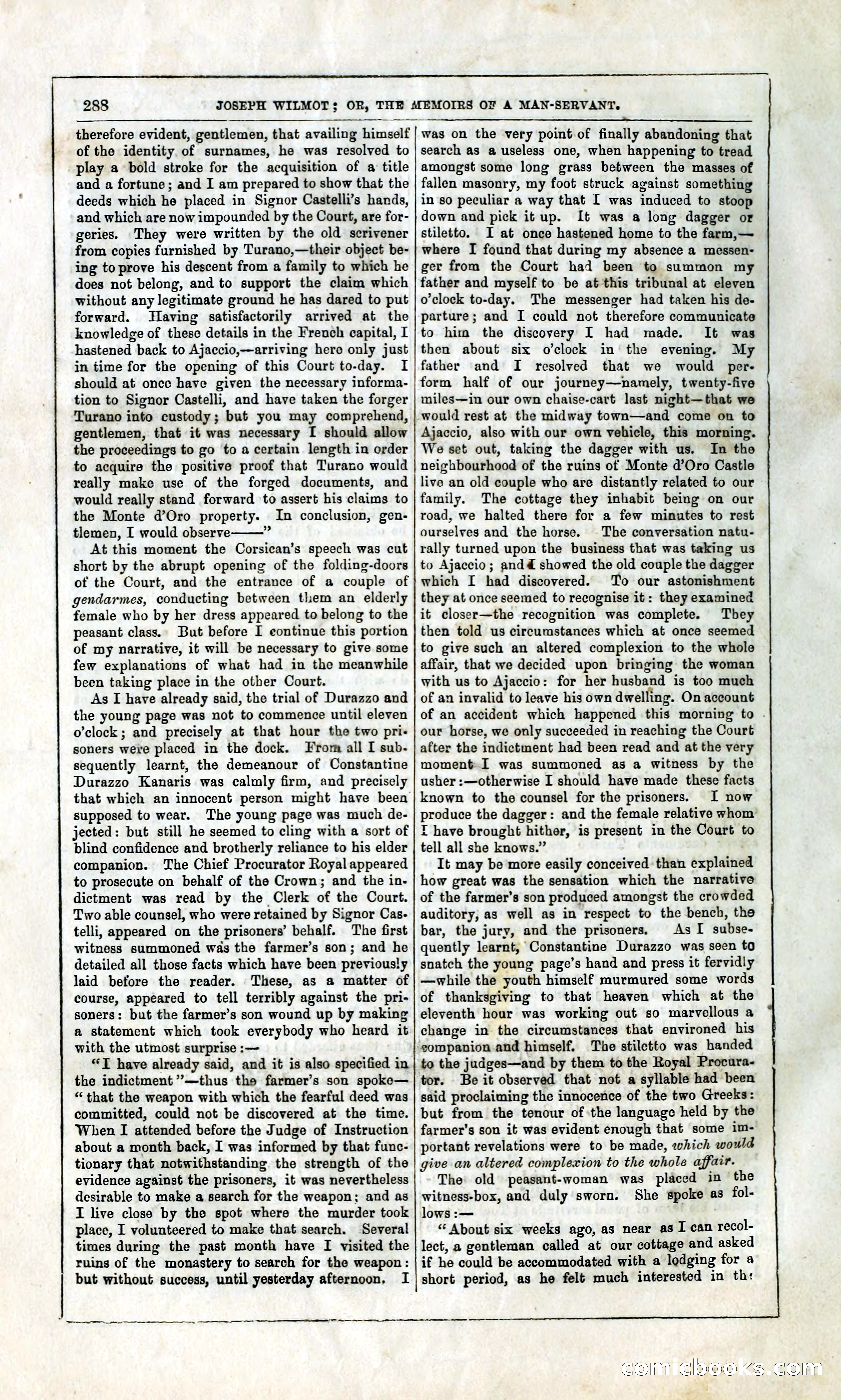
A restored page from Penny Dreadfuls, 1854. Page through the whole issue in the reader above.
📄 Transcribed text from this page (OCR, searchable)
Machine-transcribed from the original scan — historical spelling and the odd misread are preserved.
288 JOSEPH WILMOT:; OR, THE MEMOIRS OF A MAN-SERVANT. therefore evident, gentlemen, that availing himself of the identity. of surnames, he was resolved to play a bold stroke for the acquisition of a title and a fortune; and I am prepared to show that the deeds which he placed in Signor Castelli’s hands, and which are now impounded by the Court, are for- geries. They were written by the old scrivener from copies furnished by Turano,—their object be- ing to prove his descent from a family to which he does not belong, and to support the claim which without any legitimate ground he has dared to put forward. Having satisfactorily arrived at the knowledge of these details in the French capital, I hastened back to Ajaccio,—arriving here only just in time for the opening of this Court to-day. I should at once have given the necessary informa- tion to Signor Castelli, and have taken the forger Turano into custody; but you may comprehend, gentlemen, that it was necessary I should allow the proceedings to go to a certain length in order to acquire the positive proof that Turano would really make use of the forged documents, and would really stand forward to assert his claims to the Monte d’Oro property. In conclusion, gen- tlemen, I would observe re At this moment the Corsican’s speech was cut short by the abrupt opening of the folding-doors of the Court, and the entrance of a couple of gendarmes, conducting between tlem an elderly female who by her dress appeared to belong to the peasant class.. But before I eontinue this portion of my narrative, it will be necessary to give some few explanations of what had in the meanwhile been taking place in the other Court. As I have already said, the trial of Durazzo and the young page was not to commence until eleven o’clock ; and precisely at that hour the two pri- soners were placed in the dock. From all I sub- sequently learnt, the demeanour of Constantine Durazzo Kanaris was calmly firm, and precisely that which an innocent person might have been supposed to wear. The young page was much de- jected: but still he seemed to cling with a sort of blind confidence and brotherly reliance to his elder companion. The Chief Procurator Royal appeared to prosecute on behalf of the Crown; and the in- dictment was read by the Clerk of the Court. Two able counsel, who were retained by Signor Cas- telli, appeared on the prisoners’ behalf. The first witness summoned was the farmer’s son; and he detailed all those facts which have been previously laid before the reader. These, as a matter of course, appeared to tell terribly against the pri- soners: but the farmer’s son wound up by making a statement which took everybody who heard it with the utmost surprise :— “T have already said, and it is also specified in the indictment ’—thus the farmer’s son spoke— ‘that the weapon with which the fearful deed was committed, could not be discovered at the time. When I attended before the Judge of Instruction about a month back, I was informed by that func- tionary that notwithstanding the strength of the evidence against the prisoners, it was nevertheless desirable to make a search for the weapon; and as I live close by the spot where the murder took place, I volunteered to make that search. Several times during the past month have I visited the ruins of the monastery to search for the weapon: but without success, until yesterday afternoon, I was on the very point of finally abandoning that search as a useless one, when happening to tread amongst some long grass between the masses of fallen masonry, my foot struck against something in so peculiar a way that I was induced to stoop down and pick itup. It was a long dagger or stiletto. I at once hastened home to the farm,— where I found that during my absence a messen- ger from the Court had been to summon my father and myself to be at this tribunal at eleven o’clock to-day. The messenger had taken his de- parture; and I could not therefore communicate to him the discovery I had made. It was then about six o’clock in the evening. My father and I resolved that we would per- form half of our journey—namely, twenty-five miles—in our own chaise-cart last night—that we would rest at the midway town—and come on to Ajaccio, also with our own vehicle, this morning. We set out, taking the dagger with us. In tho neighbourhood of the ruins of Monte d’Oro Castle live an old couple who are distantly related to our family. The cottage they inhabit being on our road, we halted there for a few minutes to rest ourselves and the horse. The conversation natu- rally turned upon the business that was taking us to Ajaccio; anda showed the old couple the dagger which I had discovered. To our astonishment they at once seemed to recognise it: they examined it closer—the recognition was complete. They then told us circumstances which at once seemed to give such an altered complexion to the whole affair, that we decided upon bringing the woman with us to Ajaccio: for her husband is too much of an invalid to leave his own dwelling. On account of an accident which happened this morning to . our horse, we only succeeded in reaching the Court after the indictment had been read and at the very moment I was summoned as a witness by the usher :—otherwise I should have made these facts known to the counsel for the prisoners. I now produce the dagger: and the female relative whom I have brought hither, is present in the Court to tell all she knows.” It may be more easily conceived than explained how great was the sensation which the narrative of the farmer’s son produced amongst the crowded auditory, as well as in respect to the bench, the bar, the jury, and the prisoners. As I subse- quently learnt, Constantine Durazzo was seen to snatch the young page’s hand and press it fervidly —while the youth himself murmured some words of thanksgiving to that heaven which at the eleventh hour was working out so marvellous a change in the circumstances that environed his companion and himself. The stiletto was handed to the judges—and by them to the Royal Procura- tor. Be it observed that not a syllable had been said proclaiming the innocence of the two Greeks: but from the tenour of the language held by the farmer’s son it was evident enough that some im- portant revelations were to be made, which would give an altered complexion to the whole affair. The old peasant-woman was placed in the witness-box, and duly sworn. She spoke as fol- lows :— “ About six weeks ago, as near as I can recol- lect, a gentleman called at our cottage and asked if he could be accommodated with a lodging for a short period, as he felt much interested in ths COomicaoolks (c@)