
Penny Dreadfuls, 1854 · page 304 of 399
Joseph Wilmot, or, The Memoirs of a Man-Servant — page 304: what you’re looking at
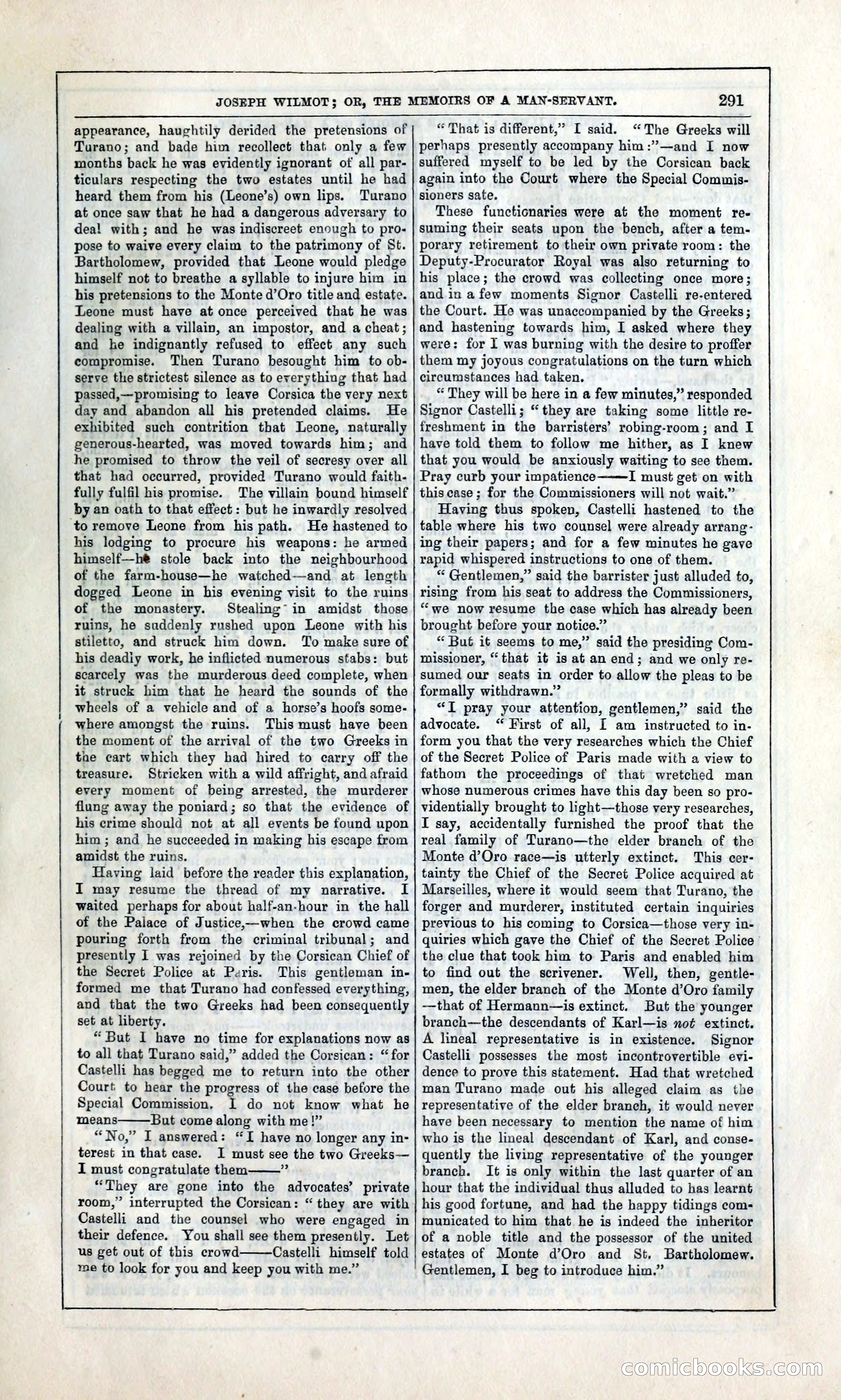
A restored page from Penny Dreadfuls, 1854. Page through the whole issue in the reader above.
📄 Transcribed text from this page (OCR, searchable)
Machine-transcribed from the original scan — historical spelling and the odd misread are preserved.
JOSEPH WILMOT; OR, THE MEMOIRS OF A MAN-SERVANT. 291 appearance, haughtily derided the pretensions of Turano; and bade him recollect that only a few months back he was evidently ignorant of all par- ticulars respecting the two estates until he had heard them from his (Leone’s) own lips. Turano at once saw that he had a dangerous adversary to dea! with; and he was indiscreet enough to pro. pose to waive every claim to the patrimony of St. Bartholomew, provided that Leone would pledge himself not to breathe a syllable to injure him in his pretensions to the Monte d’Oro title and estate. Leone must have at once perceived that he was dealing with a villain, an impostor, and a cheat; and he indignantly refused to effect any such compromise. Then Turano besought him to ob- serve the strictest silence as to everything that had passed,—promising to leave Corsica the very next day and abandon all his pretended claims. He exhibited such contrition that Leone, naturally generous-hearted, was moved towards him; and he promised to throw the veil of secresy over all that had occurred, provided Turano would faith- fully fulfil his promise. The villain bound himself by an oath to that effect: but he inwardly resolved ‘to remove Leone from his path. He hastened to his lodging to procure his weapons: he armed himself—h® stole back into the neighbourhood of the farm-house—he watched—and at length dogged Leone in his evening visit to the ruins of the monastery. Stealing’ in amidst those ruins, he suddenly rushed upon Leone with his stiletto, and struck him down. To make sure of his deadiy work, he inflicted numerous stabs: but scarcely was the murderous deed complete, when it struck him that he heard the sounds of the wheels of a vehicle and of a horse’s hoofs some- where amongst the ruins. This must have been the moment of the arrival of the two Greeks in the cart which they had hired to carry off the treasure. Stricken with a wild affright, and afraid every moment of being arrested, the murderer flung away the poniard; so that the evidence of his crime should not at all events be found upon him ; and he succeeded in making his escape from amidst the ruins. Having laid before the reader this explanation, I may resume the thread of my narrative. I waited perhaps for about half-an-hour in the hall of the Palace of Justice,—when the crowd came pouring forth from the criminal tribunal; and presently I was rejoined by the Corsican Chief of the Secret Police at Psris. This gentleman in- formed me that Turano had confessed everything, and that the two Greeks had been consequently set at liberty. “But I have no time for explanations now as to all that Turano said,” added the Corsican: “ for Castelli has begged me to return into the other Court to hear the progress of the case before the Special Commission, I do not know what he means But come along with me!” “No,” I answered: “I have no longer any in- terest in that case. I must see the two Greeks— I must congratulate them 7 “They are gone into the advocates’ private room,” interrupted the Corsican: “they are with Castelli and the counsel who were engaged in their defence. You shall see them presently. Let us get out of this crowd Castelli himself told me to look for you and keep you with me.” “That is different,’ I said. “The Greeks will perhaps presently accompany him :’—and I now suffered myself to be led by the Corsican back again into the Court where the Special Commis- sioners sate. These functionaries were at the moment re- suming their seats upon the bench, after a tem- porary retirement to their own private room: the Deputy-Procurator Royal was also returning to his place; the crowd was collecting once more; and in afew moments Signor Castelli re-entered the Court. He was unaccompanied by the Greeks; and hastening towards him, I asked where they were: for I was burning with the desire to proffer them my joyous congratulations on the turn which circumstances had taken. “ They will be here in a few minutes,” responded Signor Castelli; “they are taking some little re- freshment in the barristers’ robing-room; and I have told them to follow me hither, as I knew that you would be anxiously waiting to see them. Pray curb your impatience——I must get on with this case; for the Commissioners will not wait.” Having thus spoken, Castelli hastened to the table where his two counsel were already arrang- ing their papers; and for a few minutes he gave rapid whispered instructions to one of them. “ Gentlemen,” said the barrister just alluded to, rising from his seat to address the Commissioners, “we now resume the case which has already been brought before your notice.” “ But i¢ seems to me,” said the presiding Com- missioner, “that it is at an end; and we only re- sumed our seats in order to allow the pleas to be formally withdrawn.” “I pray your attention, gentlemen,” said the advocate. ‘“ First of all, I am instructed to in- form you that the very researches which the Chief of the Secret Police of Paris made with a view to fathom the proceedings of that wretched man whose numerous crimes have this day been so pro- videntially brought to light—those very researches, I say, accidentally furnished the proof that the real family of Turano—the elder branch of the Monte d’Oro race—is utterly extinct. This cer- tainty the Chief of the Secret Police acquired at Marseilles, where it would seem that Turano, the forger and murderer, instituted certain inquiries previous to his coming to Corsica—those very in- quiries which gave the Chief of the Secret Police the clue that took him to Paris and enabled him to find out the serivener. Well, then, gentle- men, the elder branch of the Monte d’Oro family —that of Hermann—is extinct. But the younger branch—the descendants of Karl—is no¢ extinct. A lineal representative is in existence. Signor Castelli possesses the most incontrovertible evi- dence to prove this statement. Had that wretched man Turano made out his alleged claim as the representative of the elder branch, it would never have been necessary to mention the name of him who is the lineal descendant of Karl, and conse- quently the living representative of the younger branch. It is only within the last quarter of an hour that the individual thus alluded to has learnt his good fortune, and had the happy tidings com- municated to him that he is indeed the inheritor of a noble title and the possessor of the united estates of Monte d’Oro and St, Bartholomew. Gentlemen, I beg to introduce him.” ElO@QO) <S co