
Penny Dreadfuls, 1854 · page 31 of 399
Joseph Wilmot, or, The Memoirs of a Man-Servant — page 31: what you’re looking at
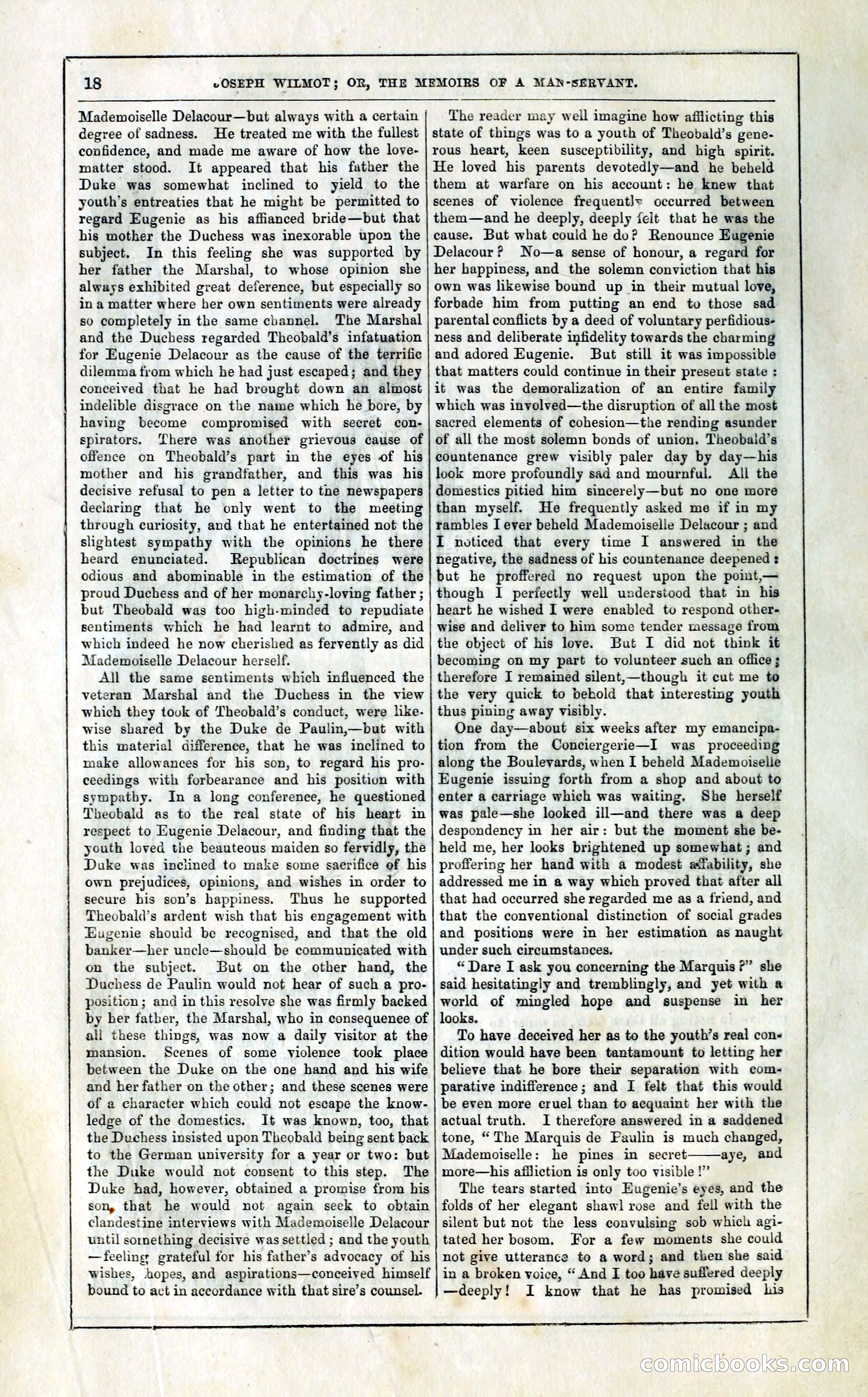
A restored page from Penny Dreadfuls, 1854. Page through the whole issue in the reader above.
📄 Transcribed text from this page (OCR, searchable)
Machine-transcribed from the original scan — historical spelling and the odd misread are preserved.
18 Mademoiselle Delacour—but always with a certain | degree of sadness. He treated me with the fullest confidence, and made me aware of how the love- matter stood. It appeared that his father the Duke was somewhat inclined to yield to the youth’s entreaties that he might be permitted to regard Eugenie as his affianced bride—but that his mother the Duchess was inexorable upon the subject. In this feeling she was supported by her father the Marshal, to whose opinion she always exhibited great deference, but especially so in a matter where her own sentiments were already so completely in the same channel. The Marshal and the Duchess regarded Theobald’s infatuation for Eugenie Delacour as the cause of the terrific dilemma from which he had just escaped; and they conceived that he had brought down an almost indelible disgrace on the name which he bore, by having become compromised with secret con- spirators. here was another grievous cause of offence on Theobald’s part in the eyes of his mother and his grandfather, and this was his decisive refusal to pen a letter to the newspapers declaring that he only went to the meeting through curiosity, and that he entertained not the slightest sympathy with the opinions he there heard enunciated. Republican doctrines were odious and abominable in the estimation of the proud Duchess and of her monarchy-loving father ; but Theobald was too high-minded to repudiate sentiments which he had learnt to admire, and which indeed he now cherished as fervently as did Mademoiselle Delacour herself. All the same sentiments which influenced the veteran Marshal and the Duchess in the view which they took of Theobald’s conduct, were like- wise shared by the Duke de Paulin,—but with this material difference, that he was inclined to make allowances for his son, to regard his pro- ceedings with forbearance and his position with sympathy. In a long conference, he questioned Theobald as to the real state of his heart in respect to Eugenie Delacour, and finding that the youth loved the beauteous maiden so fervidly, the Duke was inciined to make some saerifice of his own prejudices, opinions, and wishes in order to secure his son’s happiness. Thus he supported Theobald’s ardent wish that his engagement with Eugenie should be recognised, and that the old banker—her uncle—should be communicated with on the subject. But on the other hand, the Duchess de Paulin would not hear of such a pro- position; and in this resolve she was firmly backed by her father, the Marshal, who in consequenee of all these things, was now a daily visitor at the mansion. Scenes of some violence took place between the Duke on the one hand and his wife and her father on the other; and these scenes were of a character which could not escape the know- ledge of the domestics. It was known, too, that the Duchess insisted upon Theobald being sent back to the German university for a year or two: but the Duke would not consent to this step. The Duke had, however, obtained a promise from his son, that he would not again seek to obtain clandestine interviews with Mademoiselle Delacour until something decisive was settled ; and the youth —feeling grateful for his father’s advocacy of his wishes, hopes, and aspirations—conceived himself bound to act in accordance with that sire’s counsel. vOSEPH WILMOT; OR, THE MEMOIRS OF A MAN-SERVANT. The reader may well imagine how afilicting this state of things was to a youth of Theobald’s gene- rous heart, keen susceptibility, and high spirit. He loved his parents devotedly—and he beheld them at warfare on his account: he knew that scenes of violence frequent}y occurred between them—and he deeply, deeply {felt that he was the cause. But what could he do? Renounce Eugenie Delacour? No—a sense of honour, a regard for her happiness, and the solemn conviction that his own was likewise bound up in their mutual love, forbade him from putting an end to those sad parental conflicts by a deed of voluntary perfidious- ness and deliberate infidelity towards the charming and adored Eugenie. But still it was impossible that matters could continue in their present state : it was the demoralization of an entire family which was involved—the disruption of all the most sacred elements of cohesion—the rending asunder of all the most solemn bonds of union. Theobaid’s countenance grew visibly paler day by day—his look more profoundly sad and mournful. All the domestics pitied him sincerely—but no one more than myself. He frequently asked me if in my rambles I ever beheld Mademoiselle Delacour ; and I noticed that every time I answered in the negative, the sadness of his countenance deepened ¢ but he proffered no request upon the point,— though I perfectly well understood that in his heart he wished I were enabled to respond other- wise and deliver to him some tender message from the object of his love. But I did not think it becoming on my part to volunteer such an office; therefore I remained silent,—though it cut me to the very quick to behold that interesting youth thus pining away visibly. One day—about six weeks after my emancipa- tion from the Conciergerie—I was proceeding along the Boulevards, when I beheld Mademoiselle Eugenie issuing forth from a shop and about to enter a carriage which was waiting. She herself was pale—she looked ill—and there was a deep despondency in her air: but the moment she be- held me, her looks brightened up somewhat ; and proffering her hand with a modest afability, she addressed me in a way which proved that after all that had occurred she regarded me as a friend, and that the conventional distinction of social grades and positions were in her estimation as naught under such circumstances. “ Dare I ask you concerning the Marquis?” she said hesitatingly and tremblingly, and yet with a world of mingled hope and suspense in her looks. | To have deceived her as to the youth’s real con- dition would have been tantamount to letting her believe that he bore their separation with com- parative indifference; and I felt that this would be even more cruel than to acquaint her with the actual truth. I therefore answered in a saddened tone, “ The Marquis de Paulin is much changed, Mademoiselle: he pines in secret aye, and more—his afiliction is only too visible !” The tears started into Eugenie’s eyes, and the folds of her elegant shawl rose and fell with the silent but not the less convulsing sob which agi- tated her bosom. For a few moments she could not give utterance to a word; and then she said in a broken voice, “ And I too have suffered deeply —deeply! I know that he has promised his (COUN (SC S 0)(0)(6) i (EO)