
Penny Dreadfuls, 1854 · page 312 of 399
Joseph Wilmot, or, The Memoirs of a Man-Servant — page 312: what you’re looking at
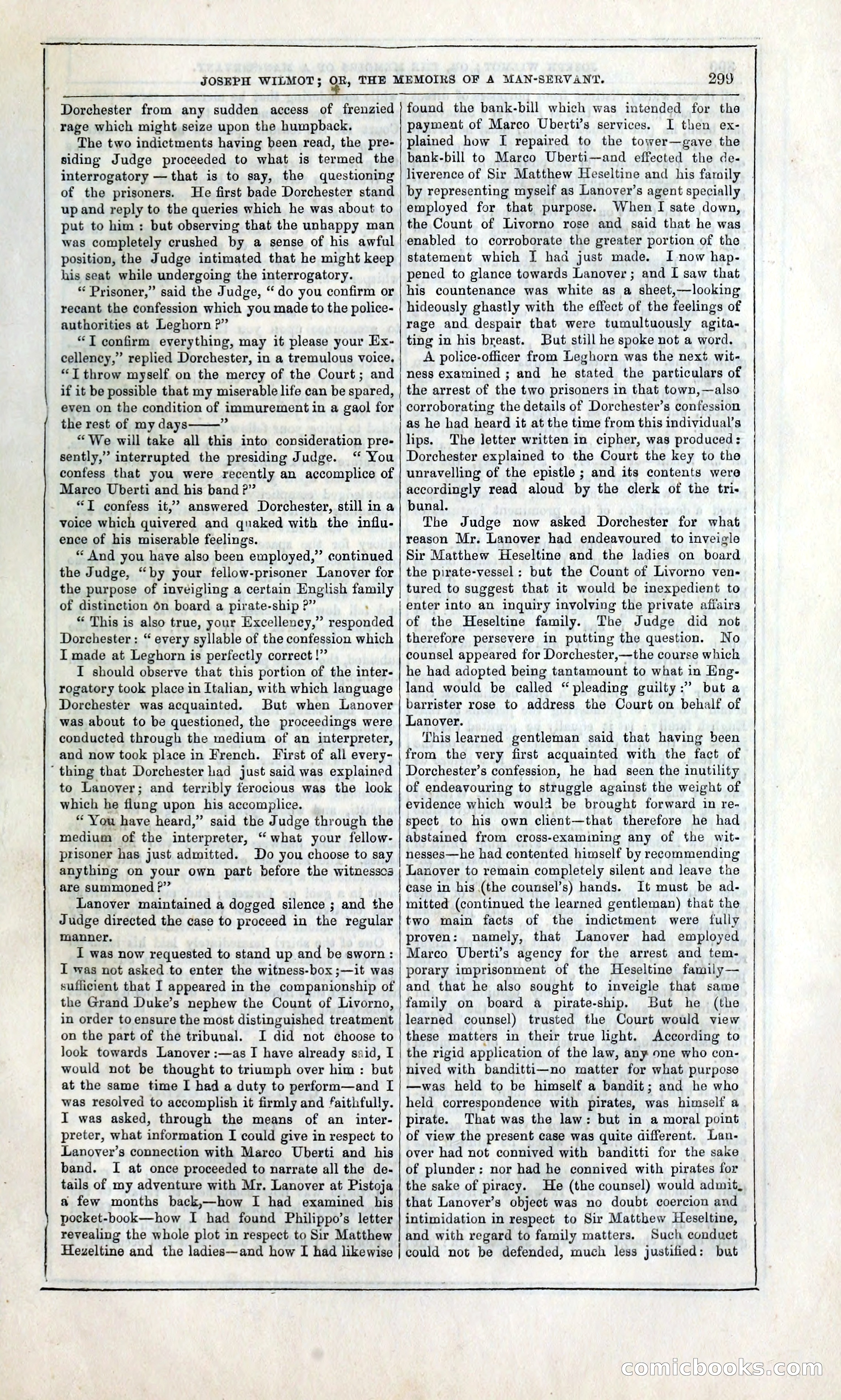
A restored page from Penny Dreadfuls, 1854. Page through the whole issue in the reader above.
📄 Transcribed text from this page (OCR, searchable)
Machine-transcribed from the original scan — historical spelling and the odd misread are preserved.
JOSEPH WILMOT; OR, THE MEMOIRS OF A MAN-SERVANT. Dorchester from any sudden access of frenzied rage which might seize upon the humpback. The two indictments having been read, the pre- siding Judge proceeded to what is termed the interrogatory —that is to say, the questioning of the prisoners. He first bade Dorchester stand up and reply to the queries which he was about to put to him: but observing that the unhappy man was completely crushed by a sense of his awful position, the Judge intimated that he might keep his seat while undergoing the interrogatory. * Prisoner,” said the Judge, “do you confirm or recant the confession which you made to the police- authorities at Leghorn P” “T confirm everything, may it please your Ex- cellency,” replied Dorchester, in a tremulous voice, “I throw myself on the mercy of the Court; and if it be possible that my miserable life can be spared, even on the condition of immurement in a gaol for the rest of my days 4 “We will take all this into consideration pre- sently,” interrupted the presiding Judge. ‘“ You confess that you were recently an accomplice of Marco Uberti and his band P” “IT confess it,” answered Dorchester, still in a voice which guivered and quaked with the influ- ence of his miserable feelings. “And you have also been employed,” continued the Judge, “by your fellow-prisoner Lanover for the purpose of inveigling a certain English family of distinction 6n board a pirate-ship ?” “ This is also true, your Excellency,” responded Dorchester : “ every syllable of the confession which I made at Leghorn is perfectly correct !” I should observe that this portion of the inter- rogatory took place in Italian, with which language Dorchester was acquainted. But when Lanover was about to be questioned, the proceedings were conducted through the medium of an interpreter, and now took place in French. First of all every- ' thing that Dorchester had just said was explained to Lanoyer; and terribly ferocious was the look which he flung upon his accomplice. “ You have heard,” said the Judge through the medium of the interpreter, “what your fellow- prisoner has just admitted. Do you choose to say anything on your own part before the witnesscs are summoned ?P” Lanover maintained a dogged silence ; and the Judge directed the case to proceed in the regular manner. I was now requested to stand up and be sworn: I was not asked to enter the witness-box ;—it was sufficient that I appeared in the companionship of the Grand Duke’s nephew the Count of Livorno, in order to ensure the most distinguished treatment on the part of the tribunal. I did not choose to look towards Lanover :—as I have already said, I would not be thought to triumph over him : but at the same time I had a duty to perform—and I was resolved to accomplish it firmly and faithfully. I was asked, through the means of an inter- preter, what information I could give in respect to Lanover’s connection with Marco Uberti and his band. I at once proceeded to narrate all the de- tails of my adventure with Mr. Lanover at Pistoja a few months back,—how I had examined his pocket-book—how I had found Philippo’s letter revealing the whole plot in respect to Sir Matthew — ee 299 found the bank-bill which was intended for the payment of Marco Uberti’s services. I then ex- plained how I repaired to the tower—gave the bank-bill to Marco Uberti—and effected the de- liverence of Sir Matthew Heseltine and his family | by representing myself as Lanover’s agent specially employed for that purpose. When I sate down, the Count of Livorno rose and said that he was enabled to corroborate the greater portion of the statement which I had just made. I now hap- pened to glance towards Lanover ; and I saw that his countenance was white as a sheet,—looking hideously ghastly with the effect of the feelings of rage and despair that were tumultuously agita- ting in his breast. But still he spoke not a word. A police-officer from Leghorn was the next wit- ness examined ; and he stated the particulars of the arrest of the two prisoners in that town,—also corroborating the details of Dorchester’s confession as he had heard it at the time from this individual’s lips. The letter written in cipher, was produced: Dorchester explained to the Court the key to the unravelling of the epistle ; and its contents were accordingly read aloud by the clerk of the tri- bunal. The Judge now asked Dorchester for what reason Mr. Lanover had endeavoured to inveigle Sir Matthew Heseltine and the ladies on board the pirate-vessel: but the Count of Livorno ven- tured to suggest that it would be inexpedient to enter into an inquiry involving the private afiairs of the Heseltine family. The Judge did not therefore persevere in putting the question. No counsel appeared for Dorchester,—the course which he had adopted being tantamount to what in ing- land would be called “pleading guilty:” but a barrister rose to address the Court on behalf of Lanover. This learned gentleman said that having been from the very first acquainted with the fact of Dorchester’s confession, he had seen the inutility of endeavouring to struggle against the weight of evidence which would be brought forward in re- spect to his own client—that therefore he had abstained from cross-examining any of the wit- nesses—he had contented himself by recommending Lanover to remain completely silent and leave the case in his (the counsel’s) hands. It must be ad- mitted (continued the learned gentleman) that the two main facts of the indictment were fully proven: namely, that Lanover had employed Marco Uberti’s agency for the arrest and tem- porary imprisonment of the Heseltine family— and that he also sought to inveigle that same family on board a pirate-ship. But he (the learned counsel) trusted the Court would view these matters in their true light. According to the rigid application of the law, any one who con- nived with banditti—no matter for what purpose —was held to be himself a bandit; and he who held correspondence with pirates, was himself a pirate. That was the law: but in a moral point of view the present case was quite different. Lan- over had not connived with banditti for the sake of plunder: nor had he connived with pirates for the sake of piracy. He (the counsel) would admit, that Lanover’s object was no doubt coercion and intimidation in respect to Sir Matthew Heseltine, and with regard to family matters. Such eonduet Hevzeltine and the ladies—and how I had likewise | could not be defended, much less justified: but OOO) S (C@)