
Penny Dreadfuls, 1854 · page 314 of 399
Joseph Wilmot, or, The Memoirs of a Man-Servant — page 314: what you’re looking at
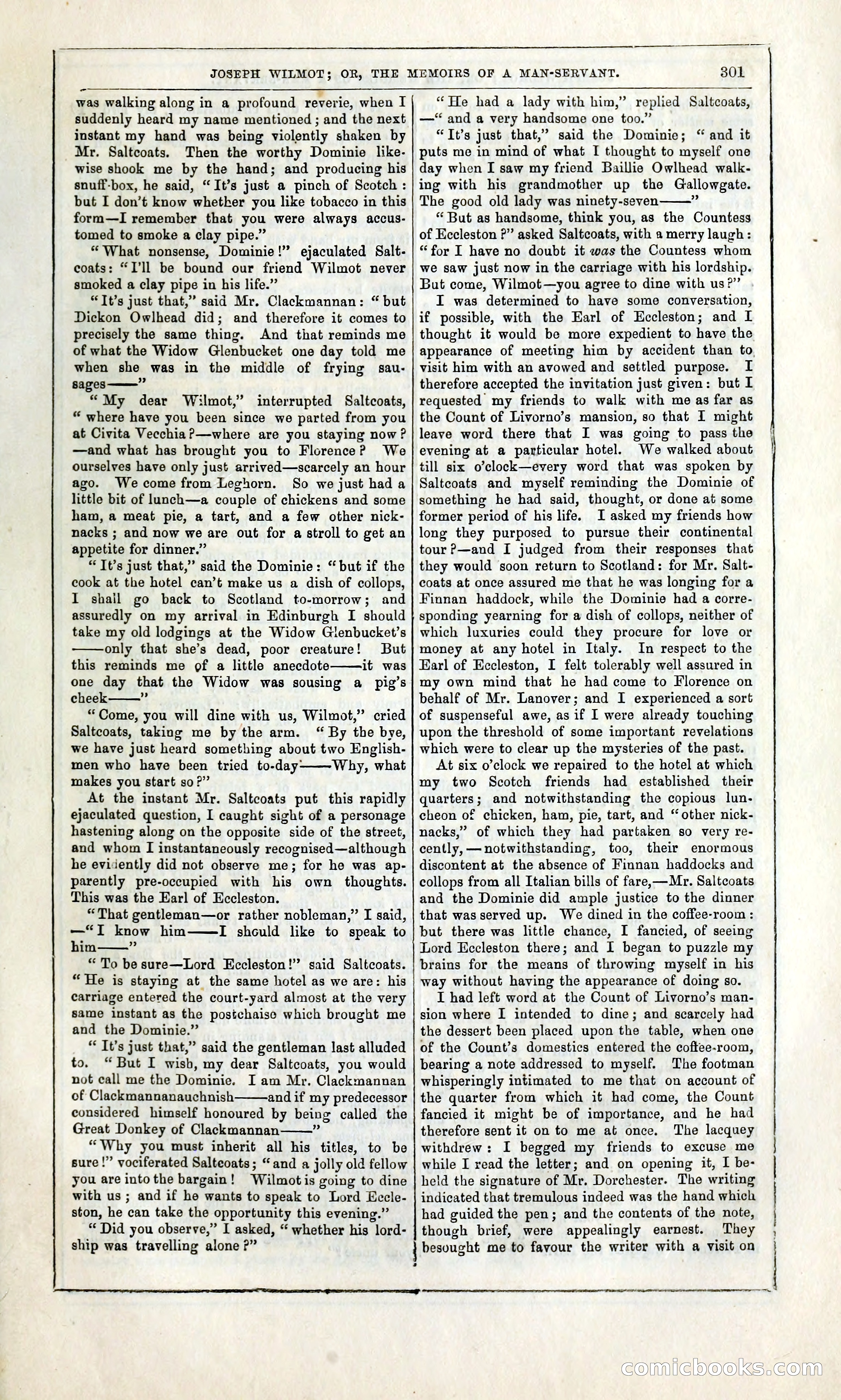
A restored page from Penny Dreadfuls, 1854. Page through the whole issue in the reader above.
📄 Transcribed text from this page (OCR, searchable)
Machine-transcribed from the original scan — historical spelling and the odd misread are preserved.
JOSEPH WILMOT; OR, THE MEMOIRS OF A MAN-SERVANT. 301 ~~ was walking along in a profound reverie, when I suddenly heard my name mentioned ; and the next instant my hand was being violently shaken by Mr. Saltcoats. Then the worthy Dominie like- wise shook me by the hand; and producing his snuff-box, he said, “It’s just a pinch of Scotch : but I don’t know whetker you like tobacco in this form—I remember that you were always accus- tomed to smoke a clay pipe.” “What nonsense, Dominie!’’ ejaculated Salt- coats: “I'll be bound our friend Wilmot never smoked a clay pipe in his life.” “It’s just that,” said Mr. Clackmannan: “ but Dickon Owlhead did; and therefore it comes to precisely the same thing. And that reminds me of what the Widow Glenbucket one day told me when she was in the middle of frying sau- sages——” “My dear Wilmot,” interrupted Saltcoats, “ where have you been since we parted from you at Civita Vecchia?—where are you staying now? —and what has brought you to Florence? We ourselves have only just arrived—scarcely an hour ago. Wecome from Leghorn. So we just had a little bit of lunch—a couple of chickens and some ham, a meat pie, a tart, and a few other nick- nacks ; and now we are out for a stroll to get an appetite for dinner.” “ It’s just that,” said the Dominie: “ but if the cook at the hotel can’t make us a dish of collops, I shail go back to Scotland to-morrow; and assuredly on my arrival in Edinburgh I should take my old lodgings at the Widow Glenbucket’s only that she’s dead, poor creature! But this reminds me of a little anecdote it was one day that the Widow was sousing a pig’s cheek ‘ “Come, you will dine with us, Wilmot,” cried Saltcoats, taking me by the arm. “ By the bye, we have just heard something about two English- men who have been tried to-day-—~Why, what makes you start so?” At the instant Mr. Saltcoats put this rapidly ejaculated question, I caught sight of a personage hastening along on the opposite side of the street, and whom I instantaneously recognised—although he evidently did not observe me; for he was ap- parently pre-occupied with his own thoughts. This was the Earl of Eccleston. “That gentleman—or rather nobleman,” I said, —“T know him——I shcould like to speak to him oe “ To be sure—Lord Eccleston!’ said Saltcoats. “He is staying at the same hotel as we are: his carriage entered the court-yard almost at the very same instant as the posichaiso which brought me and the Dominie.” It’s just that,” said the gentleman last alluded to. “ But I wish, my dear Saltcoats, you would not call me the Dominie. I am Mr. Clackmannan of Clackmannanauchnish and if my predecessor considered himself honoured by being called the Great Donkey of Clackmannan . “Why you must inherit all his titles, to be sure!” vociferated Salteoats; “and a jolly old fellow you are intothe bargain! Wilmotis going to dine with us ; and if he wants to speak to Lord Eccle- ston, he can take the opportunity this evening.” “Did you observe,” I asked, “ whether his lord- “He had a lady with him,” replied Saltcoats, —‘ and a very handsome one too.” “It’s just that,’ said the Dominie; “ and it puts me in mind of what I thought to myself one day when I saw my friend Baillie Owlhead walk- ing with his grandmother up the Gallowgate. The good old lady was ninety-seven » “ But as handsome, think you, as the Countess of Eccleston P” asked Saltcoats, with a merry laugh: “for I have no doubt it was the Countess whom we saw just now in the carriage with his lordship. But come, Wilmot—you agree to dine with us?” I was determined to have some conversation, if possible, with the Earl of Eccleston; and IL thought it would be more expedient to have the appearance of meeting him by accident than to. visit him with an avowed and settled purpose. I therefore accepted the invitation just given: but I requested my friends to walk with me as far as the Count of Livorno’s mansion, so that I might leave word there that I was going to pass the evening at a particular hotel. We walked about till six o’clock—every word that was spoken by Saltcoats and myself reminding the Dominie of something he had said, thought, or done at some former period of his life. I asked my friends how long they purposed to pursue their continental tour P—and I judged from their responses that they would soon return to Scotland: for Mr. Salt- coats at once assured me that he was longing for a Finnan haddock, while the Dominie had a corre- sponding yearning for a dish of collops, neither of which luxuries could they procure for love or money at any hotel in Italy. In respect to the Earl of Eccleston, I felt tolerably well assured in my own mind that he had come to Florence on behalf of Mr. Lanover; and I experienced a sort of suspenseful awe, as if I were already touching upon the threshold of some important revelations which were to clear up the mysteries of the past. At six o’clock we repaired to the hotel at which my two Scotch friends had established their quarters; and notwithstanding the copious lun- cheon of chicken, han, pie, tart, and “ other nick- nacks,” of which they had partaken so very re- cently, — notwithstanding, too, their enormous discontent at the absence of Finnan haddocks and collops from all Italian bills of fare,—Mr. Saltcoats and the Dominie did ample justice to the dinner that was served up. We dined in the coffee-room : but there was little chance, I fancied, of seeing Lord Eccleston there; and I began to puzzle my brains for the means of throwing myself in his way without having the appearance of doing so. I had left word at the Count of Livorno’s man- sion where I intended to dine; and scarcely had | the dessert been placed upon the table, when one of the Count’s domestics entered the coftee-room, bearing a note addressed to myself. The footman whisperingly intimated to me that on account of the quarter from which it had come, the Count fancied it might be of importance, and he had therefore sent it on to me at once. The lacquey withdrew: I begged my friends to excuse me while I read the letter; and on opening it, I be- held the signature of Mr. Dorchester. The writing indicated that tremulous indeed was the hand which had guided the pen; and the contents of the note, though brief, were appealingly earnest. They ship was travelling alone ?” | besought me to favour the writer with a visit on ELLE IAS IGE ABP CEA tt A RG PELLETED A SLOP LIA III IPAS EL CI EE PEED COmicooolks (CO) im