
Penny Dreadfuls, 1854 · page 316 of 399
Joseph Wilmot, or, The Memoirs of a Man-Servant — page 316: what you’re looking at
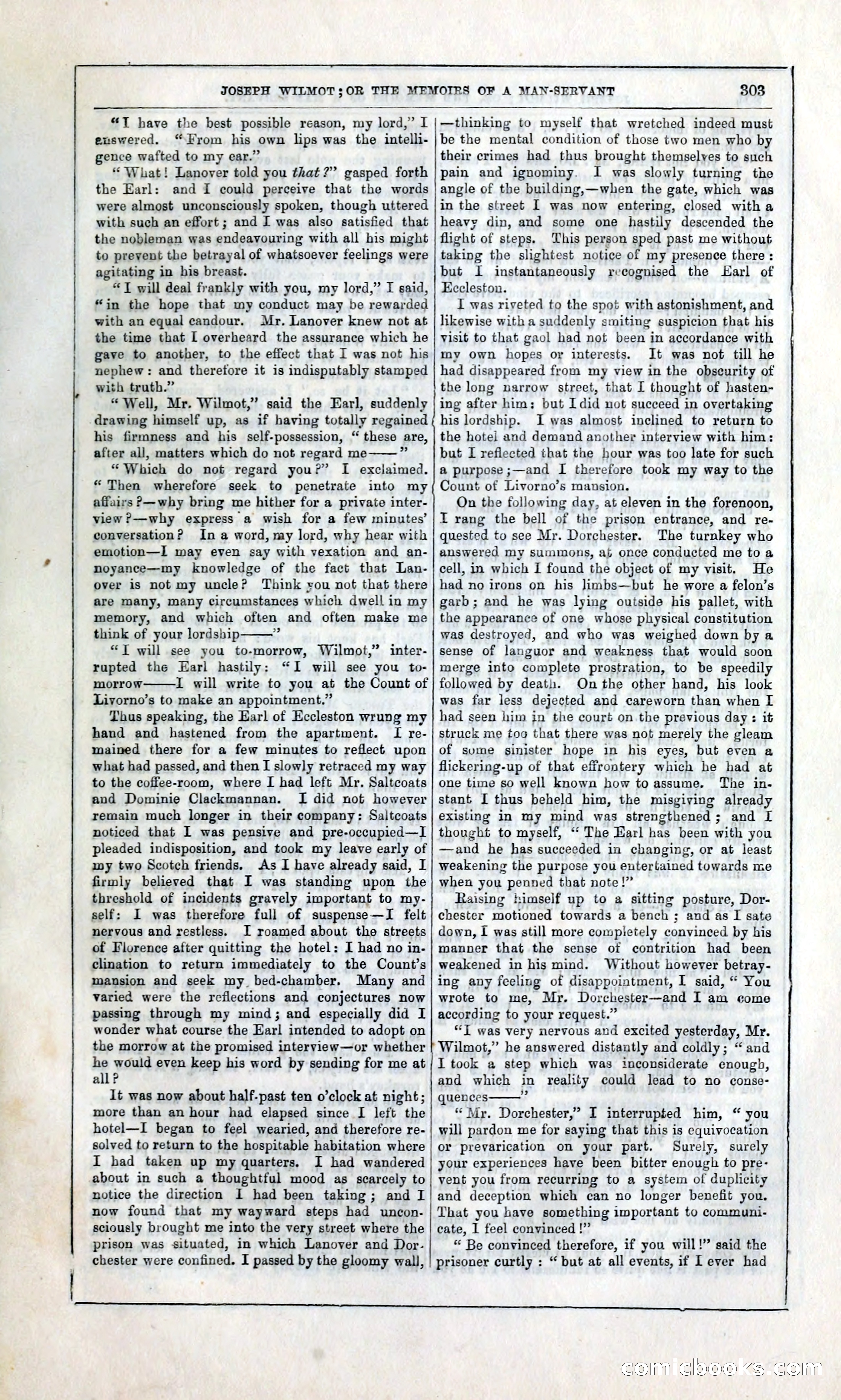
A restored page from Penny Dreadfuls, 1854. Page through the whole issue in the reader above.
📄 Transcribed text from this page (OCR, searchable)
Machine-transcribed from the original scan — historical spelling and the odd misread are preserved.
JOSEPH WILMOT;OR THE MEMOIRS OF A MAN-SERVANT “T have the best possible reason, my lord,’ I euswered. “From his own lips was the intelli- gence wafted to my ear.” * What! Lanover told you that?” gasped forth the Earl: and I could perceive that the words were almost unconsciously spoken, though uttered with such an effort; and I was also satisfied that the nobleman was endeavouring with all his might to preyent the betrayal of whatsoever feelings were agitating in his breast. *T will deal frankly with you, my lord,” I said, “in the hope that my conduct may be rewarded with an equal candour. Mr. Lanover knew not at the time that I overheard the assurance which he gave to another, to the effect that I was not his nephew: and therefore it is indisputably stamped with truth.” “Well, Mr. Wilmot,” said the Earl, suddenly drawing himself up, as if having totally regained his firmness and his self-possession, “ these are, after all, matters which do not regard me “Which do not regard you?” I exclaimed. “Then wherefore seek to penetrate into my affairs P—why bring me hither for a private inter- view ?—why express a wish for a few minutes’ conversation? In a word, my lord, why hear with emotion—Il may even say with vexation and an- noyance—my knowledge of the fact that Lan- over is not my uncle? Think vou not that there are many, many circumstances which dwell in my memory, and which often and often make me think of your lordsbip “ “T will see you to-morrow, Wilmot,” inter- rupted the Earl hastily: “I will see you to- morrow I will write to you at the Count of Livyorno’s to make an appointment.” Thus speaking, the Earl of Eccleston wrung my hand and hastened from the apartment. LI re- mained there for a few minutes to reflect upon what had passed, and then I slowly retraced my way to the coffee-room, where I had left Mr. Saltcoats aud Dominie Clackmannan. I did not however remain much longer in their company: Saltcoats noticed that L was pensive and pre-occupied—I pleaded indisposition, and took my leave early of my two Scotch friends. As I have already said, I firmly believed that I was standing upon the threshold of incidents gravely important to my- self: I was therefore full of suspense—I felt nervous and restless. I roamed about the streets of Florence after quitting the hotel: I had no in- clination to return immediately to the Count’s mansion and seek my bed-chamber. Many and varied were the reflections and conjectures now passing through my mind; and especially did I wonder what course the Earl intended to adopt on the morrow at the promised interview—or whether he would even keep his word by sending for me at all P It was now about half-past ten o’clock at night; more than an hour had elapsed since I left the hotel—I began to feel wearied, and therefore re- solved to return to the hospitable habitation where I bad taken up my quarters. I had wandered about in such a thoughtful mood as scarcely to notice the direction I had been taking; and I now found that my wayward steps had uncon- sciously brought me into the very street where the prison was situated, in which Lanover and Dor- chester were confined. I passed by the gloomy wall, 303 —thinking to myself that wretched indeed must be the mental condition of those two men who by their crimes had thus brought themselves to such pain and ignominy. I was slowly turning the angle of the building,—when the gate, which was in the street I was now entering, closed witha heavy din, and some one hastily descended the flight of steps. This person sped past me without taking the slightest notice of my presence there: but I instantaneously recognised the Earl of Eccleston. I was riveted to the spot with astonishment, and likewise witha suddenly smiting suspicion that his Visit to that gaol had not been in accordance with my own hopes or interests. It was not till he had disappeared from my view in the obscurity of the long narrow street, that I thought of hasten- ing after him: but I did not succeed in overtaking his lordship. I was almost inclined to return to the hotel and demand another interview with him: but I reflected that the hour was too late for such @ purpose ;—and I therefore took my way to the Count of Livorno’s mansion. On the following day, at eleven in the forenoon, I rang the bell of the prison entrance, and re- quested to see Mr. Dorchester. The turnkey who answered my summons, ab once conducted me to a cell, in which I found the object of my visit. He had no irons on his Jimbs—but he wore a felon’s garb; and he was lying outside his pallet, with the appearance of one whose physical constitution was destroyed, and who was weighed down by a sense of languor and weakness that would soon merge into complete prostration, to be speedily followed by death. Onthe other hand, his look was far less dejected and careworn than when I had seen him in the court on the previous day : it struck me too that there was not merely the gleam of sume sinister hope in his eyes, but even a flickering-up of that effrontery which he had at one time so well known how to assume. The in- stant I thus beheld him, the misgiving already existing in my mind was strengthened; and I thought to myself, *‘ The Earl has been with you —and he has succeeded in changing, or at least weakening the purpose you entertained towards me when you penned that note!” Raising himself up to a sitting posture, Dor- chester motioned towards a bench; and as I sate down, I was still more completely convinced by his manner that the sense of contrition had been weakened in his mind. Without however betray- ing any feeling of disappointment, I said, “ You wrote to me, Mr. Dorchester—and 1 am come according to your request.” “was very nervous and excited yesterday, Mr. Wilmot,” he answered distantly and coldly; “and I took a step which was inconsiderate enough, and which in reality could lead to no conse- quences * “ Mr. Dorchester,’ I interrupted him, “ you will pardon me for saying that this is equivocation or prevarication on your part. Surely, surely your experiences have been bitter enough to pre- vent you from recurring to a system of duplicity and deception which can no longer benefit you. That you have something important to communi- cate, 1 feel convinced !” “ Be convinced therefore, if you will!” said the prisoner curtly : “ but at all events, if Lever had DOO“ (EO)