
Penny Dreadfuls, 1854 · page 332 of 399
Joseph Wilmot, or, The Memoirs of a Man-Servant — page 332: what you’re looking at
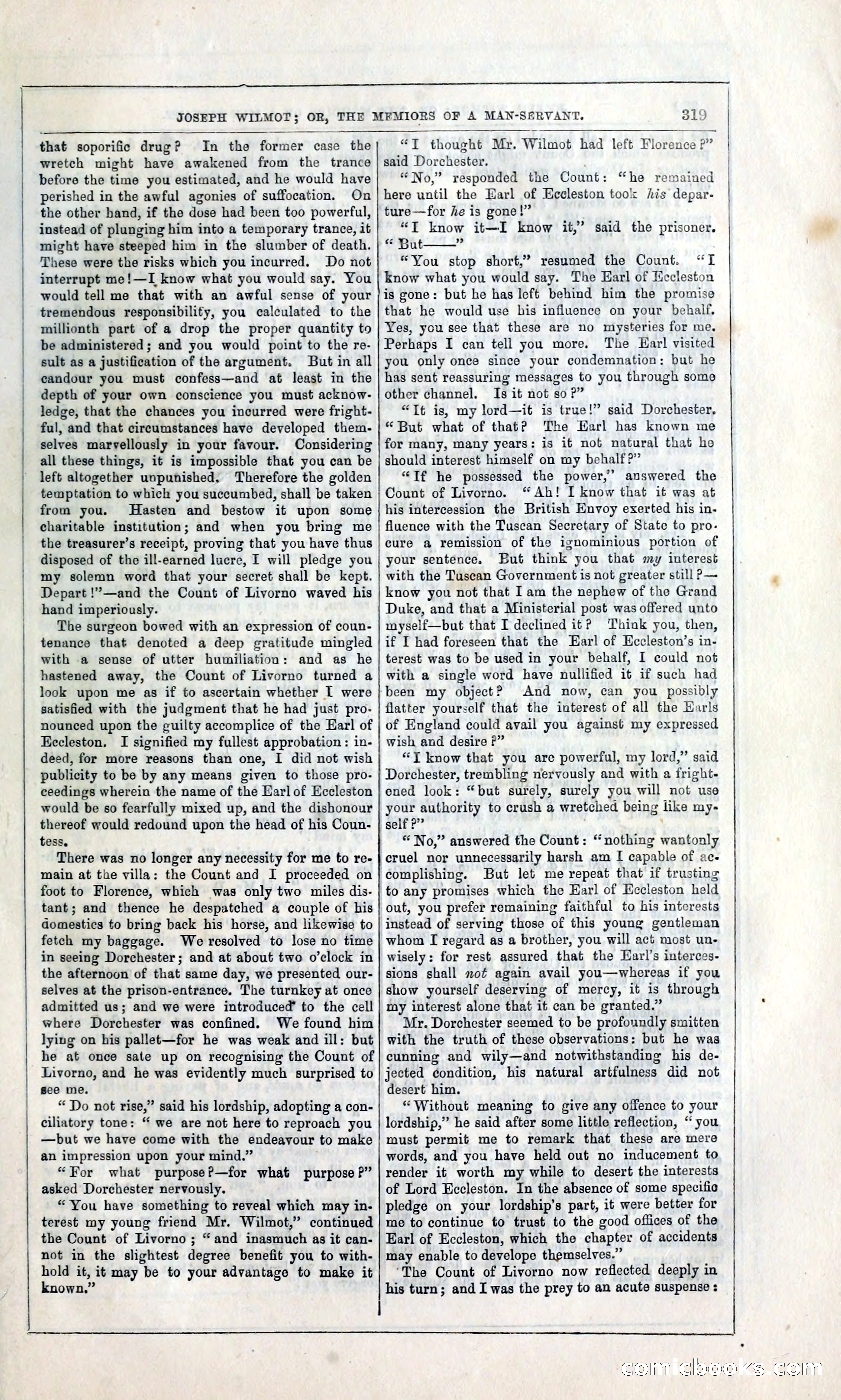
A restored page from Penny Dreadfuls, 1854. Page through the whole issue in the reader above.
📄 Transcribed text from this page (OCR, searchable)
Machine-transcribed from the original scan — historical spelling and the odd misread are preserved.
JOSEPH WILMOT; OR, THE MFMIORS OF A MAN-SERVANT. ol9 that soporific drug? In the former case the wretch might have awakened from the trance before the time you estimated, and he would have perished in the awful agonies of suffocation. On the other hand, if the dose had been too powerful, instead of plunging him into a temporary trance, it might have steeped him in the slumber of death. These were the risks which you incurred. Do not interrupt me!—I know what you would say. You would tell me that with an awful sense of your tremendous responsibility, you calculated to the millionth part of a drop the proper quantity to be administered; and you would point to the re- sult as a justification of the argument. But in all candour you must confess—and at least in the depth of your own conscience you must acknow- ledge, that the chances you incurred were fright- ful, and that circumstances have developed them- selves marvellously in your favour. Considering all these things, it is impossible that you can be left altogether unpunished, Therefore the golden temptation to which you succumbed, shall be taken from you. Hasten and bestow if upon some charitable institution; and when you bring me the treasurer’s receipt, proving that you have thus disposed of the ill-earned lucre, I will pledge you my solemn word that your secret shall be kept. Depart !’—and the Count of Livorno waved his hand imperiously. The surgeon bowed with an expression of coun- tenance that denoted a deep gratitude mingled with a sense of utter humiliation: and as he hastened away, the Count of Livorno turned a look upon me as if to ascertain whether I were satisfied with the judgment that he had just pro- nounced upon the guilty accomplice of the Earl of Eccleston. I signified my fullest approbation: in- deed, for more reasons than one, I did not wish publicity to be by any means given to those pro- eeedings wherein the name of the Earl of Eccleston would be so fearfully mixed up, and the dishonour thereof would redound upon the head of his Coun- tess. There was no longer any necessity for me to re- main at the villa: the Count and I proceeded on foot to Florence, which was only two miles dis- tant; and thence he despatched a couple of his domestics to bring back his horse, and likewise to fetch my baggage. We resolved to lose no time in seeing Dorchester; and at about two o’clock in the afternoon of that same day, we presented our- selves at the prison-entrance. The turnkey at once admitted us; and we were introduced to the cell where Dorchester was confined. We found him lying on his pallet—for he was weak and ill: but he at once sate up on recognising the Count of Livorno, and he was evidently much surprised to see me. “ Do not rise,” said his lordship, adopting a con- ciliatory tone: “ we are not here to reproach you —but we have come with the endeavour to make an impression upon your mind.” “For what purpose?—for what purpose ?” asked Dorchester nervously. “You have something to reveal which may in- terest my young friend Mr. Wilmot,” continued the Count of Livorno ; “and inasmuch as it can- not in the slightest degree benefit you to with- hold it, it may be to your advantage to make it known.” “T thought Mr. Wilmot had left Florence ?” said Dorchester. | “No,” responded the Count: “he remained here until the Earl of Eccleston took his depar- ture—for he is gone!” “T know it—I know it,’ said the prisoner. « But——” “You stop short,” resumed the Count. “I know what you would say. The Earl of Eccleston is gone: but he has left behind him the promise that he would use his influence on your behalf. Yes, you see that these are no mysteries for me. Perhaps I can tell you more. The LHar! visited you only once since your condemnation: but he has sent reassuring messages to you through some other channel. Is it not so?” “Tt is, my lord—it is true!” said Dorchester, “But what of that? The Earl has known me for many, many years: is it not natural that he should interest himself on my behalf?” “Tf he possessed the power,’ answered the Count of Livorno. “Ah! I know that it was at his intercession the British Envoy exerted his in- fluence with the Tuscan Secretary of State to pro- cure a remission of the ignominious portion of your sentence. But think you that my interest with the Tuscan Government is not greater still >— know you not that I am the nephew of the Grand Duke, and that a Ministerial post was offered unto myself—but that I declined it? Think you, then, if I had foreseen that the Earl of Eccleston’s in- terest was to be used in your behalf, I could not with a single word have nullified it if such had been my object? And now, can you possibly flatter yourself that the interest of all the Harls of England could avail you against my expressed wish and desire ?” “Y know that you are powerful, my lord,” said Dorchester, trembling nervously and with a fright- ened look: “but surely, surely you will not use your authority to crush a wretched being like my- self ?” “ No,” answered the Count: “nothing wantonly cruel nor unnecessarily harsh am I capable of ac- complishing. But let me repeat that if trusting to any promises which the Harl of Eccleston held out, you prefer remaining faithful to his interests instead of serving those of this young gentleman whom [I regard as a brother, you will act most un- wisely: for rest assured that the Harl’s interces- sions shall nof again avail you—whereas if you show yourself deserving of mercy, it is through my interest alone that it can be granted.” Mr. Dorchester seemed to be profoundly smitten with the truth of these observations: but he was cunning and wily—and notwithstanding his de- jected condition, his natural artfulness did not desert him. * Without meaning to give any offence to your lordship,” he said after some little reflection, “ you roust permit me to remark that these are mere words, and you have held out no inducement to render it worth my while to desert the interests of Lord Eccleston. In the absence of some specific pledge on your lordship’s part, it were better for me to continue to trust to the good offices of the Earl of Eccleston, which the chapter of accidents may enable to develope themselves.” ‘The Count of Livorno now reflected deeply in his turn; and I was the prey to an acute suspense : i LE | Giook (CO)