
Penny Dreadfuls, 1854 · page 338 of 399
Joseph Wilmot, or, The Memoirs of a Man-Servant — page 338: what you’re looking at
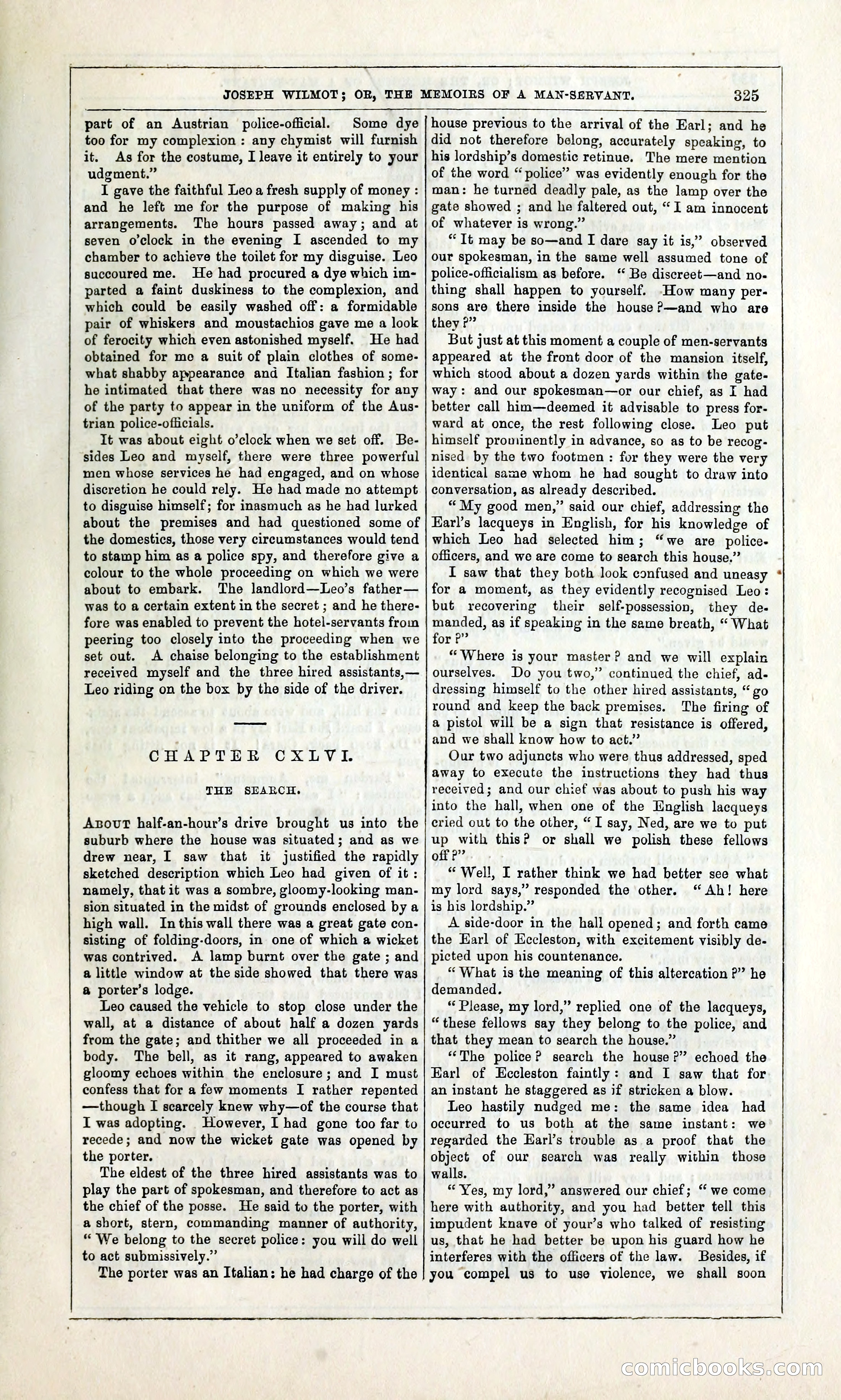
A restored page from Penny Dreadfuls, 1854. Page through the whole issue in the reader above.
📄 Transcribed text from this page (OCR, searchable)
Machine-transcribed from the original scan — historical spelling and the odd misread are preserved.
JOSEPH WILMOT; OR, THE MEMOIRS OF A MAN-SERVANT. part of an Austrian police-official. Some dye too for my complexion: any chymist will furnish it. As for the costume, I leave it entirely to your udgment.” I gave the faithful Leo a fresh supply of money : and he left me for the purpose of making his arrangements. The hours passed away; and at seven o'clock in the evening I ascended to my chamber to achieve the toilet for my disguise. Leo succoured me. He had procured a dye which im- parted a faint duskiness to the complexion, and which could be easily washed off: a formidable pair of whiskers and moustachios gave me a look of ferocity which even astonished myself. He had obtained for me a suit of plain clothes of some- what shabby appearance and Italian fashion ; for he intimated that there was no necessity for any of the party to appear in the uniform of the Aus- trian police-ofiicials. It was about eight o’clock when we set off. Be- sides Leo and myself, there were three powerful men whose services he had engaged, and on whose discretion he could rely. He had made no attempt to disguise himself; for inasmuch as he had lurked about the premises and had questioned some of the domestics, those very circumstances would tend to stamp him as a police spy, and therefore give a colour to the whole proceeding on which we were about to embark. The landlord—Leo’s father— was to a certain extent in the secret ; and he there- fore was enabled to prevent the hotel-servants from peering too closely into the proceeding when we set out. A chaise belonging to the establishment received myself and the three hired assistants,— Leo riding on the box by the side of the driver. CHAPTER CXLVI. THE SEARCH. AxovurT half-an-hour’s drive brought us into the suburb where the house was situated; and as we drew near, I saw that it justified the rapidly sketched description which Leo had given of it: namely, that it was a sombre, gloomy-looking man- sion situated in the midst of grounds enclosed by a high wall. In this wall there was a great gate con- sisting of folding-doors, in one of which a wicket was contrived. A lamp burnt over the gate ; and a little window at the side showed that there was a porter’s lodge. Leo caused the vehicle to stop close under the wall, at a distance of about half a dozen yards from the gate; and thither we all proceeded in a body. The bell, as it rang, appeared to awaken gloomy echoes within the enclosure; and I must confess that for a few moments I rather repented —though I scarcely knew why—of the course that I was adopting. However, I had gone too far to recede; and now the wicket gate was opened by the porter. The eldest of the three hired assistants was to play the part of spokesman, and therefore to act as the chief of the posse. He said to the porter, with a short, stern, commanding manner of authority, “We belong to the secret police: you will do well to act submissively.” The porter was an Italian: he had charge of the 325 house previous to the arrival of the Earl; and he did not therefore belong, accurately speaking, to his lordship’s domestic retinue. The mere mention of the word “police” was evidently enough for the man: he turned deadly pale, as the lamp over the gate showed ; and he faltered out, “I am innocent of whatever is wrong.” “It may be so—and I dare say it is,” observed our spokesman, in the same well assumed tone of police-officialism as before. ‘‘ Be discreet—and no- thing shall happen to yourself. How many per- sons are there inside the house?—and who are they ?” But just at this moment a couple of men-servants appeared at the front door of the mansion itself, which stood about a dozen yards within the gate- way: and our spokesman—or our chief, as I had better call him—deemed it advisable to press for- ward at once, the rest following close. Leo put himself pronvinently in advance, so as to be recog- nised by the two footmen : for they were the very identical same whom he had sought to draw into conversation, as already described. “My good men,” said our chief, addressing the Harl!’s lacqueys in English, for his knowledge of which Leo had selected him; “we are police- officers, and we are come to search this house.” I saw that they both look confused and uneasy for a moment, as they evidently recognised Leo: but recovering their self-possession, they de- manded, as if speaking in the same breath, “ What for P” “Where is your master? and we will explain ourselves. Do you two,” continued the chief, ad- dressing himself to the other hired assistants, “go round and keep the back premises. The firing of a pistol will be a sign that resistance is offered, and we shall know how to act.” Our two adjuncts who were thus addressed, sped away to execute the instructions they had thus received; and our chief was about to push his way into the hall, when one of the English lacqueys cried out to the other, “I say, Ned, are we to put up with this? or shall we polish these fellows off Pp” * Well, I rather think we had better see what my lord says,” responded the other. “Ah! here is his lordship.” A side-door in the hall opened; and forth came the Karl of Eccleston, with excitement visibly de- picted upon his countenance. “What is the meaning of this altercation ?” he demanded. ‘* Please, my lord,” replied one of the lacqueys, “these fellows say they belong to the police, and that they mean to search the house.” ‘‘The police? search the house ?” echoed the Earl of Eccleston faintly: and I saw that for an instant he staggered as if stricken a blow. Leo hastily nudged me: the same idea had occurred to us both at the same instant: we regarded the Harl’s trouble as a proof that the object of our search was really within those | walls. “Yes, my lord,” answered our chief; ‘‘ we come here with authority, and you had better tell this impudent knave of your’s who talked of resisting us, that he had better be upon his guard how he interferes with the officers of the law. Besides, if you compel us to use violence, we shall soon OOO) Ss (CO) FA