
Penny Dreadfuls, 1854 · page 349 of 399
Joseph Wilmot, or, The Memoirs of a Man-Servant — page 349: what you’re looking at
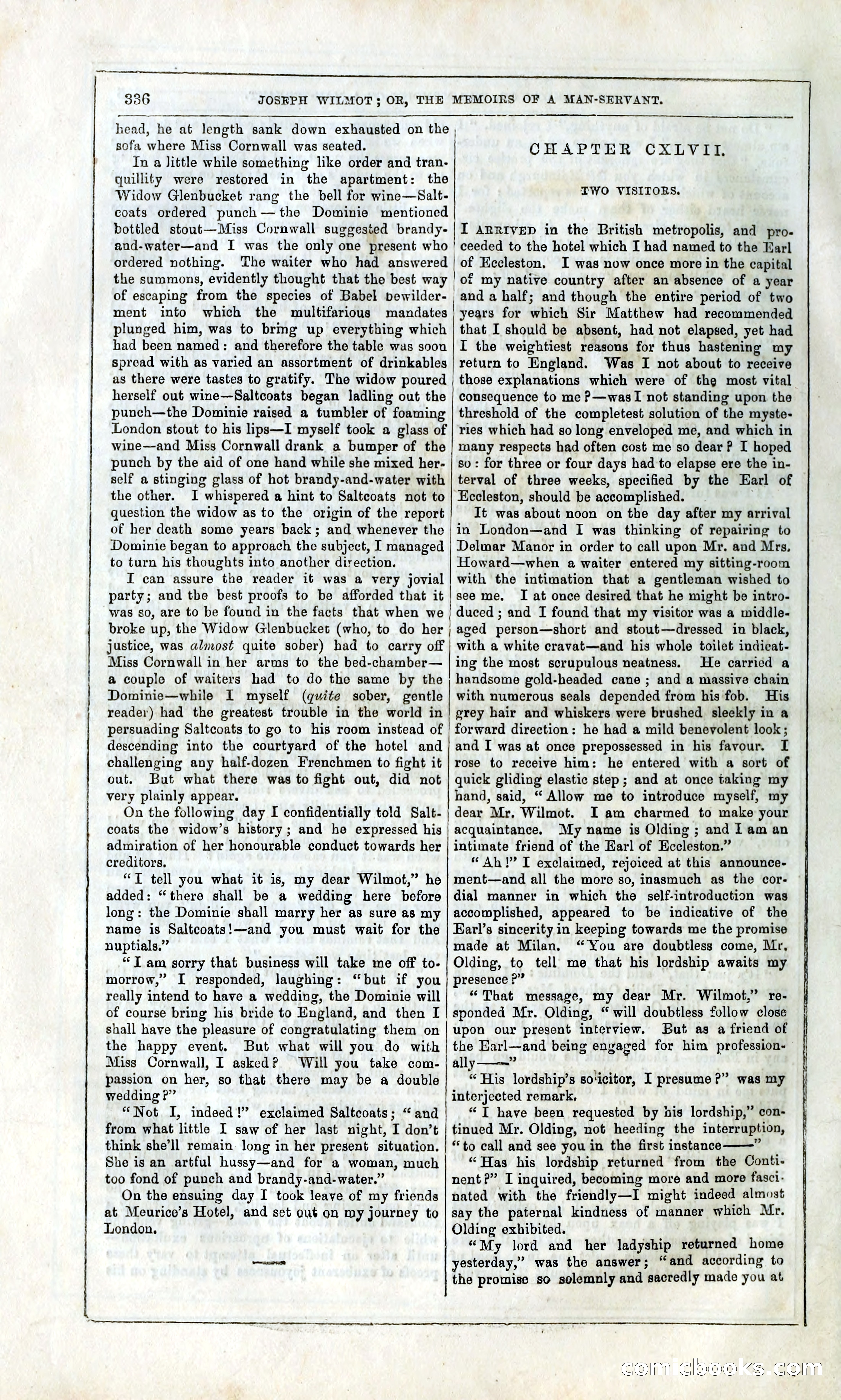
A restored page from Penny Dreadfuls, 1854. Page through the whole issue in the reader above.
📄 Transcribed text from this page (OCR, searchable)
Machine-transcribed from the original scan — historical spelling and the odd misread are preserved.
306 head, he at length sank down exhausted on the sofa where Miss Cornwall was seated. In a Jittle while something like order and tran- quillity were restored in the apartment: the Widow Glenbucket rang the bell for wine—Salt- coats ordered punch—the Dominie mentioned bottled stout-—Miss Cornwall suggested brandy- and-water—and I was the only one present who ordered nothing. ‘The waiter who had answered the summons, evidently thought that the best way of escaping from the species of Babel pewilder- ment into which the multifarious mandates plunged him, was to brmg up everything which had been named: and therefore the table was soon spread with as varied an assortment of drinkables as there were tastes to gratify. The widow poured herself out wine—Saltcoats began ladling out the punch—the Dominie raised a tumbler of foaming London stout to his lips—I myself took a glass of wine—and Miss Cornwall drank a bumper of the punch by the aid of one hand while she mixed her- self a stinging glass of hot brandy-and-water with the other. I whispered a hint to Saltcoats not to question the widow as to the origin of the report of her death some years back; and whenever the Dominie began to approach the subject, I managed to turn his thoughts into another direction. I can assure the reader it was a very jovial party; and the best proofs to be afforded that it was so, are to be found in the facts that when we broke up, the Widow Glenbucket (who, to do her justice, was almost quite sober) had to carry off Miss Cornwall in her arms to the bed-chamber— a couple of waiters had to do the same by the Dominie—while I myself (quite sober, gentle reader) had the greatest trouble in the world in persuading Saltcoats to go to his room instead of descending into the courtyard of the hotel and challenging any half-dozen Frenchmen to fight it out. But what there was to fight out, did not very plainly appear. On the following day I confidentially told Salt- coats the widow’s history; and he expressed his admiration of her honourable conduct towards her creditors. “I tell you what it is, my dear Wilmot,” he added: “there shall be a wedding here before long: the Dominie shall marry her as sure as my name is Saltcoats!—and you must wait for the nuptials.” “I am sorry that business will take me off to- morrow,” I responded, laughing: “but if you really intend to have a wedding, the Dominie will of course bring his bride to England, and then I shall have the pleasure of congratulating them on the happy event. But what will you do with Miss Cornwall, I asked? Will you take com- passion on her, so that there may be a double wedding P” “Not I, indeed!” exclaimed Saltcoats; “and from what little I saw of her last night, I don’t think she’ll remain long in her present situation. She is an artful hussy—and for a woman, much too fond of punch and brandy-and-water.” On the ensuing day I took leave of my friends at Meurice’s Hotel, and set out on my journey to London. JOSEPH WILMOT; OR, THE MEMOIRS OF A MAN-SERVANT. CHAPTER CXLVII, TWO VISITORS. I ARRIVED in the British metropolis, and pro- ceeded to the hotel which I had named to the Earl of Eccleston, I was now once more in the capital of my native country after an absence of a year and a half; and though the entire period of two years for which Sir Matthew had recommended that I should be absent, had not elapsed, yet had I the weightiest reasons for thus hastening my return to England. Was I not about to receive those explanations which were of the most vital consequence to me P—wasI not standing upon the threshold of the completest solution of the myste- ries which had so long enveloped me, and which in many respects had often cost me so dear? I hoped so : for three or four days had to elapse ere the in- terval of three weeks, specified by the LHarl of Ficcleston, should be accomplished. | It was about noon on the day after my arrival in London—and I was thinking of repairing to Delmar Manor in order to call upon Mr. and Mrs, Howard—when a waiter entered my sitting-room with the intimation that a gentleman wished to see me. I at once desired that he might be intro- duced ; and I found that my visitor was a middle- aged person—short and stout—dressed in black, with a white cravat—and his whole toilet indicat- ing the most scrupulous neatness. He carried a handsome gold-headed cane ; and a massive chain with numerous seals depended from his fob. His grey hair and whiskers were brushed sleekly in a forward direction: he had a mild benevolent look; and I was at once prepossessed in his favour. I rose to receive him: he entered with a sort of quick gliding elastic step; and at once taking my hand, said, “ Allow me to introduce myself, my dear Mr, Wilmot. I am charmed to make your acquaintance. My name is Olding ; and 1 am an intimate friend of the Earl of Eccleston.” “Ah?!” IT exclaimed, rejoiced at this announce- ment—and all the more so, inasmuch as the cor- dial manner in which the self-introduction was accomplished, appeared to be indicative of the Earl’s sincerity in keeping towards me the promise made at Milan. ‘“ You are doubtless come, Mr, Olding, to tell me that his lordship awaits my presence P” “That message, my dear Mr. Wilmot,” re- sponded Mr. Olding, “ will doubtless follow close upon our present interview. But as a friend of the Earl—and being engaged for him profession- all id ‘ His lordship’s so'icitor, I presume ?” was my interjected remark, “TI have been requested by nis lordship,” con- tinued Mr. Olding, not heeding the interruption, *‘to call and see you in the first instance % “Has his lordship returned from the Conti- nent ?” I inquired, becoming more and more fasci- nated with the friendly—I might indeed almost say the paternal kindness of manner which Mr. Olding exhibited. “My lord and her ladyship returned home yesterday,” was the answer; “and according to the promise so solemnly and sacredly made you at DOOKS.E iin (0) ee ee ee ee > —————= <<