
Penny Dreadfuls, 1854 · page 356 of 399
Joseph Wilmot, or, The Memoirs of a Man-Servant — page 356: what you’re looking at
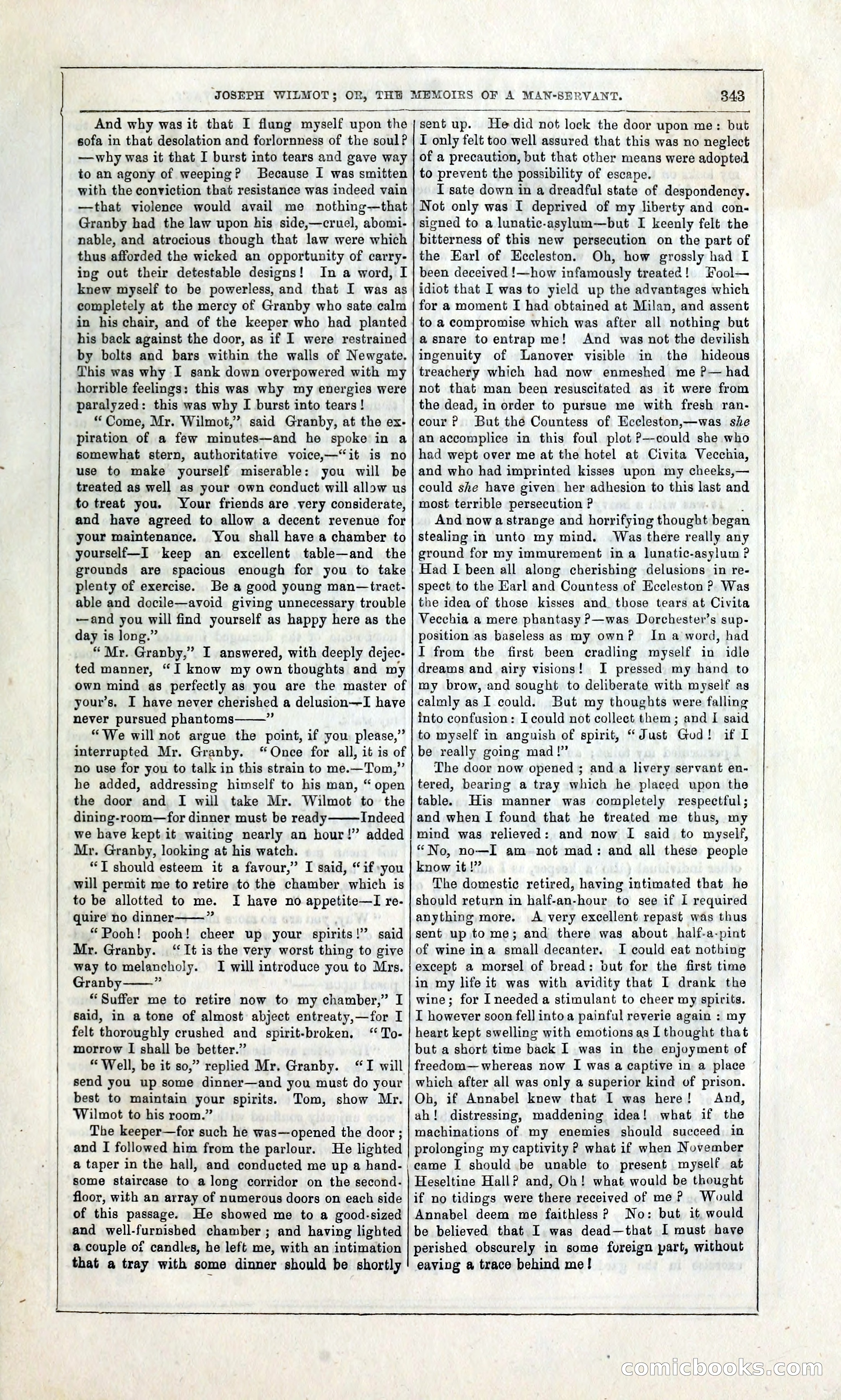
A restored page from Penny Dreadfuls, 1854. Page through the whole issue in the reader above.
📄 Transcribed text from this page (OCR, searchable)
Machine-transcribed from the original scan — historical spelling and the odd misread are preserved.
JOSEPH WILMOT; OR, THH MEMOIRS OF A MAN-SERVANT. 343 And why was it that I flung myself upon the sofa in that desolation and forlornness of the soul? —why was it that I burst into tears and gave way to an agony of weeping? Because I was smitten with the conviction that resistance was indeed vain —that violence would avail me nothing—that Granby had the law upon his side,—cruel, abomi- nable, and atrocious though that law were which thus afforded the wicked an opportunity of carry- ing out their detestable designs! In a word, I knew myself to be powerless, and that I was as completely at the mercy of Granby who sate calm in his chair, and of the keeper who had planted his back against the door, as if I were restrained by bolts and bars within the walls of Newgate. This was why I sank down overpowered with my horrible feelings: this was why my energies were paralyzed: this was why I burst into tears! “Come, Mr. Wilmot,’ said Granby, at the ex- piration of a few minutes—and he spoke in a somewhat stern, authoritative voice,—“it is no use to make yourself miserable: you will be treated as well as your own conduct will allow us to treat you. Your friends are very considerate, and have agreed to allow a decent revenue for your maintenance. You shall have a chamber to yourself—I keep an excellent table—and the grounds are spacious enough for you to take plenty of exercise. Bea good young man—tract- able and docile—avoid giving unnecessary trouble --and you will find yourself as happy here as the day is long.” “ Mr. Granby,” I answered, with deeply dejec- ted manner, “I know my own thoughts and my own mind as perfectly as you are the master of your’s. I have never cherished a delusion—-I have never pursued phantoms - “We will not argue the point, if you please,” interrupted Mr. Granby. “Once for all, it is of no use for you to talk in this strain to me.—Tom,” he added, addressing himself to his man, “ open the door and I will take Mr. Wilmot to the dining-room—for dinner must be ready Indeed we have kept it waiting nearly an hour!” added Mr. Granby, looking at his watch. “T should esteem it a favour,” I said, “if»you will permit me to retire to the chamber which is to be allotted to me. I have no appetite—I re- quire no dinner-——” | “Pooh! pooh! cheer up your spirits!’ said Mr. Granby. ‘It is the very worst thing to give way to melancholy. I will introduce you to Mrs. Granby is “Suffer me to retire now to my chamber,” I said, in a tone of almost abject entreaty,—for I felt thoroughly crushed and spirit-broken. “To- morrow I shall be better.” “Well, be it so,” replied Mr. Granby. “TI will send you up some dinner—and you must do your best to maintain your spirits. Tom, show Mr. Wilmot to his room.” The keeper—for such he was—opened the door ; and I followed him from the parlour. He lighted a taper in the hall, and conducted me up a hand- some staircase to along corridor on the second- floor, with an array of numerous doors on each side of this passage. He showed me to a good-sized and well-furnished chamber ; and having lighted a couple of candles, he left me, with an intimation that a tray with some dinner should be shortly Oo aie — eee eee KS | sent up. Hedid not lock the door upon me: but I only felt too well assured that this was no neglect of a precaution, but that other means were adopted to prevent the possibility of escape. I sate down in a dreadful state of despondency. Not only was I deprived of my liberty and con- signed to a lunatic-asylum—but I keenly felt the bitterness of this new persecution on the part of the Earl of Eccleston. Oh, how grossly had I been deceived !—how infamously treated! Fool— idiot that I was to yield up the advantages which for a moment I had obtained at Milan, and assent to a compromise which was after all nothing but asnare toentrap me! And was not the devilish ingenuity of Lanover visible in the hideous treachery which had now enmeshed me P— had not that man been resuscitated as it were from the dead, in order to pursue me with fresh ran- cour P But the Countess of Ececleston,—was she an accomplice in this foul plot P—could she who had wept over me at the hotel at Civita Vecchia, and who had imprinted kisses upon my cheeks,— could she have given her adhesion to this last and most terrible persecution P And now a strange and horrifying thought began stealing in unto my mind. Was there really any ground for my immurement ina lunatic-asylum ? Had I been all along cherishing delusions in re- spect to the Earl and Countess of Eccleston P Was the idea of those kisses and those tears at Civita Vecchia a mere phantasy P—was Dorchester’s sup- position as baseless as my own? In a word, had I from the first been cradling myself in idle dreams and airy visions! J pressed my hand to my brow, and sought to deliberate with myself as calmly as I could. But my thoughts were falling into confusion: I could not collect them; and I said to myself in anguish of spirit, “Just God! if I be really going mad!” The door now opened ; and a livery servant en- tered, bearing a tray which he placed upon the table. His manner was completely respectful; and when I found that he treated me thus, my mind was relieved: and now I said to myself, “No, no—I am not mad: and all these people know it!” The domestic retired, having intimated that he should return in half-an-hour to see if 1 required anything more. A very excellent repast was thus sent up to me; and there was about half-a-pint of wine ina small decanter. I could eat nothing except a morsel of bread: but for the first time in my life it was with avidity that I drank the wine; for I needed a stimulant to cheer my spirits. I however soon fell] intoa painful reverie again : my heart kept swelling with emotions as I thought that but a short time back I was in the enjoyment of freedom— whereas now I was a captive in a place which after all was only a superior kind of prison. Oh, if Annabel knew that I was here! And, ah! distressing, maddening idea! what if the machinations of my enemies should succeed in prolonging my captivity P what if when November came I should be unable to present myself at Heseltine Hall? and, Ob! what would be thought if no tidings were there received of me P Would Annabel deem me faithless P No: but it would be believed that I was dead—that I must havo perished obscurely in some fvureign part, without eaving a trace behind me! Conniiclooolkks (c©@)