
Penny Dreadfuls, 1854 · page 368 of 399
Joseph Wilmot, or, The Memoirs of a Man-Servant — page 368: what you’re looking at
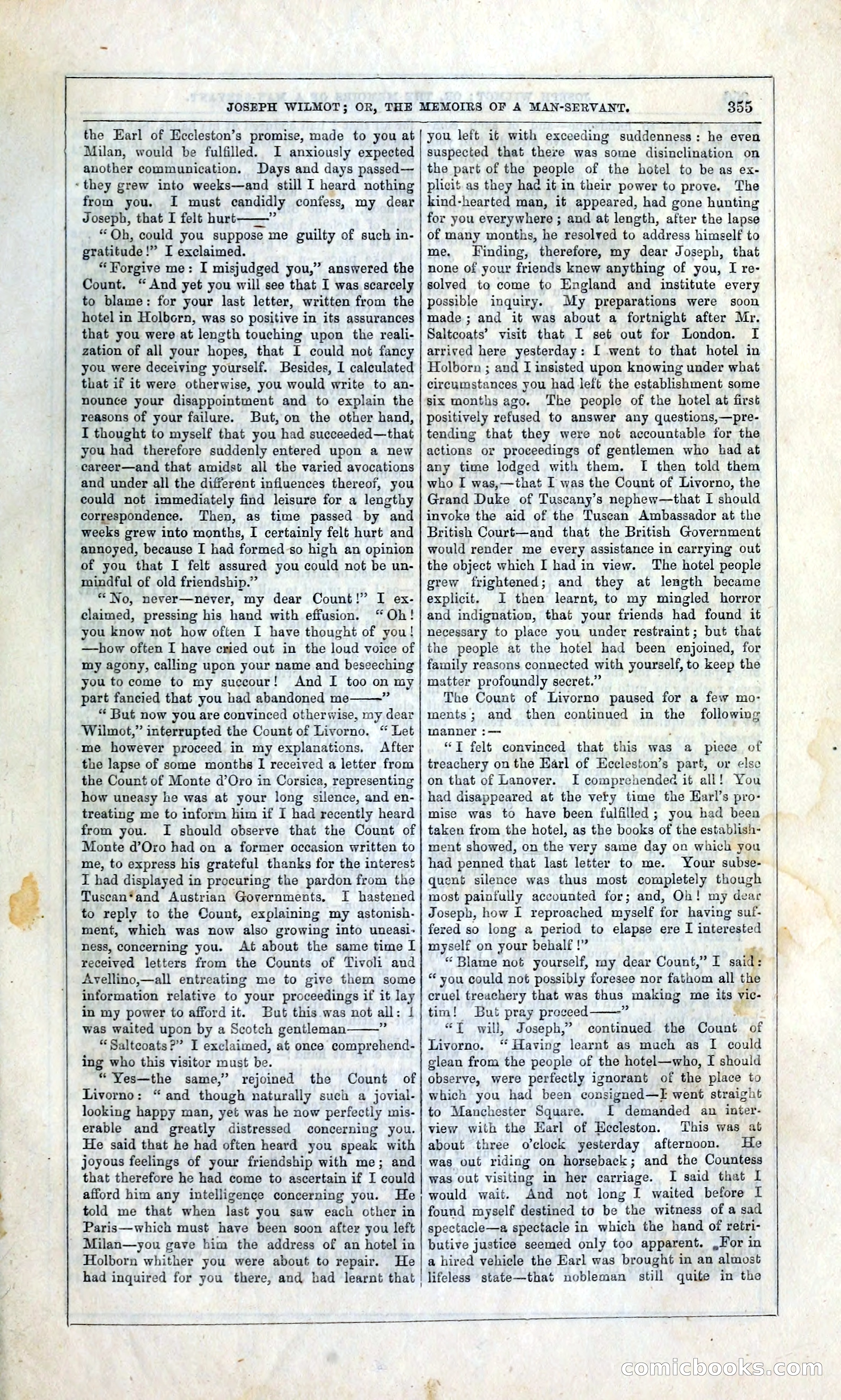
A restored page from Penny Dreadfuls, 1854. Page through the whole issue in the reader above.
📄 Transcribed text from this page (OCR, searchable)
Machine-transcribed from the original scan — historical spelling and the odd misread are preserved.
JOSEPH WILMOT; OR, THE MEMOIRS OF A MAN-SERVANT, 355 the Earl of Eccleston’s promise, made to you at Milan, would be fulfilled. I anxiously expected another communication. Days and days passed— ~they grew into weeks—and still I heard nothing from you. I must candidly confess, my dear Joseph, that I felt hurt—— “Oh, could you suppose me guilty of such in- gratitude!” I exclaimed. “Forgive me: I misjudged you,” answered the Count. “And yet you will see that I was scarcely to blame: for your last letter, written from the hotel in Holborn, was so positive in its assurances that you were at length touching upon the reali- zation of all your hopes, that I could not fancy you were deceiving yourself. Besides, 1 calculated that if it were otherwise, you would write to an- nounce your disappointment and to explain the reasons of your failure. But, on the other hand I thought to myself that you had sueceeded—that you had therefore suddenly entered upon a new career—and that amidst all the varied avocations and under all the different influences thereof, you could not immediately find leisure for a lengthy correspondence. Then, as time passed by and weeks grew into months, I certainly felt hurt and annoyed, because I had formed-so high an opinion of you that I felt assured you could not be un- mindful of old friendship.” “No, never—never, my dear Count!” I ex- claimed, pressing his hand with effusion. “Oh! you know not how often I have thought of you! —how often I have cried out in the loud voice of my agony, calling upon your name and beseeching you to come to my succour! And I too on my part fancied that you had abandoned me a1 “ But now you are convinced otherwise, my dear Wilmot,” interrupted the Count of Livorno. “ Let ‘me however proceed in my explanations. After the lapse of some months I received a letter from the Count of Monte d’Oro in Corsica, representing how uneasy he was at your long silence, and en- treating me to inform him if I had recently heard from you. I should observe that the Count of Monte d’Oxo had on a former occasion written to me, to express his grateful thanks for the interes’ 1 had displayed in procuring the pardon from the Tuscan*and Austrian Governments. I hastened to reply to the Count, explaining my astonish- ment, which was now also growing into uneasi- hess, concerning you. At about the same time I received letters from the Counts of Tivoli and Avellino,—all entreating me to give them some information relative to your proceedings if it lay in my power to afford it. But this was not all: was waited upon by a Scotch gentleman 4 “Saltcoats?” I exclaimed, at once comprehend- ing who this visitor must be. ““Yes—the same,” rejoined the Count of Livorno: “and though naturally such a jovial- looking happy man, yet was he now perfectly mis- erable and greatly distressed concerning you. He said that he had often heard you speak with joyous feelings of your friendship with me; and that therefore he had come to ascertain if I could afford him any intelligence concerning you. He told me that when last you saw each other in Paris—which must haye been soon after you left Milan—you gave him the address of an hotel in Holborn whither you were about to repair. He had inquired for you there, and had learnt that you left i¢ with exceeding suddenness: he even suspected that there was some disinclination on the part of the people of the hotel to be as ex- plicit as they hac it in their power to prove. The kind-hearted man, 16 appeared, had gone hunting for you everywhere ; and at length, after the lapse of many months, he resolved to address himself to me. finding, therefore, my dear Joseph, that none of your friends knew anything of you, I re- solved to come to England and institute every possible inquiry. My preparations were soon made; and it was about a fortnight after Mr. Saltcoats’ visit that I set out for London. I arrived here yesterday: L went to that hotel in Holborn ; and I insisted upon knowing under what circumstances you had leit the establishment some six months ago. ‘The people of the hotel at firsé positively refused to answer any questions,—pre- tending that they were not accountable for the actions or proceedings of gentlemen who had at any time lodged with them. [ then told them who I was,—that I was the Count of Livorno, the Grand Duke of Tuscany’s nephew—that I should invoke the aid of the Tuscan Ambassador at the British Court—and that the British Government would render me every assistance in carrying out the object which I had in view. The hotel people grew frightened; and they at length became explicit. I then learnt, to my mingled horror and indignation, that your friends had found it necessary to place you under restraint; but that the people at the hotel had been enjoined, for family reasons connected with yourself, to keep the matter profoundly secret.” The Count of Livorno paused for a few mo- ments; and then continued in the following manner :— “TI felt convinced that this was a piece of treachery on the Harl of Eccleston’s part, or else on that of Lanover. I comprehendec if all! You had disappeared at the vety time the Earl’s pro- mise was to have been fulfilled; you had been taken from the hotel, as the books of the establish- ment showed, on the very same day on which you had penned that last letter to me. Your subse- quent silence was thus most completely though most painfully accounted for; and, Oh! my dear Joseph, how I reproached myself for having suf- fered so long a period to elapse ere I interested myself on your behalf !” “Blame not yourself, my dear Count,” I saith “ you could not possibly foresee nor fathom all the cruel treachery that was thus making me its vie tim! But pray preceed fo “Tf will, Joseph,” continued the Count of Livorno. é Having learnt as mach as I could glean from the people of the hotel—who, I should observe, were perfectly ignorant of the place to which you had been consigned —E went straight to Manchester Square. I demanded an inter- view with the Earl of Eccleston. This was at about three o’clock yesterday afternoon. He was out riding on horseback; and the Countess was out visiting in her carriage. I said that I would wait. And not long I waited before I found myself destined to be the witness of a sad spectacle—a spectacle in which the hand of retri- butive justice seemed only too apparent. »Hor in a hired vehicle the Earl was brought in an almost lifeless state—that nobleman still quite in the book (CO)