
Penny Dreadfuls, 1854 · page 373 of 399
Joseph Wilmot, or, The Memoirs of a Man-Servant — page 373: what you’re looking at
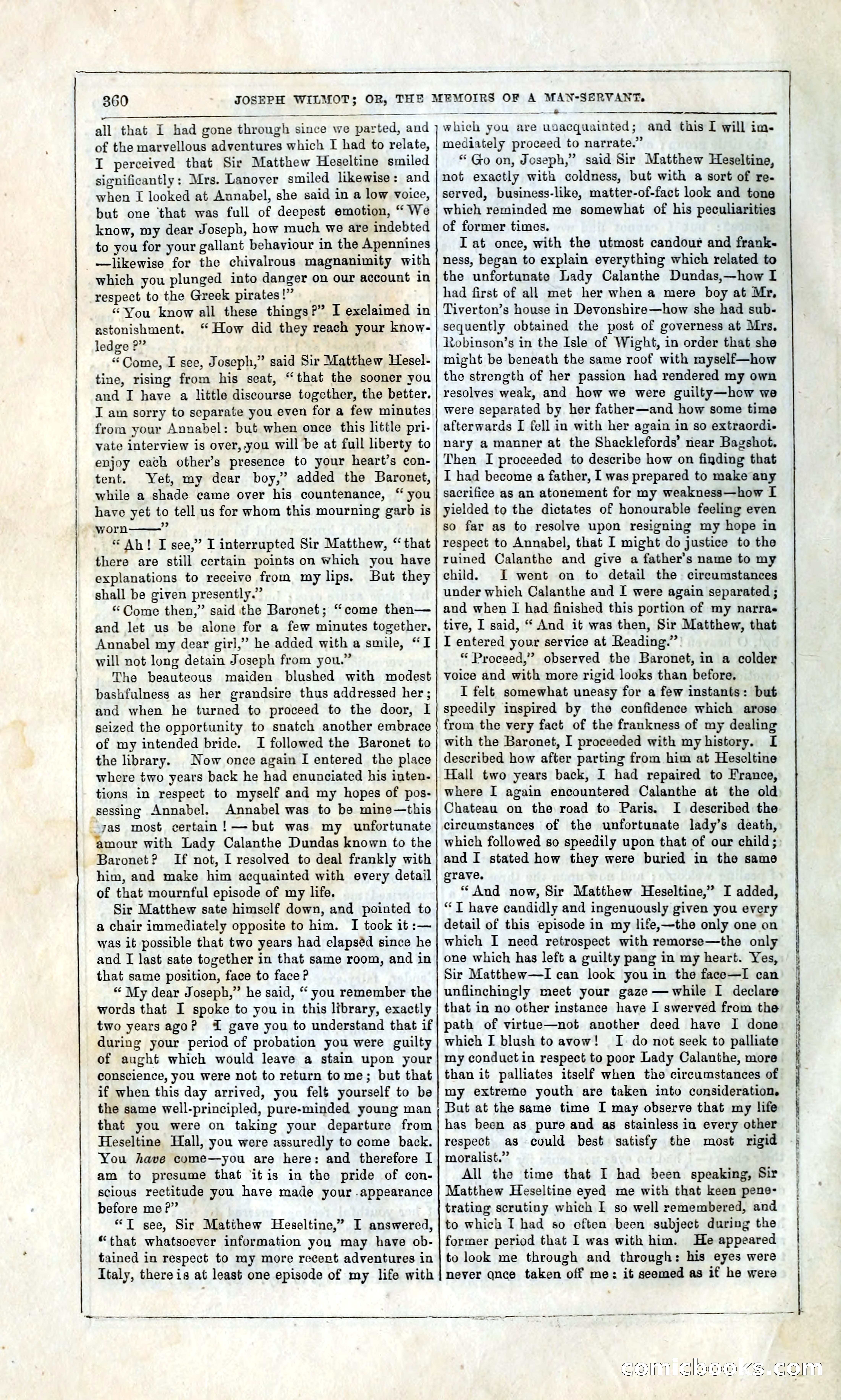
A restored page from Penny Dreadfuls, 1854. Page through the whole issue in the reader above.
📄 Transcribed text from this page (OCR, searchable)
Machine-transcribed from the original scan — historical spelling and the odd misread are preserved.
sessing Annabel. yas most certain! —but was my unfortunate 360 a all that I had gone through since we parted, and of the marvellous adventures which I had to relate, I perceived that Sir Matthew Heseltine smiled sienificantly: Mrs. Lanover smiled likewise: and when I looked at Aunabel, she said in a low voice, but one that was full of deepest emotion, “ We know, my dear Joseph, how much we are indebted to you for your gallant behaviour in the Apennines —likewise for the chivalrous magnanimity with which you plunged into danger on our account in respect to the Greek pirates!” _ “You know all these things?” I exclaimed in astonishment. ‘ How did they reach your know- ledge ?” “Come, I see, Joseph,” said Sir Matthew Hesel- tine, rising from his seat, “that the sooner you and I have a little discourse together, the better. T am sorry to separate you even for a few minutes from your Annabel: but when once this little pri- vate interview is over, -you will be at full liberty to enjoy each other’s presence to your heart’s con- tent. Yet, my dear boy,” added the Baronet, while a shade came over his countenance, “ you have yet to tell us for whom this mourning garb is worn 5 “ Ah! I see,” I interrupted Sir Matthew, “that there are still certain points on which you have explanations to receive from my lips, But they shall be given presently.” “Come then,” said the Baronet; “come then— and let us be alone for a few minutes together. Annabel my dear girl,” he added with a smile, “I will not long detain Joseph from you.” The beauteous maiden blushed with modest bashfulness as her grandsire thus addressed her; and when he turned to proceed to the door, I seized the opportunity to snatch another embrace of my intended bride. I followed the Baronet to the library. Now once again I entered the place where two years back he had enunciated his inten- tions in respect to myself and my hopes of pos- Annabel was to be mine—this ‘amour with Lady Calanthe Dundas known to the Baronet? If not, I resolved to deal frankly with him, and make him acquainted with every detail of that mournful episode of my life. Sir Matthew sate himself down, and pointed to a chair immediately opposite to him. I took it :— was it possible that two years had elapséd since he and I last sate together in that same room, and in that same position, face to face? ** My dear Joseph,” he said, “ you remember the words that I spoke to you in this library, exactly two years agoP 4 gave you to understand that if during your period of probation you were guilty of aught which would leave a stain upon your conscience, you were not to return to me; but that if when this day arrived, you felt yourself to be the same well-principled, pure-minded young man that you were on taking your departure from Heseltine Hall, you were assuredly to come back. You have come—you are here: and therefore I am to presume that itis in the pride of con- scious rectitude you have made your .appearance before me?” *“T see, Sir Matthew Heseltine,” I answered, “that whatsoever information you may have ob- tained in respect to my more recert adventures in Italy, thereis at least one episode of my life with JOSEPH WILMOT; OR, THE MEMOIRS OF A MAN-SERVANT. which you are usacquainted; and this I will im- mediately proceed to narrate.” “ Go on, Joseph,” said Sir Matthew Heseltine, not exactly with coldness, but with a sort of re. served, business-like, matter-of-fact look and tone which reminded me somewhat of his peculiarities of former times. I at once, with the utmost candour and frank. ness, began to explain everything which related to the unfortunate Lady Calanthe Dundas,—how I had first of all met her when a mere boy at Mr, Tiverton’s house in Devonshire—how she had sub- sequently obtained the post of governess at Mrs. Robinson’s in the Isle of Wight, in order that she might be beneath the same roof with myself—how the strength of her passion had rendered my own resolves weak, and how we were guilty—how we were seperated by her father—and how some time afterwards I fell in with her again in so extraordi- nary a manner at the Shacklefords’ near Bagshot. Then I proceeded to describe how on figding that I had become a father, I was prepared to make any sacrifice as an atonement for my weakness—how I yielded to the dictates of honourable feeling even so far as to resolve upon resigning my hope in respect to Annabel, that I might do justice to the ruined Calanthe and give a father’s name to my child. I went on to detail the circumstances under which Calanthe and I were again separated ; and when J had finished this portion of my narras tive, I said, “ And it was then, Sir Matthew, that I entered your service at Reading.” “ Proceed,” observed the Baronet, in a colder voice and with more rigid looks than before, I felt somewhat uneasy for a few instants: but speedily inspired by the confidence which arose from the very fact of the frankness of my dealing with the Baronet, I proceeded with my history. I described how after parting from him at Heseltine Hall two years back, I had repaired to France, where I again encountered Calanthe at the old Chateau on the road to Paris. I described the circumstances of the unfortunate lady’s death, which followed so speedily upon that of our child; and I stated how they were buried in the same grave. “And now, Sir Matthew Heseltine,” I added, “TI have candidly and ingenuously given you every detail of this episode in my life,—the only one on which I need retrospect with remorse—the only one which has left a guilty pang in my heart. Yes, Sir Matthew—I can look you in the face—I can unflinchingly meet your gaze —while I declare that in no other instance have I swerved from the path of virtue—not another deed have I done which I blush to avow! I do not seek to palliate my conductin respect to poor Lady Calanthe, more than it palliates itself when the circumstances of my extreme youth are taken into consideration. But at the same time I may observe that my life has been as pure and as stainless in every other respect as could best satisfy the most rigid moralist.” All the time that I had been speaking, Sir Matthew Heseltine eyed me with that keen pene- trating scrutiny which I so well remembered, and to which I had so cften been subject during the former period that I was with him. He appeared to look me through and through: his eyes were never ance taken off me: it seemed as if he were GiIyoo