
Penny Dreadfuls, 1854 · page 383 of 399
Joseph Wilmot, or, The Memoirs of a Man-Servant — page 383: what you’re looking at
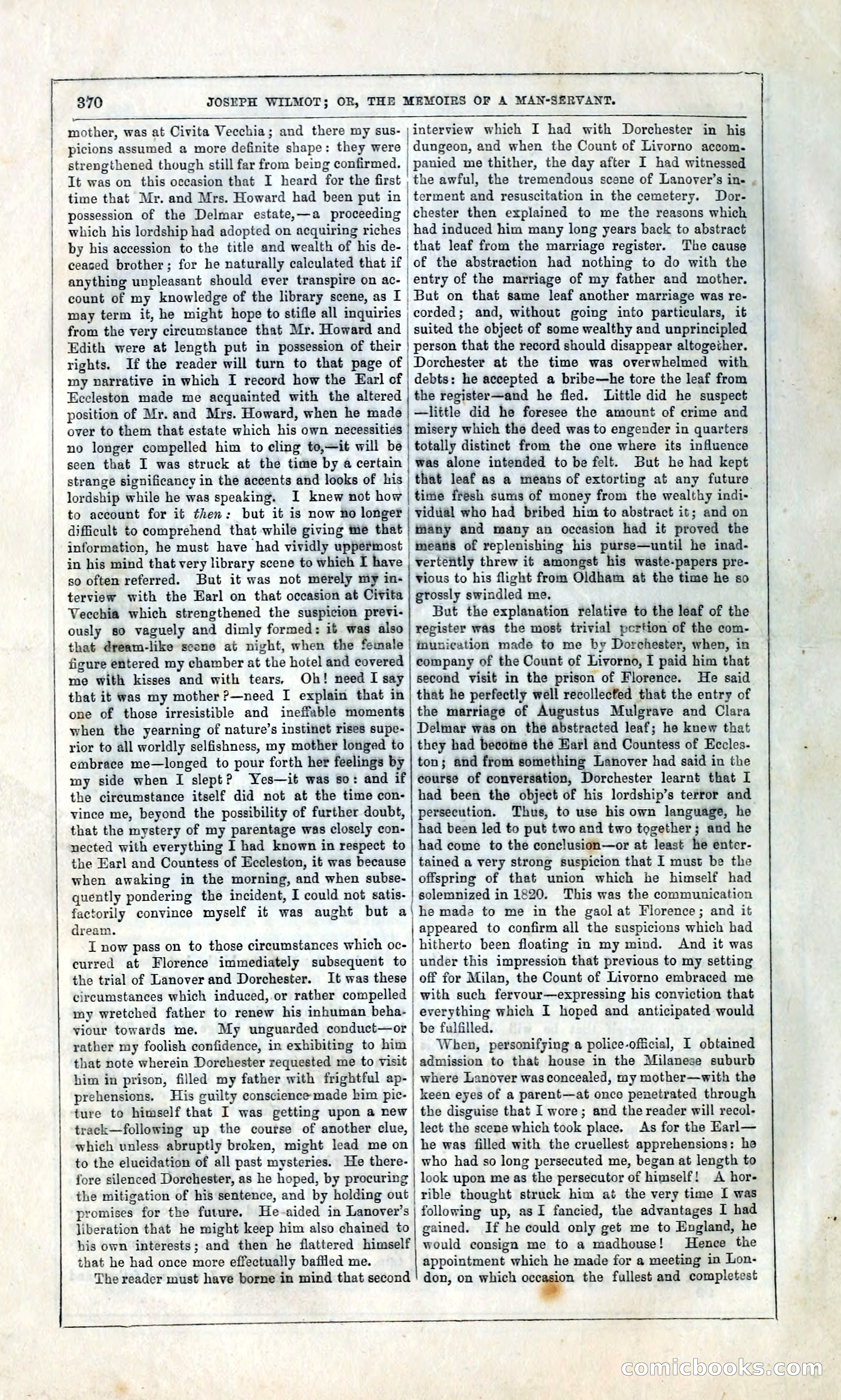
A restored page from Penny Dreadfuls, 1854. Page through the whole issue in the reader above.
📄 Transcribed text from this page (OCR, searchable)
Machine-transcribed from the original scan — historical spelling and the odd misread are preserved.
ee JOSEPH WILMOT; OR, THE MEMOIRS OF A MAN-SERVANT. i mother, was at Civita Vecchia; and there my sus- | interview which I had with Dorchester in his picions assumed a more definite shape: they were | dungeon, and when the Count of Livorno accom. strengthened though still far from being confirmed. | panied me thither, the day after I had witnessed It was on this occasion that I heard for the first the awful, the tremendous scene of Lanover’s ine , . A time that Mr. and Mrs. Howard had been put in | possession of the Delmar estate,—a proceeding which his lordship had adopted on acquiring riches by his accession to the title and wealth of his de- ceased brother; for he naturally calculated that if \that leaf from the marriage register. of the abstraction had nothing to do with the anything unpleasant should ever transpire on ac- count of my knowledge of the library scene, as I may term it, he might hope to stifle all inquiries | from the very circumstance that Mr. Howard and | Edith were at length put in possession of their | rights. If the reader will turn to that page of | my narrative in which I record how the Earl of Eccleston made me acquainted with the altered position of Mr. and Mrs. Howard, when he made over to them that estate which his own necessities | no longer compelled him to cling to,—it will be seen that I was struck at the time by a certain strange significancy in the accents and looks of his lordship while he was speaking. I knew not how terment and resuscitation in the cemetery. Dor- chester then explained to me the reasons which had induced him many long years back to abstract The cause entry of the marriage of my father and mother. But on that same leaf another marriage was re- corded; and, without going into particulars, it suited the object of some wealthy and unprincipled person that the record should disappear altogether. Dorchester at the time was overwhelmed with debts: he accepted a bribe—he tore the leaf from the recister—and he fied. Little did he suspect —little did he foresee the amount of crime and misery which the deed was to engender in quarters totally distinct from the one where its influence was alone intended to be felt. But he had kept that leaf as a means of extorting at any future time frésh sums of money from the wealthy indi- to account for it then: but it is now no longer | vidual who had bribed him to abstract it; and on difficult to comprehend that while giving me that | many and many an occasion had it proved the information, he must have had vividly uppe®most | means of replenishing his purse—until he inad- in his mind that very library scene to which I have | vertently threw it amongst his waste-papers pre- so often referred. But it was not merely my in- terview with the Earl on that occasion at Civita Vecchia which strengthened the suspicion previ- ously so vaguely and dimly formed: if was also that dream-like scone at night, when the female figure entered my chamber at the hotel and covered me with kisses and with tears, Oh! need I say that it was my mother ?—need I explain that in one of those irresistible and ineffable moments when the yearning of nature’s instinct rises supe- rior to all worldly selfishness, my mother longed to embrace me—longed to pour forth her feelings by my side when I slept? Yes—it was so: and if the circumstance itself did not at the time con- vince me, beyond the possibility of further doubt, that the mystery of my parentage was closely con- nected with everything I had known in respect to the Earl and Countess of Eccleston, it was because when awaking in the morning, and when subse- quently pondering the incident, I could not satis- factorily convince myself it was aught but a dream. I now pass on to those circumstances which oc- curred at Florence immediately subsequent to | the trial of Lanover and Dorchester. It was these circumstances which induced, or rather compelled | my wretched father to renew his inhuman beha.- | viour towards me. My unguarded conduct—or | rather my foolish confidence, in exhibiting to him that note wherein Dorchester requested me to visit him in prison, filled my father with frightful ap- | vious to his flight from Oldham at the time he so grossly swindled me, But the explanation relative to the leaf of the register was the most trivial pcrtion of the com- munication made to me by Dorchester, when, in company of the Count of Livorno, I paid him that second visit in the prison of Florence. He said that he perfectly well recollected that the entry of the marriage of Augustus Mulgrave and Clara Delmar was on the abstracted leaf; he knew that they had beeoine the Earl and Countess of Eccles- ton; and from something Lanover had said in the course of conversation, Dorchester learnt that I had been the object of his lordship’s terror and persecution. Thus, to use his own language, he had been led to put two and two together; and he had come to the conclusion—or at least he enter- tained a very strong suspicion that I must be the offspring of that union which he himself had solemnized in 1820. This was the communication he made to me in the gaol at Florence; and it appeared to confirm all the suspicions which had hitherto been floating in my mind. And it was under this impression that previous to my setting off for Milan, the Count of Livorno embraced me with such fervour—expressing his conviction that everything which I hoped and anticipated would be fulfilled. When, personifying a police-official, I obtained admission to that house in the Milanese suburb where Lanover was concealed, my mother—with the prehensions. His guilty conscience made him pic- _ keen eyes of a parent—at once penetrated through ture to himself that I was getting upon a new| the disguise that I wore; and the reader will recol- track—following up the course of another clue, | lect the scene which took place. As for the Earl— which unless abruptly broken, might lead me on| he was filled with the cruellest apprehensions: he to the elucidation of all past mysteries. He there-| who had so long persecuted me, began at length to fore silenced Dorchester, as he hoped, by procuring | look upon me as the persecutor of himself! A hor- the mitigation of his sentence, and by holding out | rible thought struck him at the very time I was promises for the future. He-aided in Lanover’s | following up, asI fancied, the advantages I had liberation that he might keep him also chained to| gained. If he could only get me to England, he his own interests; and then he flattered himself! would consign me to a madhouse! Hence the that he had once more effectually baffled me. appointment which he made for a meeting in Lon- The reader must have borne in mind that second ! don, on which a i the fullest and completest comicyooks Se ee ee