
Penny Dreadfuls, 1854 · page 393 of 399
Joseph Wilmot, or, The Memoirs of a Man-Servant — page 393: what you’re looking at
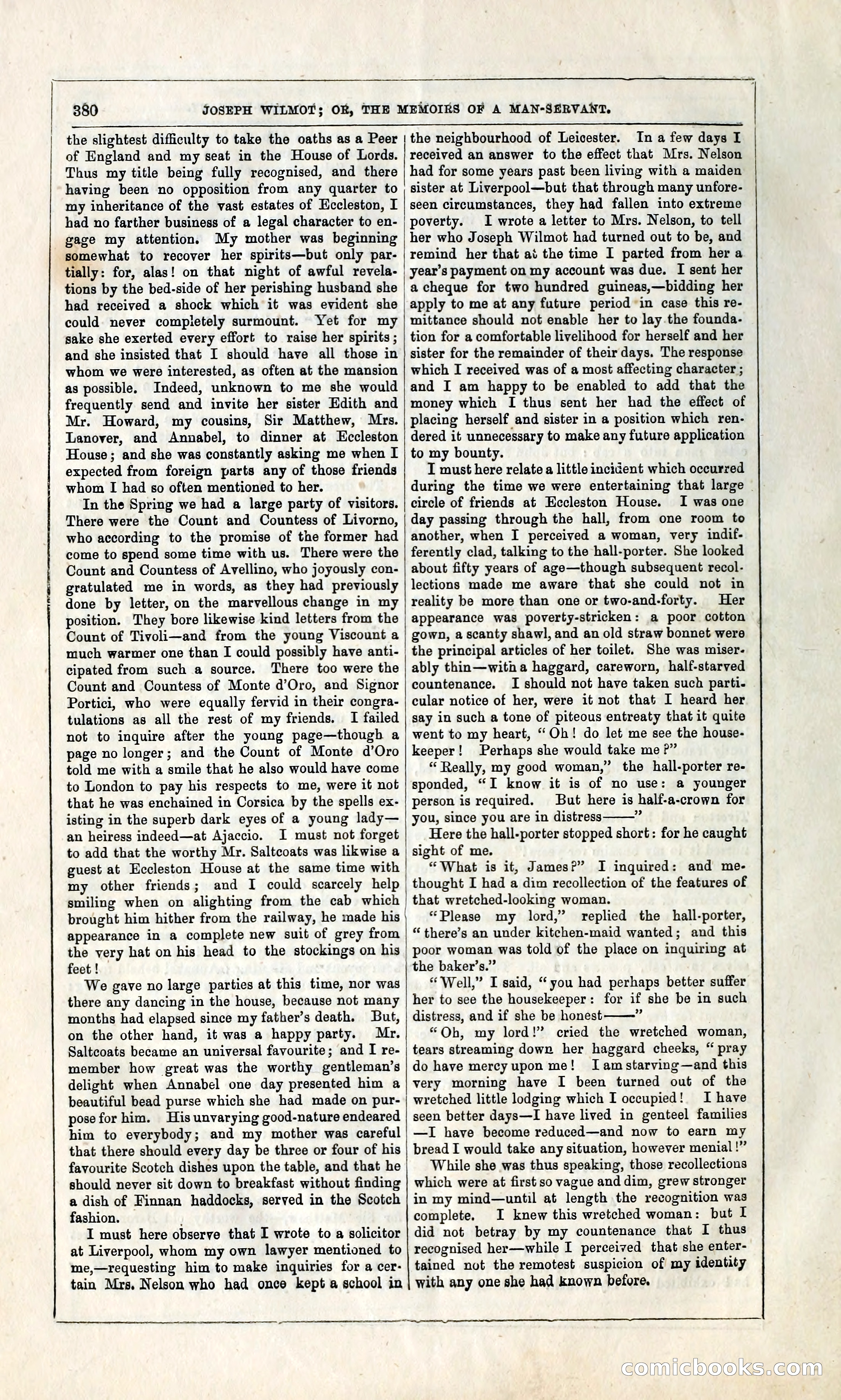
A restored page from Penny Dreadfuls, 1854. Page through the whole issue in the reader above.
📄 Transcribed text from this page (OCR, searchable)
Machine-transcribed from the original scan — historical spelling and the odd misread are preserved.
380 JOSEPH WILMOT; OR, THE MEMOIRS OF A MAN-SERVANT. the slightest difficulty to take the oaths as a Peer of England and my seat in the House of Lords. Thus my title being fully recognised, and there having been no opposition from any quarter to my inheritance of the vast estates of Eccleston, I had no farther business of a legal character to en- gage my attention. My mother was beginning somewhat to recover her spirits—but only par- tially: for, alas! on that night of awful revela- tions by the bed-side of her perishing husband she had received a shock which it was evident she could never compietely surmount. Yet for my sake she exerted every effort to raise her spirits ; and she insisted that I should have all those in whom we were interested, as often at the mansion as possible. Indeed, unknown to me she would frequently send and invite her sister Edith and Mr. Howard, my cousins, Sir Matthew, Mrs. Lanover, and Annabel, to dinner at Eccleston House; and she was constantly asking me when I expected from foreign parts any of those friends whom I had so often mentioned to her. In the Spring we had a large party of visitors. There were the Count and Countess of Livorno, who according to the promise of the former had come to spend some time with us. There were the Count and Countess of Avellino, who joyously con- gratulated me in words, as they had previously done by letter, on the marvellous change in my position. They bore likewise kind letters from the Count of Tivoli—and from the young Viscount a much warmer one than I could possibly have anti- cipated from such a source. There too were the Count and Countess of Monte d’Oro, and Signor Portici, who were equally fervid in their congra- tulations as all the rest of my friends. I failed not to inquire after the young page—though a page no longer; and the Count of Monte d’Oro told me with a smile that he also would have come to London to pay his respects to me, were it not that he was enchained in Corsica by the spells ex- isting in the superb dark eyes of a young lady— an heiress indeed—at Ajaccio. I must not forget to add that the worthy Mr. Saltcoats was likwise a guest at Eccleston House at the same time with my other friends; and I could scarcely help smiling when on alighting from the cab which brought him hither from the railway, he made his appearance in a complete new suit of grey from the very hat on his head to the stockings on his feet ! We gave no large parties at this time, nor was there any dancing in the house, because not many months had elapsed since my father’s death. But, on the other hand, it was a happy party. Mr. Saltcoats became an universal favourite; and I re- member how great was the worthy gentleman’s delight when Annabel one day presented him a beautiful bead purse which she had made on pur- pose for him. His unvarying good-nature endeared him to everybody; and my mother was careful that there should every day be three or four of his favourite Scotch dishes upon the table, and that he should never sit down to breakfast without finding a dish of Finnan haddocks, served in the Scotch fashion. . I must here observe that I wrote to a solicitor at Liverpool, whom my own lawyer mentioned to me,—requesting him to make inquiries for a cer- tain Mrs. Nelson who had once kept a school in the neighbourhood of Leicester. In a few days I received an answer to the effect that Mrs. Nelson had for some years past been living with a maiden sister at Liverpool—but that through many unfore- seen circumstances, they had fallen into extreme poverty. I wrote a letter to Mrs. Nelson, to tell her who Joseph Wilmot had turned out to be, and remind her that ai the time I parted from her a year’s payment on my account was due. I sent her a cheque for two hundred guineas,—bidding her apply to me at any future period in case this re- mittance should not enable her to lay.the founda- tion for a comfortable livelihood for herself and her sister for the remainder of their days. The response which I received was of a most affecting character ; and I am happy to be enabled to add that the money which I thus sent her had the effect of placing herself and sister in a position which ren- dered it unnecessary to make any future application to my bounty. I must here relate a little incident which occurred during the time we were entertaining that large ~ circle of friends at Eccleston House. I was one day passing through the hall, from one room to another, when I perceived a woman, very indif- ferently clad, talking to the hall-porter. She looked about fifty years of age—though subsequent recol- lections made me aware that she could not in reality be more than one or two-and-forty. Her appearance was poverty-stricken: a poor cotton gown, a scanty shawl, and an old straw bonnet were the principal articles of her toilet. She was miser- ably thin—witn a haggard, careworn, half-starved countenance. I should not have taken such parti. cular notice of her, were it not that I heard her say in such a tone of piteous entreaty that it quite went to my heart, “Oh! do let me see the house- keeper! Perhaps she would take me ?P” “Really, my good woman,” the hall-porter re- sponded, “I know it is of no use: a younger person is required. But here is half-a-crown for you, since you are in distress ki Here the hall-porter stopped short: for he caught sight of me. “What is it, James?” I inquired: and me- thought I had a dim recollection of the features of that wretched-looking woman. “Please my lord,’ replied the hall-porter, “ there’s an under kitchen-maid wanted; and this poor woman was told of the place on inquiring at the baker’s.” “Well,” I said, “you had perhaps better suffer her to see the housekeeper: for if she be in such distress, and if she be honest 4 7 “Oh, my lord!” cried the wretched woman, tears streaming dowry her haggard cheeks, “ pray do have mercy upon me! I amstarving—and this very morning have I been turned out of the wretched little lodging which I occupied! I have seen better days—I have lived in genteel families —I have become reduced—and now to earn my bread I would take any situation, however menial!” While she was thus speaking, those recollections which were at first so vague and dim, grew stronger in my mind—until at length the recognition was complete. I knew this wretched woman: but I did not betray by my countenance that I thus recognised her—while I perceived that she enter- tained not the remotest suspicion of my identity with any one she had known before. EOC) <S) (©)