
Penny Dreadfuls, 1854 · page 400 of 399
Joseph Wilmot, or, The Memoirs of a Man-Servant — page 400: what you’re looking at
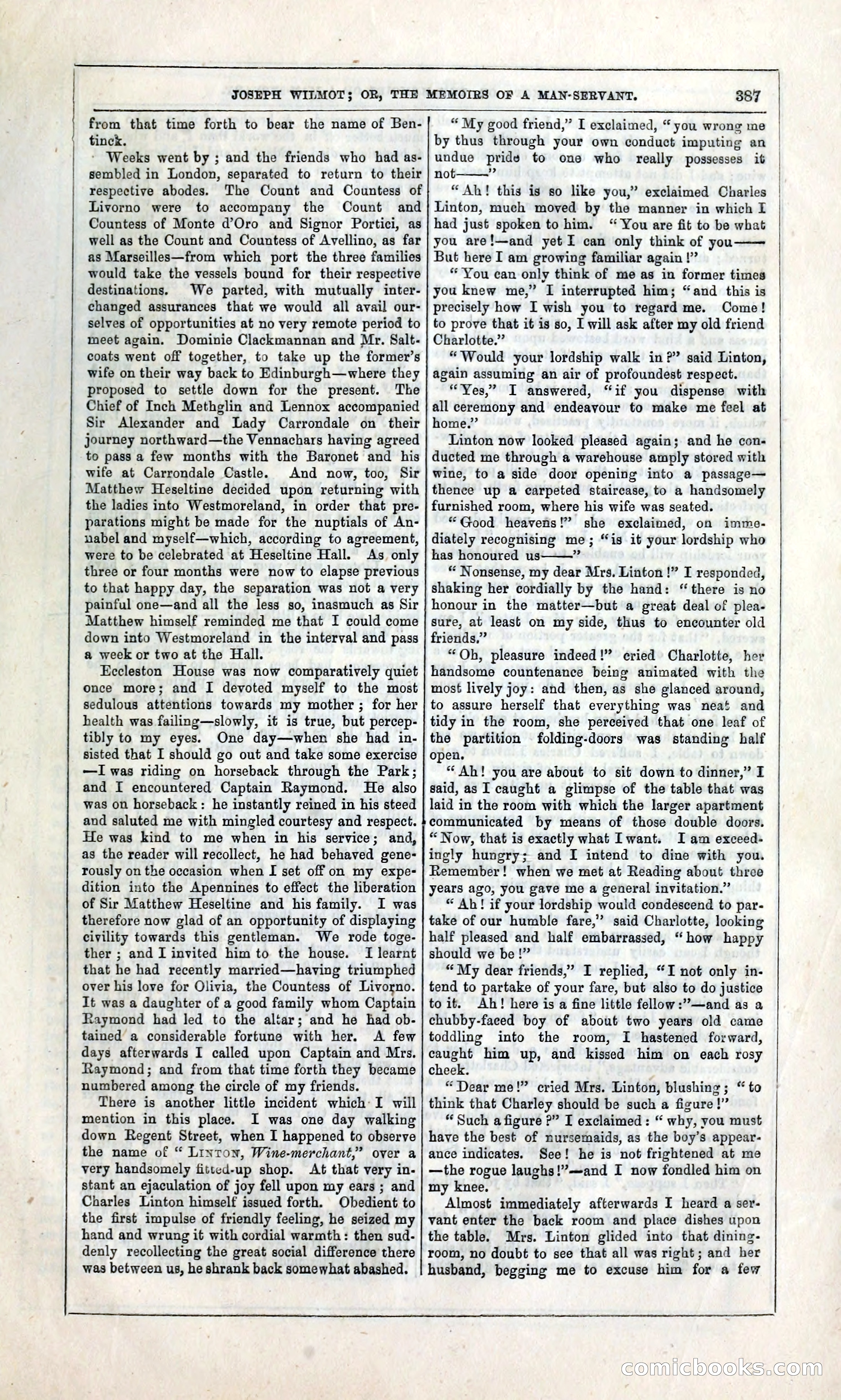
A restored page from Penny Dreadfuls, 1854. Page through the whole issue in the reader above.
📄 Transcribed text from this page (OCR, searchable)
Machine-transcribed from the original scan — historical spelling and the odd misread are preserved.
Oe eee ee ee JOSEPH WILMOT; OR, THE MEMOIRS OF A MAN-SERVANT. from that time forth to bear the name of Ben- tinck. ' Weeks went by ; and the friends who had as- sembled in London, separated to return to their respective abodes. The Count and Countess of Livorno were to accompany the Count and Countess of Monte d’Oro and Signor Portici, as well as the Count and Countess of Avellino, as far as Marseilles—from which port the three families would take the vessels bound for their respective destinations. We parted, with mutually inter- changed assurances that we would all avail our- selves of opportunities at no very remote period to meet again. Dominie Clackmannan and Mr. Salt- coats went off together, to take up the former’s wife on their way back to Edinburgh—where they proposed to settle down for the present. The Chief of Inch Methglin and Lennox accompanied Sir Alexander and Lady Carrondale on their journey northward—the Vennachars having agreed to pass a few months with the Baronet and his wife at Carrondale Castle. And now, too, Sir Matthew Heseltine decided upon returning with the ladies into Westmoreland, in order that pre- parations might be made for the nuptials of An- nabel and myself—which, according to agreement, were to be celebrated at Heseltine Hall. As only three or four months were now to elapse previous to that happy day, the separation was not a very painful one—and all the less so, inasmuch as Sir Matthew himself reminded me that 1 could come down into Westmoreland in the interval and pass a week or two at the Hall. Eccleston House was now comparatively quiet once more; and I devoted myself to the most sedulous attentions towards my mother ; for her health was failing—slowly, it is true, but percep- tibly to my eyes. One day—when she had in- sisted that I should go out and take some exercise —I was riding on horseback through the Park; and I encountered Captain Raymond. He also was on horseback : he instantly reined in his steed and saluted me with mingled courtesy and respect. He was kind to me when in his service; and, as the reader will recollect, he had behaved gene- rously on the occasion when I set off on my expe- dition into the Apennines to effect the liberation of Sir Matthew Heseltine and his family. I was therefore now glad of an opportunity of displaying civility towards this gentleman. We rode toge- ther ; and I invited him to the house. [ learnt that he had recently married—having triumphed over his love for Olivia, the Countess of Livorno. It was a daughter of a good family whom Captain Raymond had led to the altar; and he had ob- tained a considerable fortune with her. <A few days afterwards I called upon Captain and Mrs. Raymond; and from that time forth they became numbered among the circle of my friends. There is another little incident which:I will mention in this place. I was one day walking down Regent Street, when I happened to observe the name of “ Linton, Wine-merchant,” over a very handsomely fitted-up shop. At that very in- stant an ejaculation of joy fell upon my ears ; and Charles Linton himself issued forth. Obedient to the first impulse of friendly feeling, he seized my hand and wrung if with cordial warmth: then sud- denly recollecting the great social difference there was between us, he shrank back somewhat abashed. 387 “ My good friend,” I exclaimed, “ you wrong me by thus through your own conduct imputing an undue pride to one who really possesses it not——~” “Ah! this is so like you,” exclaimed Charles Linton, much moved by the manner in which I had just spoken to him. “You are fit to be what you are!—and yet I can only think of yu—— But here I am growing familiar again !’ * You can only think of me as in former times you knew me,” I interrupted him; “and this is precisely how I wish you to regard me. Come! to prove that it is so, I will ask after my old friend Charlotte.” “Would your lordship walk in?” said Linton, again assuming an air of profoundest respect. “Yes,” I answered, “if you dispense with all ceremony and endeavour to make me feel at home.” Linton now looked pleased again; and he con- ducted me through a warehouse amply stored with wine, to a side door opening into a passage— thence up a carpeted staircase, to a handsomely furnished room, where his wife was seated. “Good heavens!” she exclaimed, on imme- diately recognising me; “is it your lordship who has honoured us ? “ Nonsense, my dear Mrs. Linton !” I responded, shaking her cordially by the hand: “there is no honour in the matter—but a great deal of plea- sure, at least on my side, thus to encounter old friends,” “Oh, pleasure indeed!” eried Charlotte, her handsome countenance being animated with the most lively joy: and then, as she glanced around, to assure herself that everything was neat and tidy in the room, she perceived that one leaf of the partition folding-doors was standing half open. “Ah! you are about to sit down to dinner,” I said, as I caught a glimpse of the table that was laid in the room with which the larger apartment communicated by means of those double doors. “Now, that is exactly what Iwant. Iam exceed- ingly hungry; and I intend to dine with you. Remember! when we met at Reading about three years ago, you gave me a general invitation.” “ Ah! if your lordship would condescend to par- take of our humble fare,” said Charlotte, looking half pleased and half embarrassed, “how happy should we be !” “My dear friends,” I replied, “I not only in- tend to partake of your fare, but also to do justice to it. Ah! here is a fine little fellow :”—and as a chubby-faced boy of about two years old came toddling into the room, I hastened forward, caught him up, and kissed him on each rosy cheek. “Dear me!” cried Mrs. Linton, blushing; “ to think that Charley should be such a figure!” * Such a figure P” I exclaimed: “ why, you must have the best of nursemaids, as the boy’s appear- ance indicates. See! he is not frightened at me —the rogue laughs!”—and I now fondled him on my knee. Almost immediately afterwards I heard a ser- vant enter the back room and place dishes upon the table. Mrs. Linton glided into that dining- room, no doubt to see that all was right; and her husband, begging me to excuse him for a few EloOOk<S (SO)