
Penny Dreadfuls, 1854 · page 43 of 399
Joseph Wilmot, or, The Memoirs of a Man-Servant — page 43: what you’re looking at
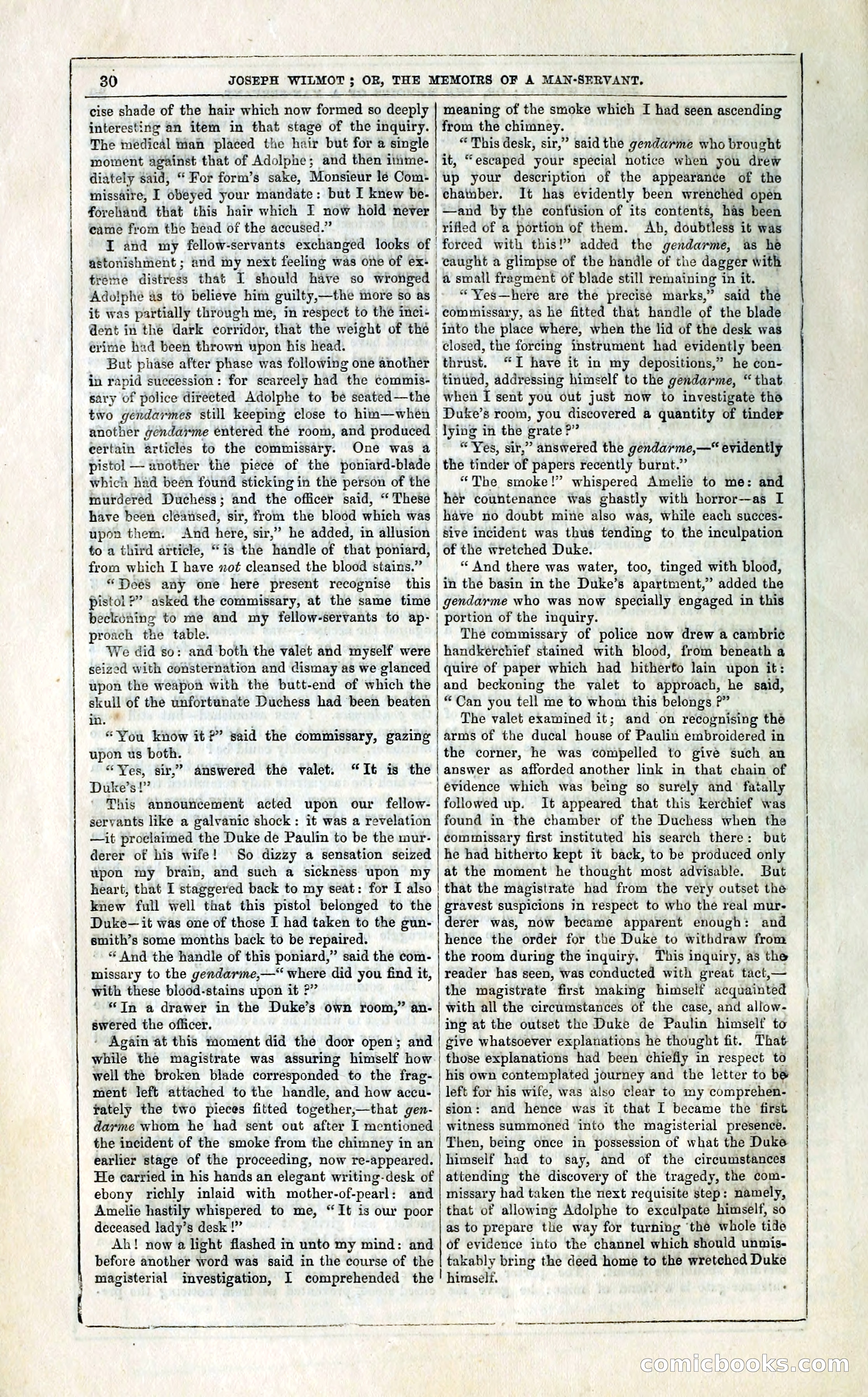
A restored page from Penny Dreadfuls, 1854. Page through the whole issue in the reader above.
📄 Transcribed text from this page (OCR, searchable)
Machine-transcribed from the original scan — historical spelling and the odd misread are preserved.
a OEE 8 pe ES 30 cise shade of the hair which now formed so deeply interesting an item in that stage of the inquiry. The médical man placed the hair but for a single moment against that of Adolphe; and then imme- diately said, “ For form’s sake, Monsieur le Com- missaire, I obeyed your mandate: but I knew be- forehand that this hair which IT now hold never came from the head of the accused.” I and my fellow-servants exchanged looks of | astonishment ; and my next feeling was one of ex: | treme distress that I should have so wronged Adolphe &s to believe him guilty,—the more 80 as it was partially through me, in respect to the inci- eee dent in the dark corridor, that the weight of the | erime had been thrown upon his head. But phase after phase was following one another | in rapid succession: for scarcely had “the commis: | sary of police directed Adolphe to be seated—the | two gendarmes still keeping close to him—when another gendarme entered thé room, and produced | certain articles to the commissary. One was a pistol — another the piece of the poniard-blade which had been found sticking in the person of the murdered Duchess; and the officer said, “ These | have been cléansed, sir, from the blood which was | upon them. And here, sir,” he added, in allusion | to a third article, “ is the handle of that poniard, from which I have xot cleansed the blood stains.” * Does any one here present recognise this pistol ?’ asked the commissary, at the same time beckoning to me and my fellow-servants to ap- proach the table. We did so: and both the valet and myself were seized with consternation and dismay as we glanced upon the weapon with the butt-end of which the skull of the unfortunate Duchess had been beaten in. ” “You know it?” said the commissary, gazing upon us both. “Yes, sir.’ answered the valet. Duke’s!” This announcement acted upon our fellow- servants like a galvanic shock: it was a revelation —it proclaimed the Duke de Paulin to be the mur- derer of his wife! So dizzy a sensation seized upon my brain, and such a sickness upon my heart, that I staggered back to my seat: for I also knew full well that this pistol belonged to the Duke—it was one of those I had taken to the gun- smith’s some months back to be repaired. * And the handle of this poniard,” said the com- missary to the gendarme,— where did you find it, with these blood-stains upon it ?” In a drawer in the Duke’s own room,” an- swered the officer. - Again at this moment did the door open; and while the magistrate was assuring himself how well the broken blade corresponded to the frag- ment left attached to the handle, and how accu- rately the two pieces fitted together,—that gen- | darme whom he had sent out after I mentioned | the incident of the smoke from the chimney in an earlier stage of the proceeding, now re-appeared. He carried in his hands an elegant writing-desk of ebony richly inlaid with mother-of-pearl: and Amelie hastily whispered to me, “It is our poor deceased lady’s desk !” Ah! now a light flashed in unto my mind: and before another word was said in the course of the magisterial investigation, I comprehended the “Tt is baw | a i i ee ee se eee ewe ———<_ JOSEPH WILMOT: OR, THE MEMOIRS OF A MAN-SERVANT. meaning of the smoke which I had seen ascending from the chimney. “This desk, sir,” said the gendarme who brought it, “escaped your special notice when you drew up your description of the appearance of the chatnber. It has evidently been wrenchéd open —and by the confusion of its contents, has been | rifled of a portion of them. Ah, doubtless it was forced with this!” added the gendarme, as he caught a glimpse of the handle of the dagger with a small fragment of blade still remaining in it. “Yes—here are the precisé marks, * said the | commissary, as he fitted that handle of the blade into the place where, when the lid of the desk was ! Closed, the forcing instrument had evidently been thrust. “I have it in my depositions,” he con- tinued, addressing himself to the gendarme, “ that whet I sent you out just now to investigate the Dake’ 8 room, you discovered a quantity of tinder lying in the grate t ai “Yes, sir,” answered the gendarme,—* evidently the tinder of papers recently burnt.” “The smoke!” whispered Amelie to me: and hér countenance was ghastly with horror—as I ‘have no doubt mine also was, while each succes- 'Sive incident was thus tending to the inculpation of the wretched Duke. “ And there was water, too, tinged with blood, in the basin in the Duke’s apartment,” added the gendarme who was now specially engaged in this portion of the inquiry. The commissary of police now drew a cambri¢ handkerchief stained with blood, from beneath a quire of paper which had hitherto lain upon it: and beckoning the valet to approach, he said, “Can you tell me to whom this belongs P” The valet examined it; and on recognising thé arms of the ducal house of Paulin embroidered in ae corner, he was compelled to give such an answer as afforded another link in that chain of evidence which was being so surely and fatally followed up. 1t appeared that this kerchief was ‘i in the chamber of the Duchess when the commissary first instituted his search there: but he had hitherto kept it back, to be produced only at the moment he thought most advisable. But that the magistrate had from the very outset the gravest suspicions jn respect to who the real mur- derer was, now became apparent enough: and hence the order for the Duke to withdraw from | the room during the inquiry. This inquiry, as the reader has seen, was conducted with great tact,— the magistrate first making himself acquainted with all the circumstances of the case, and allow- ing at the outset the Duke de Paulin himself to give whatsoever explanations he thought fit. That those explanations had been chiefly in respect to his own contemplated journey and the letter to be left for his wife, was also clear to my comprehen. sion: and hence was it that I became the first witness summoned into the magisterial presence. | Then, being once in possession of what the Duke himself had to say, and of the circumstances attending the discovery of the tragedy, the com- missary had taken the next requisite step: namely, that of allowing Adolphe to exculpate himself, so as to prepare tlie way for turning ‘the whole tide of evidence into the channel which should unmis- takably bring the deed home to the wretched Duke | himself. ee ae eee (E(©) JOOK te eS CO (EO)