
Penny Dreadfuls, 1854 · page 49 of 399
Joseph Wilmot, or, The Memoirs of a Man-Servant — page 49: what you’re looking at
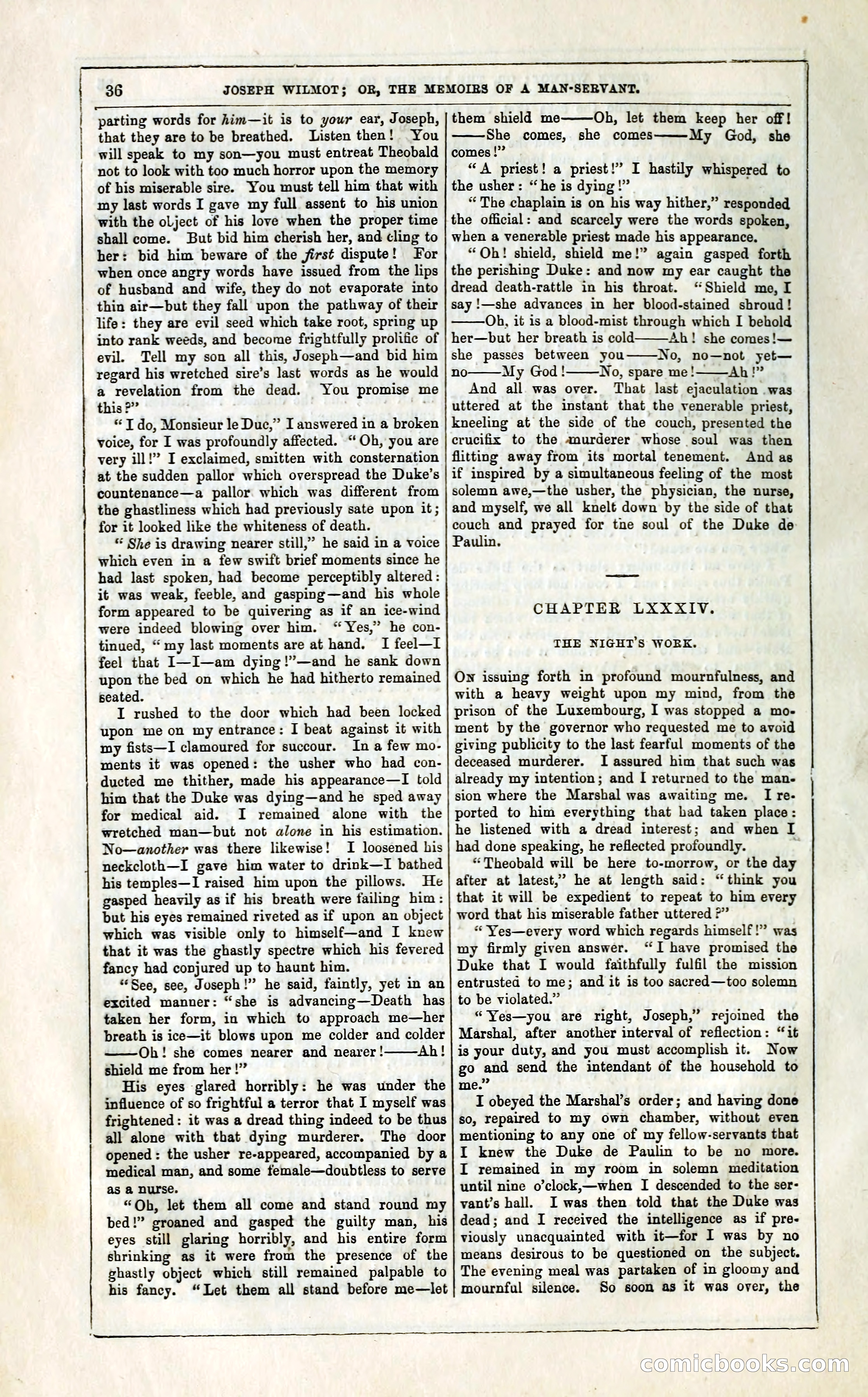
A restored page from Penny Dreadfuls, 1854. Page through the whole issue in the reader above.
📄 Transcribed text from this page (OCR, searchable)
Machine-transcribed from the original scan — historical spelling and the odd misread are preserved.
Be a a ee ens | 36 JOSEPH WILMOT; OR, THE MEMOIRS OF A MAN-SERVANT. Ee DL? De ba = tS cbus) O Ae Are ee LS lL — ee ee parting words for him—it is to your ear, Joseph, that they are to be breathed. Listen then! You will speak to my son—you must entreat Theobald not to look with too much horror upon the memory of his miserable sire. You must tell him that with my last words I gave my full assent to his union with the oLject of his love when the proper time shall come. But bid him cherish her, and cling to her: bid him beware of the jirst dispute! For when once angry words have issued from the lips of husband and wife, they do not evaporate into thin air—but they fall upon the pathway of their life: they are evil seed which take root, spring up into rank weeds, and become frightfully prolific of evil. Tell my son all this, Joseph—and bid him regard his wretched sire’s last words as he would a revelation from the dead. You promise me this ?” ; “ T do, Monsieur le Duc,” I answered in a broken voice, for I was profoundly affected. “‘Oh, you are very ill!” I exclaimed, smitten with consternation at the sudden pallor which overspread the Duke’s countenance—a pallor which was different from the ghastliness which had previously sate upon it; for it looked like the whiteness of death. “ She is drawing nearer still,” he said in a voice which even in a few swift brief moments since he had last spoken, had become perceptibly altered: it was weak, feeble, and gasping—and his whole form appeared to be quivering as if an ice-wind were indeed blowing over him. “ Yes,” he con- tinued, “my last moments are at hand. I feel—I feel that I—I—am dying!”—and he sank down upon the bed on which he had hitherto remained | seated. I rushed to the door which had been locked upon me on my entrance: I beat against it with my fists—I clamoured for succour. In a few mo- ments it was opened: the usher who had con- ducted me thither, made his appearance—I told him that the Duke was dying—and he sped away for medical aid. I remained alone with the wretched man—but not alone in his estimation. No—another was there likewise! I loosened his neckcloth—I gave him water to drink—I bathed his temples—I raised him upon the pillows. He gasped heavily as if his breath were failing him: but his eyes remained riveted as if upon an object which was visible only to himself—and I knew that it was the ghastly spectre which his fevered fancy had conjured up to haunt him. ‘See, see, Joseph!” he said, faintly, yet in an excited manner: “she is advancing—Death has taken her form, in which to approach me—her breath is ice—it blows upon me colder and colder Oh! she comes nearer and nearer! Ah! shield me from her!” His eyes glared horribly: he was under the influence of so frightful a terror that I myself was frightened: it was a dread thing indeed to be thus all alone with that dying murderer. The door opened: the usher re-appeared, accompanied by a medical man, and some female—doubtless to serve as a nurse. “Ob, let them all come bed!” groaned and gasped eyes still glaring horribly, and his entire form shrinking as it were from the presence of the ghastly object which still remained palpable to his fancy. “Let them all stand before me—let and stand round my the guilty man, his them shield me——Oh, let them keep her off! She comes, she comes———-My God, she comes !” “A priest! a priest!” I hastily whispered to the usher: “ he is dying!” “ The chaplain is on his way hither,” responded the official: and scarcely were the words spoken, when a venerable priest made his appearance. “Oh! shield, shield me!” again gasped forth the perishing Duke: and now my ear caught the dread death-rattle in his throat. “Shield me, I say !—she advances in her blood-stained shroud! Oh, it is a blood-mist through which I behold her—but her breath is cold Ah! she comes!— she passes between you No, no—not yet— no My God! No, spare me !———Ah !” And all was over. That last ejaculation was uttered at the instant that the venerable priest, kneeling at the side of the couch, presented the crucifix to the anurderer whose soul was then flitting away from its mortal tenement. And as if inspired by a simultaneous feeling of the most solemn awe,—the usher, the physician, the nurse, and myself, we all knelt down by the side of that couch and prayed for tne soul of the Duke de Paulin. CHAPTER LXXXIV. THE NIGHT'S WORK. On issuing forth in profound mournfulness, and with a heavy weight upon my mind, from the prison of the Luxembourg, I was stopped a mo- ment by the governor who requested me to avoid giving publicity to the last fearful moments of the deceased murderer. I assured him that such was already my intention; and I returned to the man- sion where the Marshal was awaiting me. I re- ported to him everything that bad taken place: he listened with a dread interest; and when I had done speaking, he reflected profoundly. . “Theobald will be here to-morrow, or the day after at latest,’ he at length said: “think you that it will be expedient to repeat to him every word that his miserable father uttered ?” *‘-Yes—every word which regards himself!” was my firmly given answer. “I have promised the Duke that I would faithfully fulfil the mission entrusted to me; and it is too sacred—too solemn to be violated.” “Yes—you are right, Joseph,” rejoined the Marshal, after another interval of reflection: “it is your duty, and you must accomplish it. Now go and send the intendant of the household to me.” I obeyed the Marshal’s order; and having done so, repaired to my own chamber, without even mentioning to any one of my fellow-servants that I knew the Duke de Paulin to be no more. I remained in my room in solemn meditation until nine o’clock,—when I descended to the ser- vant’s hall. Iwas then told that the Duke was dead; and I received the intelligence as if pre- viously unacquainted with it—for I was by no means desirous to be questioned on the subject. The evening meal was partaken of in gloomy and mournful silence. So soon as it was over, the CONnNCEOOO< (EO)