
Penny Dreadfuls, 1854 · page 52 of 399
Joseph Wilmot, or, The Memoirs of a Man-Servant — page 52: what you’re looking at
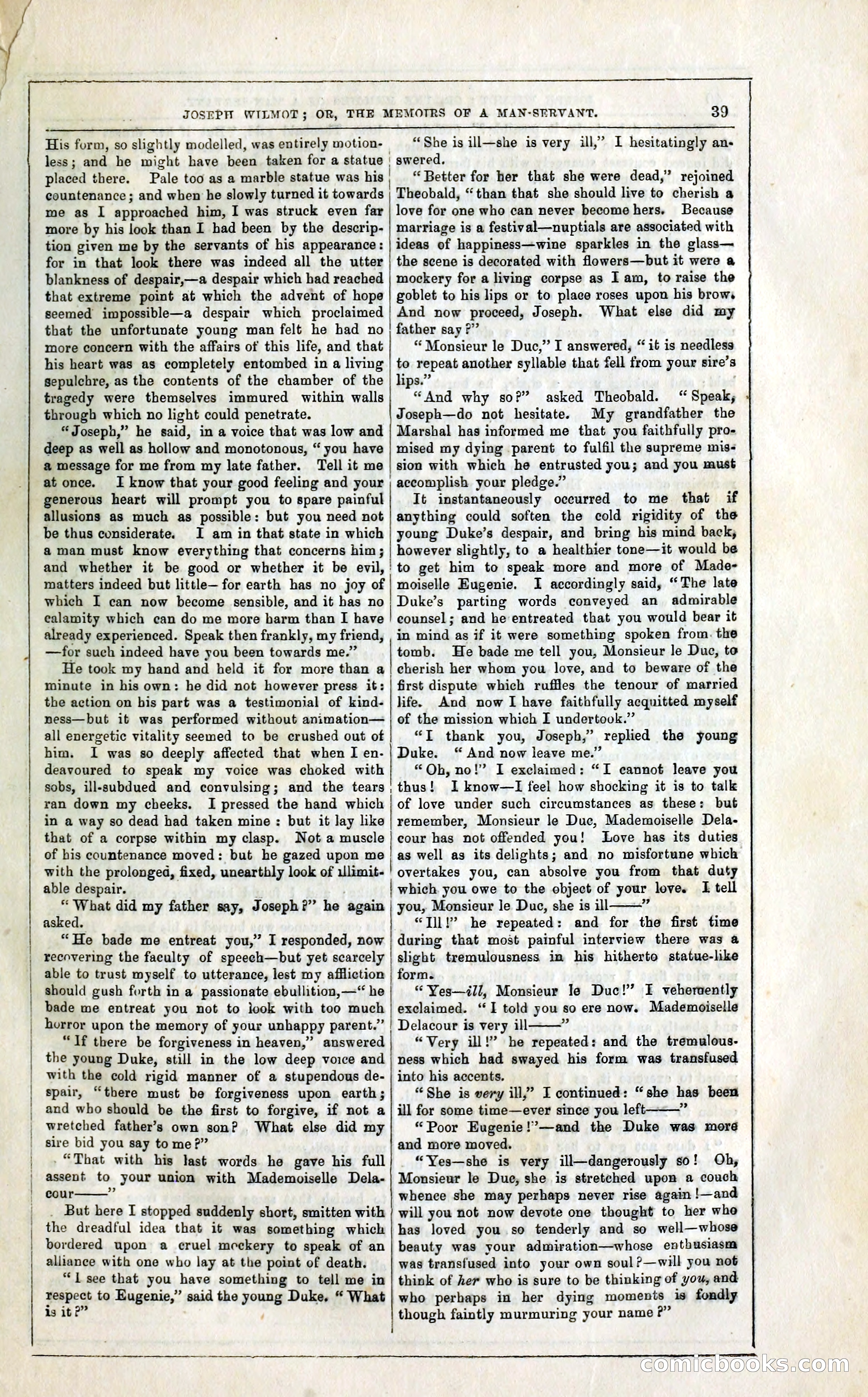
A restored page from Penny Dreadfuls, 1854. Page through the whole issue in the reader above.
📄 Transcribed text from this page (OCR, searchable)
Machine-transcribed from the original scan — historical spelling and the odd misread are preserved.
oe JOSEPH WILMOT; OR, THE MEMOTRS OF A MAN-SERVANT. 39 His form, so slightly modelled, was entirely motion- ‘She is ill—she is very ill,’ I hesitatingly an- less; and he might have been taken for a statue | swered. placed there. Pale too as a marble statue was his! “Better for her that she were dead,” rejoined countenance; and when he slowly turned it towards | Theobald, “than that she should live Ph cherish @ me as 1 approached him, I was struck even far | love for one who can never become hers. Because more by his look than I had been by the descrip- | marriage is a festival—nuptials are associated with tion given me by the servants of his appearance: | ideas of happiness—wine sparkles in the glass— for in that look there was indeed all the utter | the scene is decorated with flowers—but it were a blankness of despair,—a despair which had reached | mockery for a living corpse as Iam, to raise the that extreme point at which the advent of hope | goblet to his lips or to place roses upon his brows seemed impossible—a despair which proclaimed | And now proceed, Joseph. What else did my that the unfortunate young man felt he had no, father say ?” more concern with the affairs of this life, and that “ Monsieur le Duc,’ I answered, “it is needless his heart was as completely entombed in a living | to repeat another syllable that fell from your sire’s sepulchre, as the contents of the chamber of the | lips.” tragedy were themselves immured within walls| “And why so?” asked Theobald. “ Speak, through which no light could penetrate. Joseph—do not hesitate. My grandfather the “Joseph,” he said, in a voice that was low and | Marshal has informed me that you faithfully pro- deep as well as hollow and monotonous, “ you have | mised my dying parent to fulfil the supreme mis- a message for me from my late father. Tell it me | sion with which he entrusted you; and you must at once. I know that your good feeling and your | accomplish your pledge.” generous heart will prompt you to spare painful} It instantaneously occurred to me that if allusions as much as possible: but you need not | anything could soften the cold rigidity of the be thus considerate. I am in that state in which | young Duke’s despair, and bring his mind back, a man must know everything that concerns him; | however slightly, to a healthier tone—it would be and whether it be good or whether it be evil,'! to get him to speak more and more of Made- matters indeed but little—for earth has no joy of moiselle Eugenie. I accordingly said, “The late which I can now become sensible, and it has no| Duke’s parting words conveyed an admirable calamity which can do me more barm than I have | counsel; and he entreated that you would bear it already experienced. Speak then frankly, my friend, in ind as if it were something spoken from. the —for such indeed have you been towards me.’ tomb. He bade me tell you, Monsieur le Duc, to He took my hand and held it for more than a| cherish her whom you love, and to beware of the minute in his own: he did not however press it: | first dispute which ruffles the tenour of married the action on bis part was a testimonial of kind- | life. And now I have faithfully acquitted myself ness—but it was performed without animation— | of the mission which I undertook.” all energetic vitality seemed to be crushed out of “T thank you, Joseph,” replied the young him. I was so deeply affected that when Ilen-| Duke. “ And now leave me.” deavoured to speak my voice was choked with “Qh, no!” I exclaimed: “I cannot leave you sobs, ill-esubdued and convulsing; and the tears; thus! I know—I feel how shocking it is to talk ran down my cheeks. I pressed the hand which | of love under such circumstances as these: but in a way so dead had taken mine: but it lay like | remember, Monsieur le Duc, Mademoiselle Dela- that of a corpse within my clasp. Not a muscle | cour has not offended you! Love has its duties of his countenance moved: but he gazed upon me | as well as its delights; and no misfortune which with the prolonged, fixed, unearthly look of ulimit- : overtakes you, can absolve you from that duty able despair. | which you owe to the object of your love. Ef tell “ What did my father say, Joseph?” he again | you, Monsieur le Duc, she is ill m asked. “Til!” he repeated: and for the first time “He bade me entreat you,” I responded, now | during that most painful interview there was a recovering the faculty of speech—but yet scarcely | slight tremulousness in his hitherto statue-lke able to trust myself to utterance, lest my affliction | form. should gush forth in a passionate ebullition,—“ he “ Yes—ill, Monsieur Ie Duc!’ I veheraently bade me entreat you not to look with too much exclaimed. ‘I told you so ere now. Mademoiselle horror upon the memory of your unhappy parent.” | Delacour is very ill i “If there be forgiveness i in heaven,” answered| “Very ill!” he repeated: and the tremulous- i i the young Duke, still in the low deep voice and | ness which had swayed his form was transfused with the cold rigid manner of a stupendous de- | into his accents. spair, “there must be forgiveness upon earth; “She is very ill,’ I continued: “she has been and who should be the first to forgive, if not a/| ill for some time—ever since you left———” wretched father’s own son? What else did my| “Poor Eugenie!’—and the Duke was moré sire bid you say to me?” and more moved. -“That with his last words he gave his full} “Yes—she is very ill—dangerously so! Obs assent to your union with Mademoiselle Dela-| Monsieur le Due, she is stretched upon a couch cour . whence she may perhaps never rise again !—and _ But here I stopped suddenly short, smitten with | will you not now devote one thought to her whe the dreadful idea that it was something which | has loved you so tenderly and so well—whose bordered upon a cruel mcckery to speak of an| beauty was your admiration—whose enthusiasm alliance with one who lay at the point of death. was transfused into your own soul?—will you not “I see that you have something to tell me in | think of her who is sure to be thinking of you, and respect to Eugenie,” said the young Duke. “ What | who perhaps in her dying moments is fondly as it though faintly murmuring your name ?” RRMOSaIL 447) OUT riety i's CON MEIOO “S (E(@)