
Penny Dreadfuls, 1854 · page 58 of 399
Joseph Wilmot, or, The Memoirs of a Man-Servant — page 58: what you’re looking at
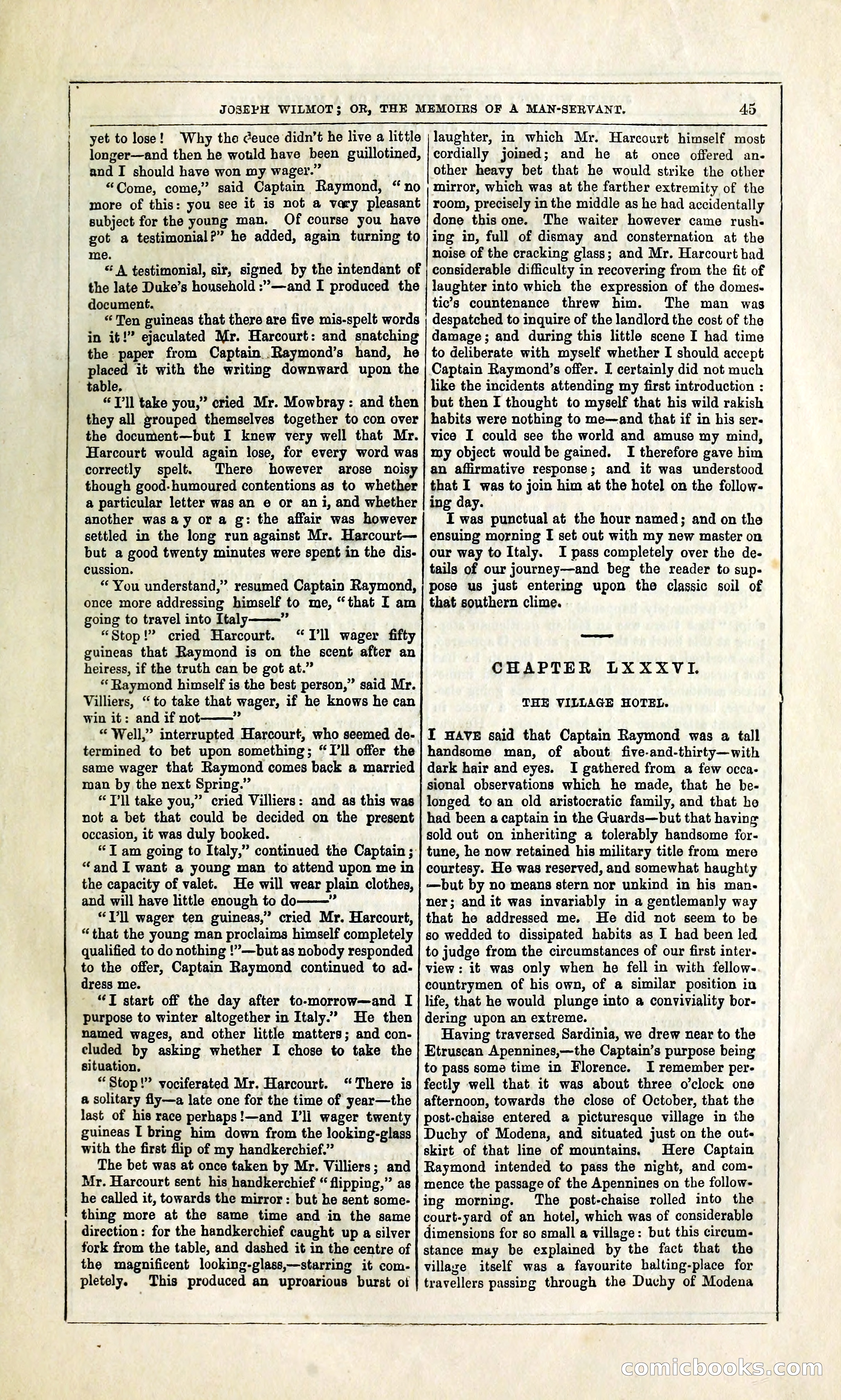
A restored page from Penny Dreadfuls, 1854. Page through the whole issue in the reader above.
📄 Transcribed text from this page (OCR, searchable)
Machine-transcribed from the original scan — historical spelling and the odd misread are preserved.
eee . JOSEPH WILMOT$ OR, THE MEMOIRS OF A MAN-SERVANT. A5 yet to lose! Why the deuce didn’t he live a little longer—and then he wotild have been guillotined, and I should have won my wager.” “Come, come,” said Captain Raymond, “no more of this: you see it is not a vary pleasant subject for the young man. Of course you have got a testimonial?” he added, again turning to me. “ A testimonial, sir, signed by the intendant of the late Duke’s household :”’—and I produced the document. «Ten guineas that there are five mis-spelt words in it!” ejaculated Mr. Harcourt: and snatching the paper from Captain..Raymond’s hand, he placed it with the writing downward upon the table. “T’ll take you,” cried Mr. Mowbray: and then they all grouped themselves together to con over the document—but I knew very well that Mr. Harcourt would again lose, for every word was correctly spelt. There however arose noisy though good-humoured contentions as to whether a particular letter was an e or ani, and whether another was ay or a g: the affair was however settled in the long run against Mr. Harcourt— but a good twenty minutes were spent in the dis- cussion. “You understand,” resumed Captain Raymond, once more addressing himself to me, “that I am going to travel into Italy ——” “Stop!” cried Harcourt. “Tl wager fifty guineas that Raymond is on the scent after an heiress, if the truth can be got at.” “ Raymond himself is the best person,” said Mr. Villiers, “to take that wager, if he knows he can Win it: and if not eA “ Well,” interrupted Harcourt, who seemed de- termined to bet upon something; “I'll offer the same wager that Raymond comes back a married man by the next Spring.” “T’ll take you,” cried Villiers: and as this was not a bet that could be decided on the present occasion, it was duly booked. “TI am going to Italy,” continued the Captain ; “and I want a young man to attend upon me in the capacity of valet. He will wear plain clothes, and will have little enough to do + “Tl wager ten guineas,” cried Mr. Harcourt, “that the young man proclaims himself completely qualified to do nothing !”—but as nobody responded to the offer, Captain Raymond continued to ad- dress me. “T start off the day after to-morrow—and I purpose to winter altogether in Italy.” He then named wages, and other little matters; and con- cluded by asking whether I chose to take the situation, | “Stop!” vociferated Mr. Harcourt. “There is a solitary fly—a late one for the time of year—the last of his race perhaps!—and I’li wager twenty guineas I bring him down from the looking-glass with the first flip of my handkerchief.” The bet was at once taken by Mr. Villiers; and Mr. Harcourt sent his handkerchief “ flipping,” as he called it, towards the mirror: but he sent some- thing more at the same time and in the same direction: for the handkerchief caught up a silver fork from the table, and dashed it in the centre of the magnificent looking-glass,—starring it com- pletely. This produced an uproarious burst of laughter, in which Mr. Harcourt himself most cordially joimed; and he at once offered an- other heavy bet that he would strike the other mirror, which was at the farther extremity of the room, precisely in the middle as he had accidentally done this one. The waiter however came rush- ing in, full of dismay and consternation at the noise of the cracking glass; and Mr. Harcourt had considerable difficulty in recovering from the fit of laughter into which the expression of the domes- tic’s countenance threw him. The man was | despatched to inquire of the landlord the cost of the damage; and during this little scene I had time to deliberate with myself whether I should accept Captain Raymond’s offer. I certainly did not much like the incidents attending my first introduction : but then I thought to myself that his wild rakish habits were nothing to me—and that if in his ser- vice I could see the world and amuse my mind, my object would be gained. I therefore gave him an affirmative response; and it was understood that I was to join him at the hotel on the follow- ing day. 3 I was punctual at the hour named; and on the ensuing morning I set out with my new master on our way to Italy. I pass completely over the de- tails of our journey—and beg the reader to sup- pose us just entering upon the classic soil of that southern clime. CHAPTER LXXXVI. THE VILLAGE HOTEL. I HAVE said that Captain Raymond was a tall handsome man, of about five-and-thirty—with dark hair and eyes. I gathered from a few occa- sional observations which he made, that he be- longed to an old aristocratic family, and that he had been a captain in the Guards—but that having sold out on inheriting a tolerably handsome for- tune, he now retained his military title from mere courtesy. He was reserved, and somewhat haughty —but by no means stern nor unkind in his man- ner; and it was invariably in a gentlemanly way that he addressed me. He did not seem to be so wedded to dissipated habits as I had been led to judge from the circumstances of our first inter- view : it was only when he fell in with fellow- countrymen of his own, of a similar position in life, that he would plunge into a conviviality bor- dering upon an extreme. Having traversed Sardinia, we drew near to the Etruscan Apennines,—the Captain’s purpose being to pass some time in Florence. I remember per- fectly well that i¢ was about three o’clock one afternoon, towards the close of October, that the post-chaise entered a picturesque village in the Duchy of Modena, and situated just on the out- skirt of that line of mountains. Here Captain Raymond intended to pass the night, and com- mence the passage of the Apennines on the follow- ing morning. The post-chaise rolled into the court-yard of an hotel, which was of considerable dimensions for so small a village: but this cireum- stance muy be explained by the fact that the villaze itself was a favourite halting-place for travellers passing through the Duchy of Modena —_—_—_—— C—O > Eonmmicloooks (C@)