
Penny Dreadfuls, 1854 · page 76 of 399
Joseph Wilmot, or, The Memoirs of a Man-Servant — page 76: what you’re looking at
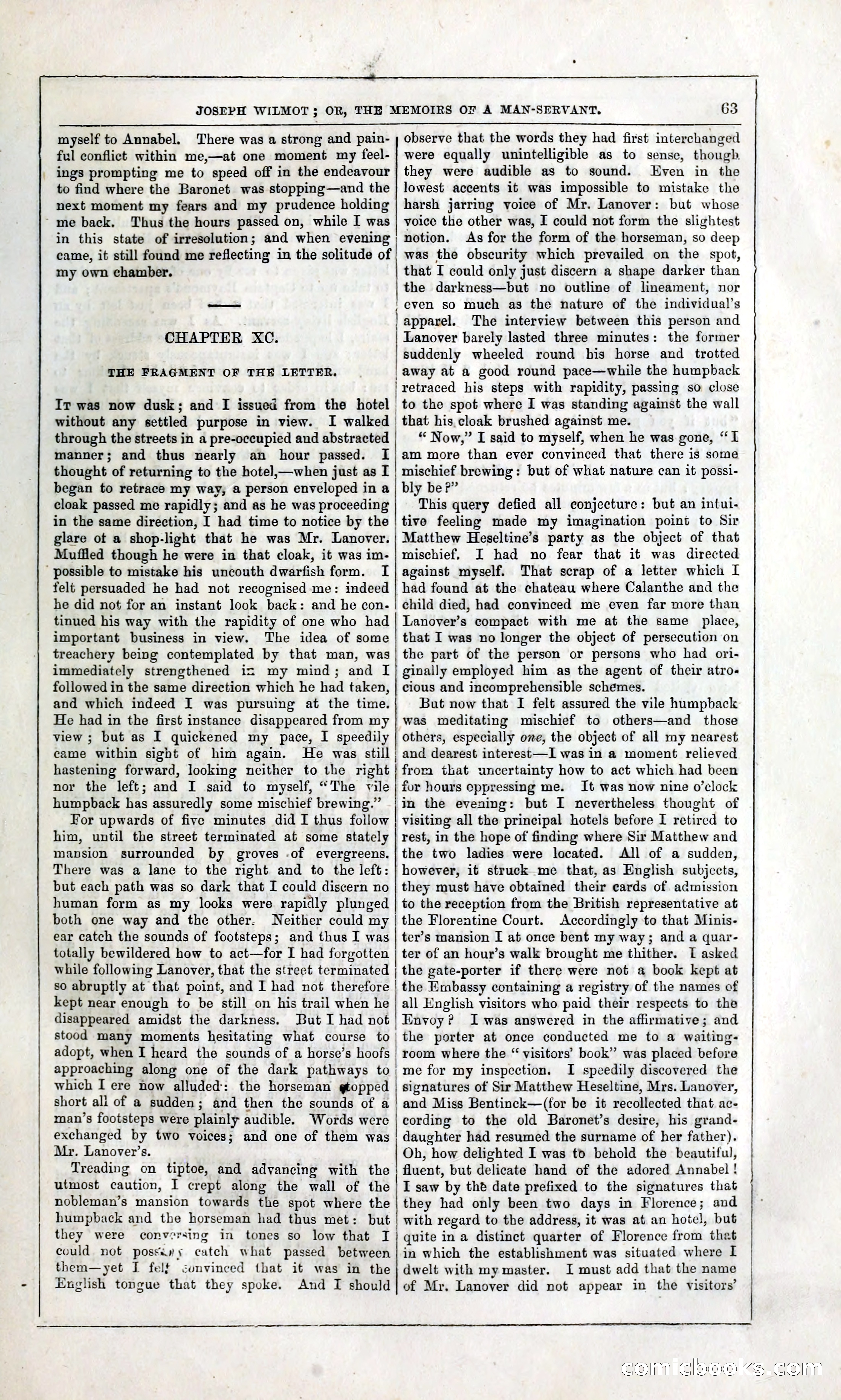
A restored page from Penny Dreadfuls, 1854. Page through the whole issue in the reader above.
📄 Transcribed text from this page (OCR, searchable)
Machine-transcribed from the original scan — historical spelling and the odd misread are preserved.
JOSEPH WILMOT; OR, THE MEMOIRS OF A MAN-SERVANT. myself to Annabel. There was a strong and pain- ful conflict within me,—at one moment my feel- ings prompting me to speed off in the endeavour to find where the Baronet was stopping—and the next moment my fears and my prudence holding ‘me back. Thus the hours passed on, while I was in this state of irresolution; and when evening came, it still found me reflecting in the solitude of my own chamber. ae CHAPTER XC. THE FRAGMENT OF THE LETTER. without any settled purpose in view. I walked through the streets in a pre-occupied and abstracted manner; and thus nearly an hour passed. I thought of returning to the hote],—when just as I began to retrace my way, a person enveloped in a cloak passed me rapidly; and as he was proceeding in the same direction, I had time to notice by the glare ot a shop-light that he was Mr. Lanover. Muffled though he were in that cloak, it was im- ‘possible to mistake his uncouth dwarfish form. I felt persuaded he had not recognised me: indeed he did not for an instant look back: and he con- tinued his way with the rapidity of one who had important business in view. The idea of some treachery being contemplated by that man, was immediately strengthened iz my mind; and I followed in the same direction which he had taken, and which indeed I was pursuing at the time. He had in the first instance disappeared from my view ; but as I quickened my pace, I speedily came within sight of him again. He was still 63 observe that the words they had first interchanged were equally unintelligible as to sense, though they were audible as to sound. Even in the lowest accents it was impossible to mistake the harsh jarring voice of Mr. Lanover: but whose voice the other was, I could not form the slightest notion. As for the form of the horseman, so deep was the obscurity which prevailed on the spot, that I could only just discern a shape darker than the darkness—but no outline of lineament, nor ! even so much as the nature of the individual’s | apparel. The interview between this person and Lanover barely lasted three minutes: the former suddenly wheeled round his horse and trotted away at a good round pace—while the humpback 'retraced his steps with rapidity, passing so close Ir was now dusk; and I issued from the hotel | to the spot where I was standing against the wall that his,cloak brushed against me. * Now,” I said to myself, when he was gone, “1 am more than ever convinced that there is some mischief brewing: but of what nature can it possi- bly be?” This query defied all conjecture: but an intui- tive feeling made my imagination point to Sir Matthew Heseltine’s party as the object of that mischief, I had no fear that it was directed against myself. That scrap of a letter which I had found at the chateau where Calanthe and the child died, had convinced me even far more than Lanover’s compact with me at the same place, that I was no longer the object of persecution on the part of the person or persons who had ori- ginally employed him as the agent of their atro- cious and incomprehensible schemes. But now that I felt assured the vile humpback was meditating mischief to others—and those others, especially one, the object of all my nearest and dearest interest—I was in a moment relieved hastening forward, looking neither to the right} from that uncertainty how to act which had been nor the left; and I said to myself, “The vile humpback has assuredly some mischief brewing.” For upwards of five minutes did I thus follow him, until the street terminated at some stately mansion surrounded by groves .of evergreens. There was a lane to the right and to the left: but each path was so dark that I could discern no human form as my looks were rapidly plunged both one way and the other. Neither could my ear catch the sounds of footsteps; and thus I was totally bewildered how to act—for I had forgotten for hours oppressing me. It was now nine o’clock in the evening: but I nevertheless thought of visiting all the principal hotels before I retired to rest, in the hope of finding where Sir Matthew and the two ladies were located. All of a sudden, however, it struck me that, as English subjects, they must have obtained their cards of admission to the reception from the British representative at the Florentine Court. Accordingly to that Minis- ter’s mansion I at once bent my way; and a quar- ter of an hour’s walk brought me thither. L asked while following Lanover, that the street terminated | the gate-porter if there were not a book kept at so abruptly at that point, and I had not therefore | the Embassy containing a registry of the names of kept near enough to be still on his trail when he | all English visitors who paid their respects to the disappeared amidst the darkness. But I had not| Envoy? I was answered in the affirmative; and stood many moments hesitating what course to| the porter at once conducted me to a waiting- adopt, when I heard the sounds of a horse’s hoofs | room where the “ visitors’ book” was placed before approaching along one of the dark pathways to which I ere now alluded: the horseman gtopped short ali of a sudden; and then the sounds of a man’s footsteps were plainly audible. "Words were exchanged by two voices; and one of them was Mr. Lanover’s. Treading on tiptoe, and advancing with the utmost caution, I crept along the wall of the nobleman’s mansion towards the spot where the humpback and the horseman had thus met: but they were conversing in tones so low that I could not poss»; catch what passed between them—yet I felf convinced that it was in the English tongue that they spoke. And I should me for my inspection. I speedily discovered the signatures of Sir Matthew Heseltine, Mrs. Lanover, and Miss Bentinck—(for be it recollected that ac- cording to the old Baronet’s desire, his grand- daughter had resumed the surname of her father). Oh, how delighted I was to behold the beautiful, fluent, but delicate hand of the adored Annabel! I saw by the date prefixed to the signatures that they had only been two days in Florence; and with regard to the address, it was at an hotel, but quite in a distinct quarter of Florence from thet in which the establishment was situated where I dwelt with my master. I must add that the name of Mr. Lanover did not appear in the visitors’ Glyoo S (C@) im