
Penny Dreadfuls, 1854 · page 83 of 399
Joseph Wilmot, or, The Memoirs of a Man-Servant — page 83: what you’re looking at
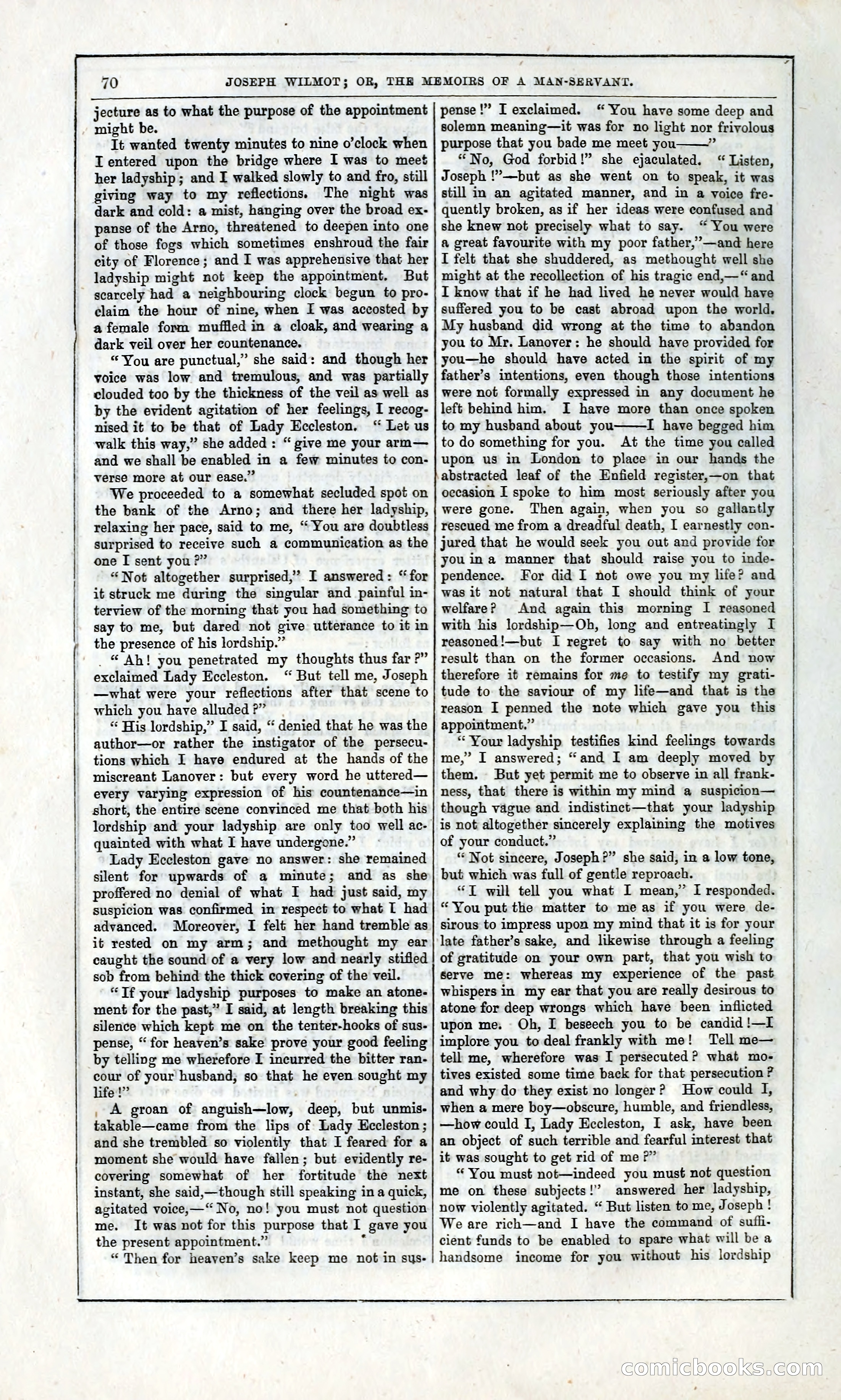
A restored page from Penny Dreadfuls, 1854. Page through the whole issue in the reader above.
📄 Transcribed text from this page (OCR, searchable)
Machine-transcribed from the original scan — historical spelling and the odd misread are preserved.
70 jecture as to what the purpose of the appointment might be. It wanted twenty minutes to nine o’clock when T entered upon the bridge where I was to meet her ladyship ; and I walked slowly to and fro, still giving way to my reflections. The night was dark and cold: a mist, hanging over the broad ex- panse of the Arno, threatened to deepen into one of those fogs which sometimes enshroud the fair city of Florence; and I was apprehensive that her ladyship might not keep the appointment. But scarcely had a neighbouring clock begun to pro- claim the hour of nine, when I was accosted by afemale form muffled in a cloak, and wearing a dark veil over her countenance. “You are punctual,” she said: and though her voice was low and tremulous, and was partially clouded too by the thickness of the veil as well as by the evident agitation of her feelings, I recog- nised it to be that of Lady Eccleston. “ Let us walk this way,” she added : “ give me your arm— and we shall be enabled in a few minutes to con- verse more at our ease.” We proceeded to a somewhat secluded spot on the bank of the Arno; and there her ladyship, relaxing her pace, said to me, “ You are doubtless surprised to receive such a communication as the one I sent you ?” “Not altogether surprised,’ I answered: “for it struck me during the singular and painful in- terview of the morning that you had something to say to me, but dared not give utterance to it in the presence of his lordship.” _ “ Ah! you penetrated my thoughts thus far ?” exclaimed Lady Eccleston. “ But tell me, Joseph —what were your reflections after that scene to which you have alluded P” “ His lordship,” I said, “ denied that he was the author—or rather the instigator of the persecu- tions which I have endured at the hands of the miscreant Lanover: but every word he uttered— every varying expression of his countenance—in short, the entire scene convinced me that both his lordship and your ladyship are only too well ac- quainted with what I have undergone.” Lady Eccleston gave no answer: she remained silent for upwards of a minute; and as she proffered no denial of what I had just said, my suspicion was confirmed in respect to what L had advanced. Moreover, I felt her hand tremble as it rested on my arm; and methought my ear caught the sound of a very low and nearly stifled sob from behind the thick covering of the veil. “Tf your ladyship purposes to make an atone- ment for the past,” I said, at length breaking this silence which kept me on the tenter-hooks of sus- pense, “for heaven’s sake prove your good feeling by telling me wherefore I incurred the bitter ran- cour of your husband, so that he even sought my life!” | _ A groan of anguish—low, deep, but unmis- takable—came from the lips of Lady Eccleston ; and she trembled so violently that I feared for a moment she would have fallen; but evidently re- covering somewhat of her fortitude the next instant, she said,—though still speaking in a quick, agitated voice,—“ No, no! you must not question me. It was not for this purpose that I gave you the present appointment.” y “ Then for heayen’s sake keep me not in sus- JOSEPH WILMOT; OR, THE MEMOIRS OF A MAN-SERVANT. pense!” T exclaimed. “You have some deep and solemn meaning—it was for no light nor frivolous purpose that you bade me meet you e “No, God forbid!” she ejaculated. “ Listen, Joseph !’—but as she went on to speak, it was still in an agitated manner, and in a voice fre- quently broken, as if her ideas were confused and she knew not precisely what to say. “ You were a great favourite with my poor father,’—and here I felt that she shuddered, as methought well she might at the recollection of his tragic end,—“ and I know that if he had lived he never would have suffered you to be cast abroad upon the world. My husband did wrong at the time to abandon you to Mr. Lanover: he should have provided for you—he should have acted in the spirit of my father’s intentions, even though those intentions were not formally expressed in any document he left behind him. I have more than once spoken to my husband about you I have begged him to do something for you. At the time you called upon us in London to place in our hands the abstracted leaf of the Enfield register,—on that occasion I spoke to him most seriously after you were gone. Then again, when you so gallantly rescued me from a dreadful death, I earnestly con- jured that he would seek you out and provide for you ina manner that should raise you to inde- pendence. For did I not owe you my life? and was it not natural that I should think of your welfare? And again this morning I reasoned with his lordship—Oh, long and entreatingly I reasoned!—but I regret to say with no better result than on the former occasions. And now therefore if remains for me to testify my grati- tude to the saviour of my life—and that is the reason I penned the note which gave you this appointment.” “ Your ladyship testifies kind feelings towards me,” I answered; “and I am deeply moved by them. But yet permit me to observe in all frank- ness, that there is within my mind a suspicion— though vague and indistinct—that your ladyship is not altogether sincerely explaining the motives of your conduct.” “ Not sincere, Joseph?” she said, in a low tone, but which was full of gentle reproach. “TI will tell you what I mean,” I responded. “You put the matter to meas if you were de- sirous to impress upon my mind that it is for your late father’s sake, and likewise through a feeling of gratitude on your own part, that you wish to Serve me: whereas my experience of the past whispers in my ear that you are really desirous to atone for deep wrongs which have been inflicted upon me. Oh, I beseech you to be candid !—I implore you to deal frankly with me! Tell me— tell me, wherefore was I persecuted? what mo- tives existed some time back for that persecution ? and why do they exist no longer? How could I, when a mere boy—obscure, humble, and friendless, —how could I, Lady Eccleston, I ask, have been an object of such terrible and fearful interest that it was sought to get rid of me P” “ You must not—indeed you must not question me on these subjects!’ answered her ladyship, now violently agitated. “ But listen to me, Joseph! We are rich—and I have the command of sufii- cient funds to be enabled to spare what will be a handsome income for you without his lordship —_— S (CO) ELONOO