
Penny Dreadfuls, 1854 · page 85 of 399
Joseph Wilmot, or, The Memoirs of a Man-Servant — page 85: what you’re looking at
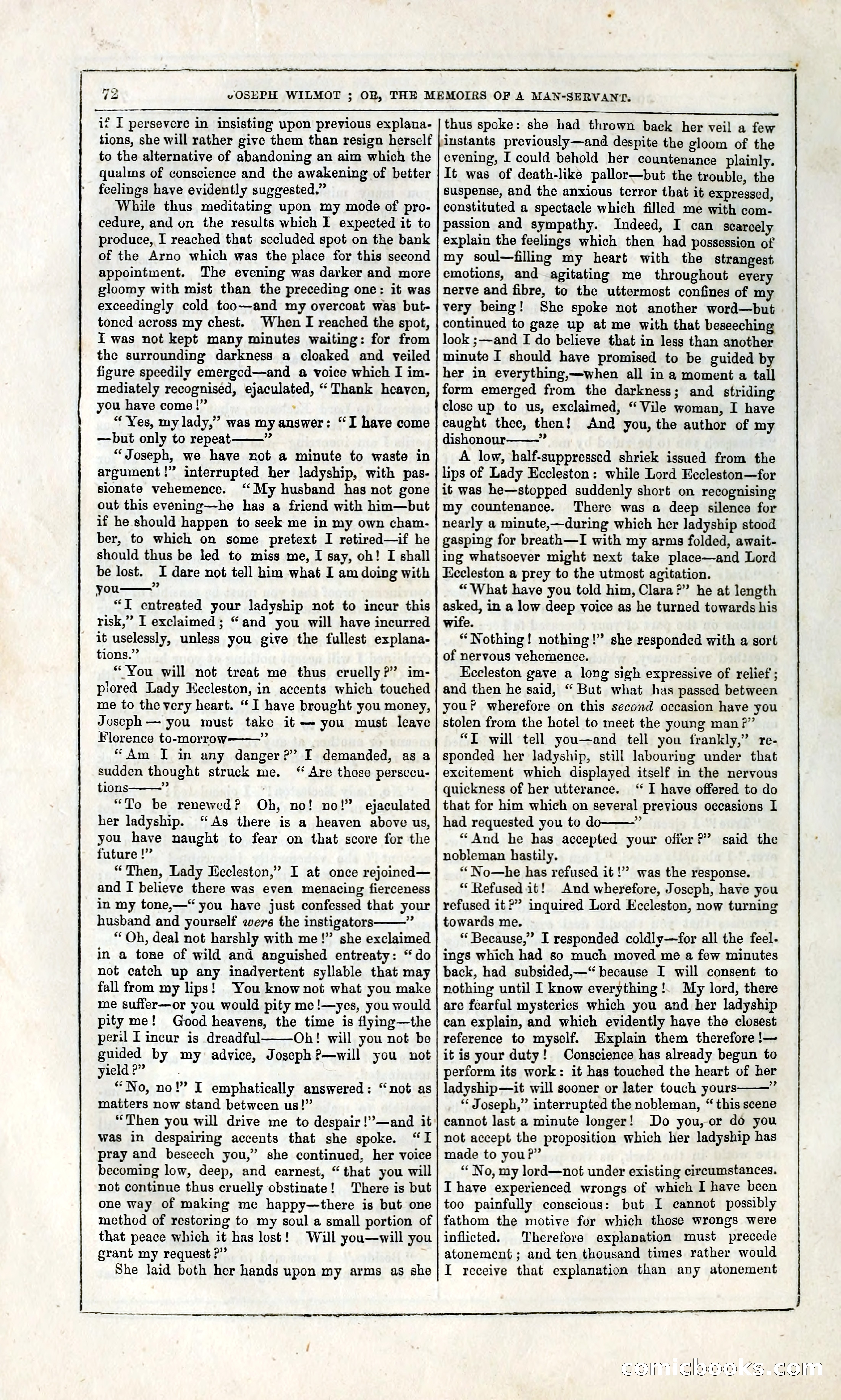
A restored page from Penny Dreadfuls, 1854. Page through the whole issue in the reader above.
📄 Transcribed text from this page (OCR, searchable)
Machine-transcribed from the original scan — historical spelling and the odd misread are preserved.
ae 2 vOSEPH WILMOT ; OB, THE MEMOIRS OF A MAN-SERVANT. Sn A OS EL a a wee eee ea eye mage eam me mm ieee a een eee if I persevere in insisting upon previous explana- tions, she will rather give them than resign herself to the alternative of abandoning an aim which the qualms of conscience and the awakening of better feelings have evidently suggested.” While thus meditating upon my mode of pro- cedure, and on the results which I expected it to produce, I reached that secluded spot on the bank of the Arno which was the place for this second appointment. The evening was darker and more gloomy with mist than the preceding one: it was exceedingly cold too—and my overcoat was but- toned across my chest. When I reached the spot, I was not kept many minutes waiting: for from the surrounding darkness a cloaked and veiled figure speedily emerged—and a voice which I im- mediately recognised, ejaculated, “ Thank heaven, you have come!” , “Yes, my lady,”’ was my answer: “I have come —but only to repeat #4 “Joseph, we have not a minute to waste in argument!” interrupted her ladyship, with pas- sionate vehemence. ‘My husband has not gone out this evening—he has a friend with himn—but if he should happen to seek me in my own cham- ber, to which on some pretext I retired—if he should thus be led to miss me, I say, oh! I shall be lost. I dare not tell him what I am doing with you 3? “T entreated your ladyship not to incur this risk,” I exclaimed; “and you will have incurred it uselessly, unless you give the fullest explana- tions.” “You will not treat me thus cruelly?” im- plored Lady Eccleston, in accents which touched me to the very heart. “I have brought you money, Joseph — you must take it — you must leave Florence to-morrow 7 “Am I in any danger?’ I demanded, as a sudden thought struck me. “ Are those persecu- tions ” . “To be renewed? Oh, no! no!” ejaculated her ladyship. ‘As there is a heaven above us, you have naught to fear on that score for the future !” “Then, Lady Eccleston,’ I at once rejoined— and I believe there was even menacing fierceness in my tone,—“ you have just confessed that your husband and yourself were the instigators ‘ “Oh, deal not harshly with me!” she exclaimed in a tone of wild and anguished entreaty: “do not catch up any inadvertent syllable that may fall from my lips! ‘You know not what you make me suffer—or you would pity me !—yes, you would pity me! Good heavens, the time is flying—the peril I incur is dreadful Oh! will you not be guided by my advice, Joseph?—will you not yield ?” “No, no!’ I emphatically answered: “not as matters now stand between us!” “Then you will drive me to despair!”—and it was in despairing accents that she spoke. “I pray and beseech you,” she continued, her voice becoming low, deep, and earnest, “that you will not continue thus cruelly obstinate! There is but one way of making me happy—there is but one method of restoring to my soul a small portion of that peace which it has lost! Will you—will you grant my request?” She laid both her hands upon my arms as she thus spoke: she had thrown back her veil a few instants previously—and despite the gloom of the evening, [ could behold her countenance plainly. It was of death-like pallor—but the trouble, the suspense, and the anxious terror that it expressed, constituted a spectacle which filled me with com- passion and sympathy. Indeed, I can scarcely explain the feelings which then had possession of my soul—filling my heart with the strangest emotions, and agitating me throughout every nerve and fibre, to the uttermost confines of my very being! She spoke not another word—but continued to gaze up at me with that beseeching look ;—and I do believe that in less than another minute I should have promised to be guided by her in everything,—when all in a moment a tall form emerged from the darkness; and striding close up to us, exclaimed, “ Vile woman, I have caught thee, then! And you, the author of my dishonour 4 A low, half-suppressed shriek issued from the lips of Lady Eccleston: while Lord Eccleston—for it was he—stopped suddenly short on recognising my countenance. There was a deep silence for nearly a minute,—during which her ladyship stood gasping for breath—I with my arms folded, await- ing whatsoever might next take place—and Lord Eccleston a prey to the utmost agitation. “What have you told him, Clara?” he at length asked, in a low deep voice as he turned towards his wife. “Nothing! nothing!” she responded with a sort of nervous vehemence. Eccleston gave a long sigh expressive of relief ; and then he said, “ But what has passed between you? wherefore on this second occasion have you stolen from the hotel to meet the young man?” “JT will tell you—and tell you frankly,” re- sponded her ladyship, still labouring under that excitement which displayed itself in the nervous quickness of her utterance. ‘I have offered to do that for him which on several previous occasions I had requested you to do——” ““And he has accepted your ofier?”’ said the nobleman hastily. “No—he has refused it!” was the response. “Refused it! And wherefore, Joseph, have you refused it ?” inquired Lord Eccleston, now turning towards me. Because,’ I responded coldly—for all the feel- ings which had so much moved me a few minutes back, had subsided,—“ because I will consent to nothing until I know everything !. My lord, there are fearful mysteries which you and her ladyship can explain, and which evidently have the closest reference to myself. Explain them therefore !— it is your duty! Conscience has already begun to perform its work: it has touched the heart of her ladyship—it will sooner or later touch yours a “‘ Joseph,” interrupted the nobleman, “ this scene cannot last a minute longer! Do you, or do you not accept the proposition which her ladyship has made to you?” “ No, my lord—not under existing circumstances. I have experienced wrongs of which I have been too painfully conscious: but I cannot possibly fathom the motive for which those wrongs were inflicted. Therefore explanation must precede atonement ; and ten thousand times rather would I receive that explanation than any atonement Goals (Cc)