
Penny Dreadfuls, 1854 · page 98 of 399
Joseph Wilmot, or, The Memoirs of a Man-Servant — page 98: what you’re looking at
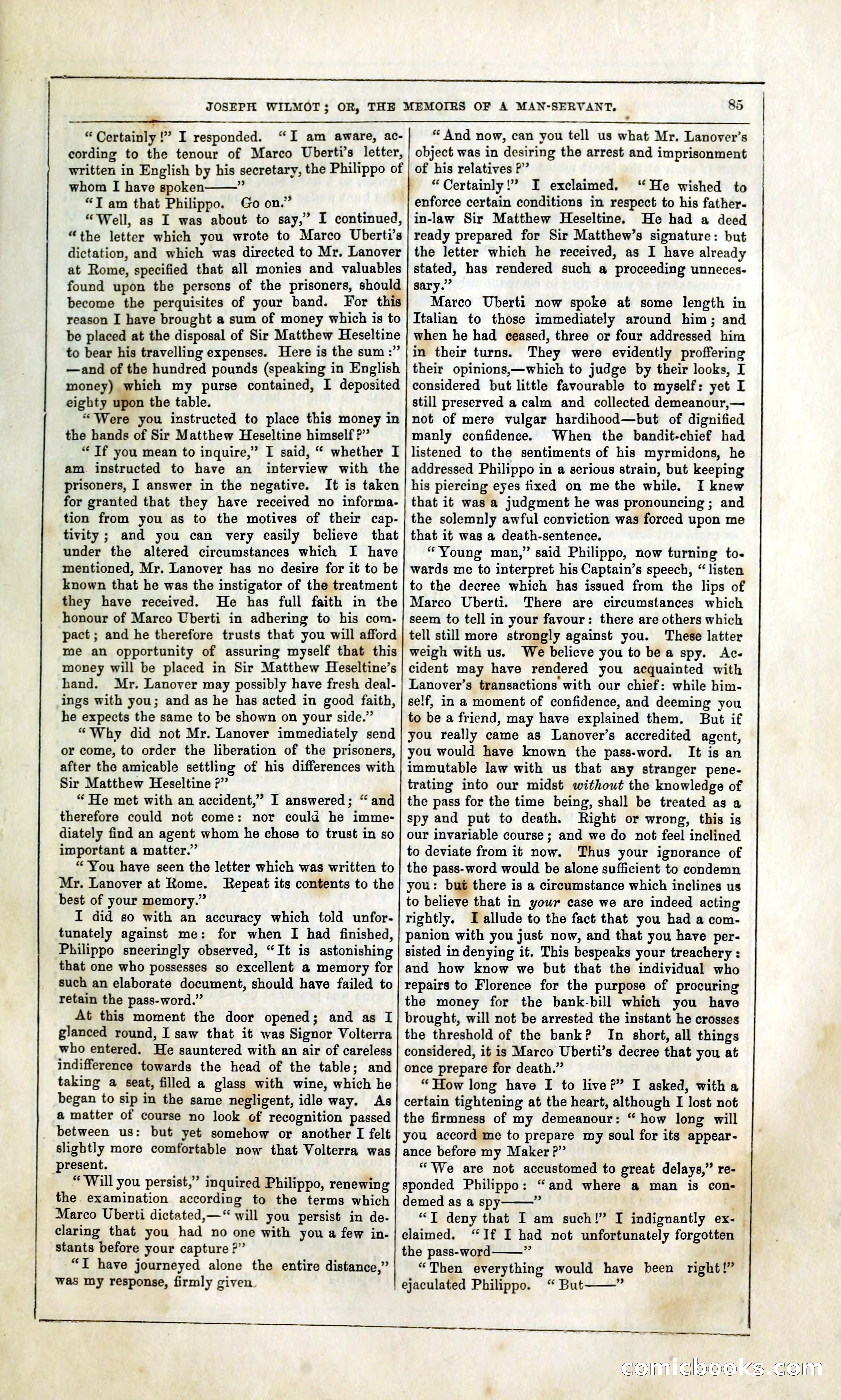
A restored page from Penny Dreadfuls, 1854. Page through the whole issue in the reader above.
📄 Transcribed text from this page (OCR, searchable)
Machine-transcribed from the original scan — historical spelling and the odd misread are preserved.
LLL ALLL AL ee JOSEPH WILMOT; OR, THE MEMOIRS OF A MAN-SERVANT, 85 “Certainly!” I responded. “I am aware, ac- cording to the tenour of Marco Uberti’s letter, written in English by his secretary, the Philippo of whom I have spoken “T am that Philippo. Go on.” “Well, as I was about to say,” I continued, “the letter which you wrote to Marco Uberti’s dictation, and which was directed to Mr. Lanover at Rome, specified that all monies and valuables found upon the persens of the prisoners, should become the perquisites of your band. For this reason I have brought a sum of money which is to be placed at the disposal of Sir Matthew Heseltine to bear his travelling expenses. Here is the sum :” —and of the hundred pounds (speaking in English money) which my purse contained, I deposited eighty upon the table. “Were you instructed to place this money in the hands of Sir Matthew Heseltine himself?” “‘ If you mean to inquire,” I said, “ whether I am. instructed to have an interview with the prisoners, I answer in the negative. It is taken for granted that they have received no informa- tion from you as to the motives of their cap- tivity; and you can very easily believe that under the altered circumstances which I have mentioned, Mr. Lanover has no desire for it to be known that he was the instigator of the treatment they have received. He has full faith in the honour of Marco Uberti in adhering to his com. pact ; and he therefore trusts that you will afford me an opportunity of assuring myself that this money will be placed in Sir Matthew Heseltine’s hand. Mr. Lanover may possibly have fresh deal- ings with you; and as he has acted in good faith, he expects the same to be shown on your side.” “Why did not Mr. Lanover immediately send or come, to order the liberation of the prisoners, after the amicable settling of his differences with Sir Matthew Heseltine ?” “ He met with an accident,” I answered; “and therefore could not come: nor could he imme- diately find an agent whom he chose to trust in so important a matter.” “You have seen the letter which was written to Mr. Lanover at Rome. Repeat its contents to the best of your memory.” I did so with an accuracy which told unfor- tunately against me: for when I had finished, Philippo sneeringly observed, “It is astonishing that one who possesses so excellent a memory for such an elaborate document, should have failed to retain the pass-word.” At this moment the door opened; and as I glanced round, I saw that it was Signor Volterra who entered. He sauntered with an air of careless indifference towards the head of the table; and taking a seat, filled a glass with wine, which he began to sip in the same negligent, idle way. As a matter of course no look of recognition passed _ between us: but yet somehow or another I felt slightly more comfortable now that Volterra was present. “Will you persist,” inquired Philippo, renewing the examination according to the terms which Marco Uberti dictated,—“ will you persist in de. claring that you had no one with you a few in. stants before your capture ?” “TI have journeyed alone the entire distance,” was my response, firmly given. a in their turns. their opinions,—which to judge by their looks, I manly confidence. listened to the sentiments of his myrmidons, he tell still more strongly against you. “ And now, can you tell us what Mr. Lanover’s object was in desiring the arrest and imprisonment of his relatives ?” “Certainly!” I exclaimed. ‘He wished to enforce certain conditions in respect to his father- in-law Sir Matthew Heseltine. ready prepared for Sir Matthew’s signature: but He had a deed the letter which he received, as I have already stated, has rendered such a proceeding unneces- sary.” Marco Uberti now spoke at some length in Italian to those immediately around him; and when he had ceased, three or four addressed him They were evidently proffering considered but little favourable to myself: yet I still preserved a calm and collected demeanour,— not of mere vulgar hardihood—but of dignified When the bandit-chief had addressed Philippo in a serious strain, but keeping his piercing eyes fixed on me the while. I knew that it was a judgment he was pronouncing ; and the solemnly awful conviction was forced upon me that it was a death-sentence. “Young man,” said Philippo, now turning to- wards me to interpret his Captain’s speech, “ listen to the decree which has issued from the lips of Marco Uberti. There are circumstances which seem to tell in your favour: there are others which These latter weigh with us. We believe you to bea spy. Ac- cident may have rendered you acquainted with Lanover’s transactions with our chief: while him- self, in a moment of confidence, and deeming you to be a friend, may have explained them. But if you really came as Lanover’s accredited agent, you would have known the pass-word. It is an immutable law with us that any stranger pene- trating into our midst without the knowledge of the pass for the time being, shall be treated as a spy and put to death. Right or wrong, this is our invariable course ; and we do not feel inclined to deviate from it now. Thus your ignorance of the pass-word would be alone sufficient to condemn you: but there is a circumstance which inclines us to believe that in your case we are indeed acting rightly. I allude to the fact that you had a com- panion with you just now, and that you have per- sisted in denying it. This bespeaks your treachery : and how know we but that the individual who repairs to Florence for the purpose of procuring the money for the bank-bill which you have brought, will not be arrested the instant he crosses the threshold of the bank? In short, all things considered, it is Marco Uberti’s decree that you at once prepare for death.” “ How long have I to live?” I asked, with a certain tightening at the heart, although I lost not the firmness of my demeanour: “ how long will you accord me to prepare my soul for its appear- ance before my Maker ?” “We are not accustomed to great delays,” re- sponded Philippo: “and where a man is con- demed as a spy (2 “T deny that I am such!” I indignantly ex- “Tf I had not unfortunately forgotten 33 claimed. the pass-word “Then everything would have been right!” ejaculated Philippo. “ But——” Gloo SS (©)