
Penny Dreadfuls, 1901 · page 31 of 37
Marion Marlowe in Chicago, or, Trapped by a Lunatic — page 31: what you’re looking at
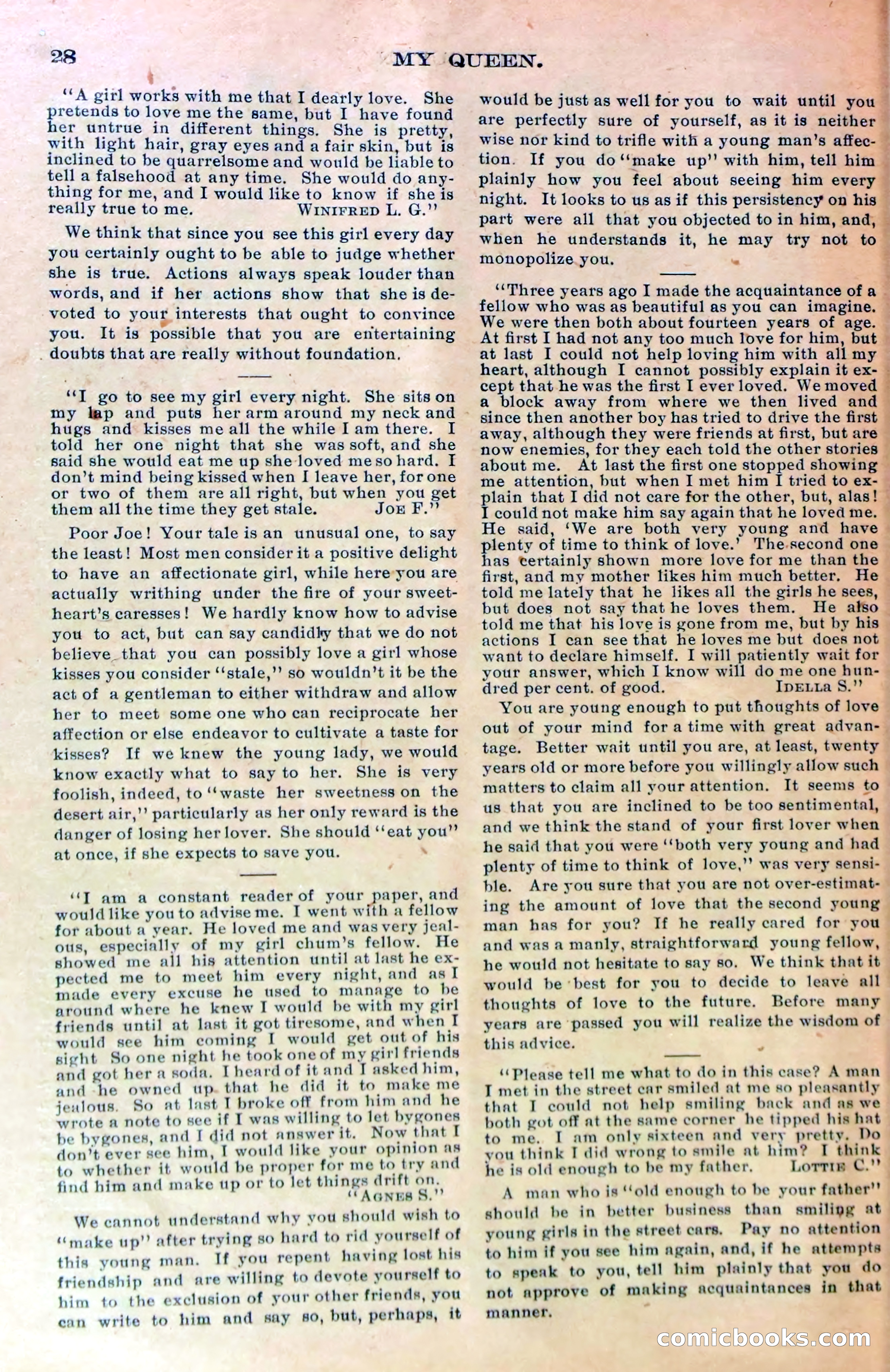
A restored page from Penny Dreadfuls, 1901. Page through the whole issue in the reader above.
📄 Transcribed text from this page (OCR, searchable)
Machine-transcribed from the original scan — historical spelling and the odd misread are preserved.
28 ‘‘A girl works with me that I dearly love. She pretends to love me the same, but I have found her untrue in different things. She is pretty, with light hair, gray eyes and a fair skin, but is inclined to be quarrelsome and would be liable to tell a falsehood at any time. She would do any- thing for me, and I would like to know if she is really true to me. WINIFRED L. G.”’ We think that since you see this girl every day you certainly ought to be able to judge whether she is true. Actions always speak louder than words, and if her actions show that she is de- voted to your interests that ought to convince you. It is possible that you are entertaining _ doubts that are really without foundation, ‘‘T go to see my girl every night. She sits on my lap and puts herarm around my neck and - hugs and kisses me all the while lam there. I told her one night that she was soft, and she said she would eat me up she loved meso hard. I don’t mind being kissed when I leave her, forone or two of them are all right, but when you get them all the time they get stale. Jon F.” Poor Joe! Your tale is an unusual one, to say the least! Most men consider it a positive delight to have an affectionate girl, while here-yyou are actually writhing under the fire of your sweet- heart’s caresses! We hardly know how to advise you to act, but can say candidky that we do not believe that you can possibly love a girl whose kisses you consider ‘‘stale,’’ so wouldn’t it be the act of a gentleman to either withdraw and allow her to meet some one who can reciprocate her affection or else endeavor to cultivate a taste for kisses? If we knew the young lady, we would know exactly what to say to her. She is very foolish, indeed, to ‘‘waste her sweetness on the desert air,’’ particularly as her only reward is the danger of losing her lover. She should ‘‘eat you” at once, if she expects to save you. . “T am a constant reader of your paper, and wouldlike you to advise me. I went with a fellow for about a year. He loved me and was very jeal- ous, especially of my girl chum’s fellow. He showed me all his attention until at last he ex- pected me to meet him every night, and as I made every excuse he used to manage to be around where he knew I would be with my girl friends until at last it got tiresome, and when I would see him coming I would get out of his sight So one night he took one of my girl friends and got her a soda, [heard of it and I asked him, and he owned up. that he did it to make me jenlous. So at last I broke off from him and he wrote a note to see if I was willing to let bygones be bygones, and I did not answer it. Now that I don’t ever see him, I would like your opinion as to whether it would be proper for me to try and find him and make up or to let things drift on. ‘AGNES 8.” We cannot understand why you should wish to “make up’ after trying so hard to rid yourself of this voung man. If you repent having lost his friendship and are willing to devote yourself to him to the exclusion of your other friends, you can write to him and say 80, but, perhaps, it “MY QUEEN. would be just as well for you to wait until you are perfectly sure of yourself, as it is neither wise nor kind to trifle with a young man’s affec- tion. If you do‘‘make up’’ with him, tell him plainly how you feel about seeing him every night. It looks to us asif this persistency on his part were all that you objected to in him, and, when he understands it, he may try not to monopolize you. ‘° “Three years ago I made the acquaintance ofa fellow who was as beautiful as you can imagine. We were then both about fourteen years of age. At first I had not any too much love for him, but : at last I could not help loving him with all my heart, although I cannot possibly explain it ex- cept that he was the first I ever loved. We moved a block away from where we then lived and since then another boy has tried to drive the first away, although they were friends at first, but are now enemies, for they each told the other stories about me. At last the first one stopped showing > me attention, but when I met him I tried to ex- plain that I did not care for the other, but, alas! I could not make him say again that he loved me. He said, ‘We are both very young and have plenty of time to think of love.’ The.second one has certainly shown more love for me than the first, and my mother likes him much better. He told me lately that he likes all the girls he sees, but does not say that he loves them. He also | told me that his love is gone from me, but by his actions I can see that he loves me but does not want to declare himself. I will patiently wait for your answer, which I know will do me one hun-_ dred per cent. of good. IpDELLa S."” You are young enough to put thoughts of love ~ out of your mind fora time with great we tage. Better wait until you are, at least, twenty years old or more before you willingly allow such ~ matters to claim all your attention. It seems to- us that you are inclined to be too sentimental, — and we think the stand of your first lover when — he said that you were ‘‘both very young and had ~ plenty of time to think of love,’’ was very sensi-— ble. Are you sure that you are not over-estimat-— ing the amount of love that the second young} man has for you? If he really cared for you and was a manly, straightforward young fellow, he would not hesitate to say so. We think thatit would be best for you to decide to leave all” thoughts of love to the future. Before many — years are passed you will realize the wisdom of this advice. : | ‘(Please tell me what to do in this case? A man | I met in the street car smiled at me so pleasantly | that I could not help smiling back and as we — both got off at the same corner he tipped his hat_ to me. I am only sixteen and very pretty, Do- vou think I did wrong to smile at him? T think | he is old enough to be my father, Lortig C.'? A man who is “old enough to be your father” should be in better business than smilipg at young girls in the street cars, Pay no attention to him if you see him again, and, if he west Lp to speak to you, tell him plainly that you do- not approve of making acquaintances in that— manner, EComicbooks.com ‘