
Penny Dreadfuls, 1901 · page 28 of 38
Marion Marlowe in St. Paul, or, The Company's Mascot in a Double Deal — page 28: what you’re looking at
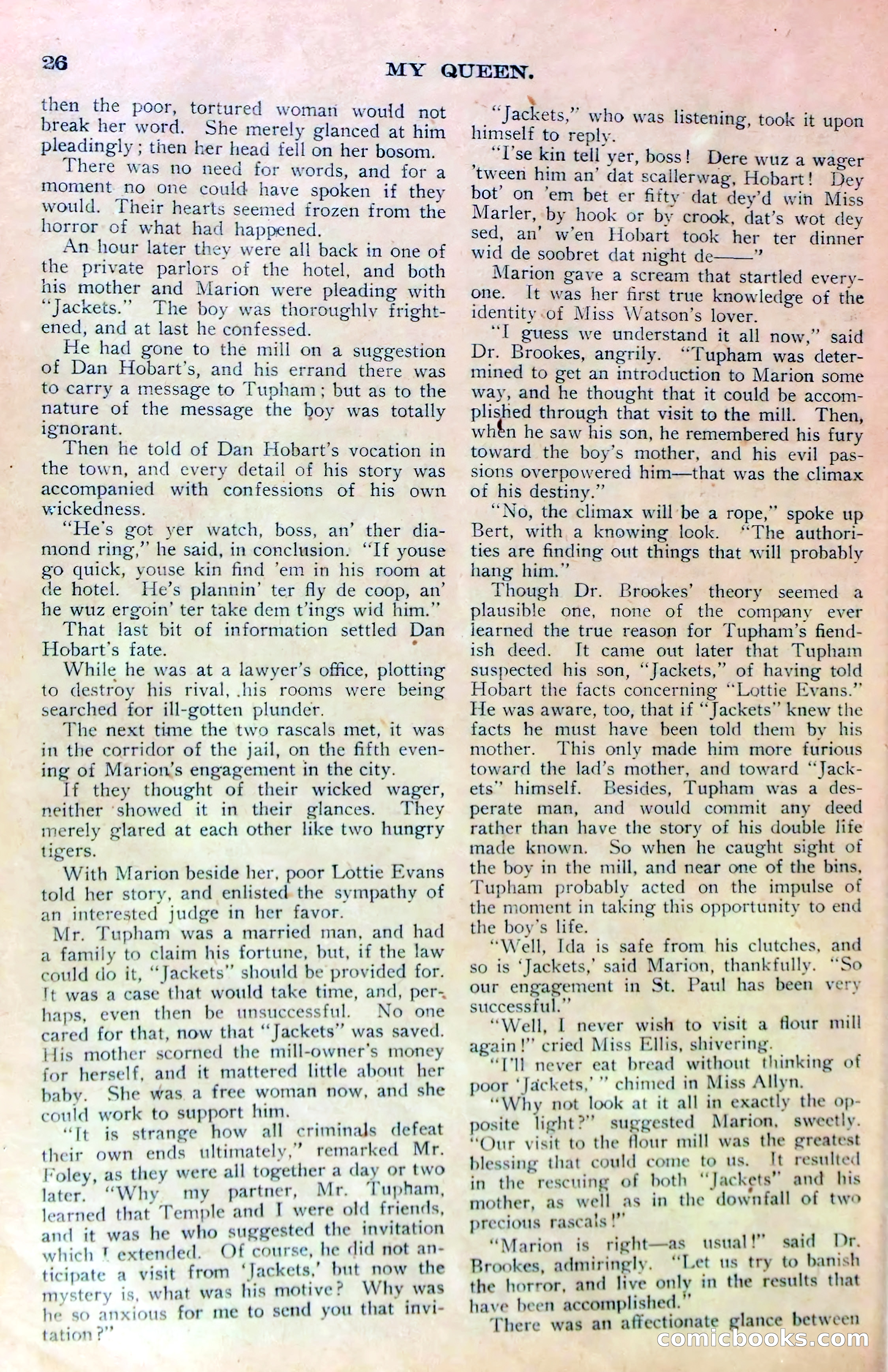
A restored page from Penny Dreadfuls, 1901. Page through the whole issue in the reader above.
📄 Transcribed text from this page (OCR, searchable)
Machine-transcribed from the original scan — historical spelling and the odd misread are preserved.
26 then the poor, tortured woman would not break her word. She merely glanced at him pleadingly ; then her head fell on her bosom. There was no need for words, and for a moment no one could have spoken if they would. Their hearts seemed frozen from the horror of what had happened. An hour later they were all back in one of the private parlors of the hotel, and both nis mother and Marion were pleading with “Jackets.” The boy was thoroughly fright- ened, and at last he confessed. | He had gone to the mill on a suggestion of Dan Hobart’s, and his errand there was to carry a message to Tupham; but as to the nature of the message the hoy was totally ignorant. Then he told of Dan Hobart’s vocation in the town, and every detail of his story was accompanied with confessions of his own wickedness. “He's got yer watch, boss, an’ ther dia- mond ring,”’ he said, in conclusion. “If youse go quick, youse kin find ‘em in his room at de hotel. He’s plannin’ ter fly de coop, an’ he wuz ergoin’ ter take dem t’ings wid him.” That last bit of information settled Dan Hobart’s fate. r While he was at a lawyer’s office, plotting to destroy his rival, .his rooms were being searched for ill-gotten plunder. The next time the two rascals met, it was in the corridor of the jail, on the fifth even- ing of Marion’s engagement in the city. If they thought of their wicked wager, neither ‘showed it in their glances. They merely glared at each other like two hungry tigers. With Marion beside her, poor Lottie Evans told her story, and enlisted the sympathy of an interested judge in her favor. Mr. Tupham was a married man, and had a family to claim his fortune, but, if the law could do it, “Jackets” should be provided for. lt was a case that would take time, and, per-~ haps, even then be unsuccessful. No one cared for that, now that “Jackets” was saved. iis mother scorned the mill-owner’s money for herself, and it mattered little about her habv. She was a free woman now, and she could work to support him. “Tt is strange how all criminals defeat their own ends ultimately,” remarked Mr. Foley, as they were all together a day or two later. “Why my partner, Mr. Tupham, learned that Temple and I were old friends, and it was he who suggested the invitation which ' extended. Of course, he did not an- ticipate a visit from ‘Jackets,’ but now the mystery is, what was his motive? Why was he so anxious for me to send you that invi- tation p”” MY QUEEN. eh _ “Jackets,” who was listening, himself to reply. _ tse kin tell yer, boss!’ Dere wuz a wager tween him an’ dat scallerwag, Hobart! Dey bot’ on ’em bet er hity dat dey’d win Miss Marler, by hook or by crook, dat’s wot dey sed, an’ w’en Hobart took her ter dinner wid de soobret dat night de——” Marion gave a scream that startled every- one. It was her first true knowledge of the identity.of Miss Watson’s lover. , “I guess we understand it all now,” said Dr. Brookes, angrily. “Tupham was deter- mined to get an introduction to Marion some way, and he thought that it could be accom- plished through that visit to the mill. Then, when he saw his son, he remembered his fury toward the boy’s mother, and his evil pas- sions overpowered him—that was the climax ot his destiny.” “No, the climax willbe a rope,” spoke up Bert, with a knowing look. “The authori- ties are finding out things that will probably hang him.” Though Dr. Brookes’ theory seemed a plausible one, none of the company ever learned the true reason for Lupham’s fiend- ish deed. It came out later that Tupham suspected his son, “Jackets,” of having told Hobart the facts concerning “Lottie Evans.” He was aware, too, that if “Jackets” knew the facts he must have been told them by his mother. This only made him more furious toward the lad’s mother, and toward “Jack- ets’ himself. Besides, Tupham was a des- perate man, and would commit any deed rather than have the story of his double lite made known. So when he caught sight of the boy in the mill, and near one of the bins, Tupham probably acted on the impulse of the moment in taking this opportunity to end the boy’s life. | “Well, Ida is safe from his clutches, and so is ‘Jackets,’ said Marion, thankfully. “So our engagement in St. Paul has been very successful.” “Well, I never wish to visit a flour mill again!’ cried Miss Ellis, shivering. __ “T'll never eat bread without thinking of poor ‘Jackets,’ ’ chimed in Miss Allyn. “Why not look at it all in exactly the op- posite light?’ suggested Marion, sweetly. “Our visit to the flour mill was the greatest blessing that could come to us. It resulted in the rescuing of both “Jackets” and his mother, as well as in the downfall of two precious rascais |” “Marion is right—as usual!” said Dr. Brookes, admiringly. “Let us try to banish the horror, and live only in the results that have been accomplished.” There was an affectionate glance between GOMIIEDOOKS EGOmM took it upon ~ -"