
Penny Dreadfuls, 1900 · page 19 of 38
Marion Marlowe's Cleverness, or, Exposing a Bold Fraud — page 19: what you’re looking at
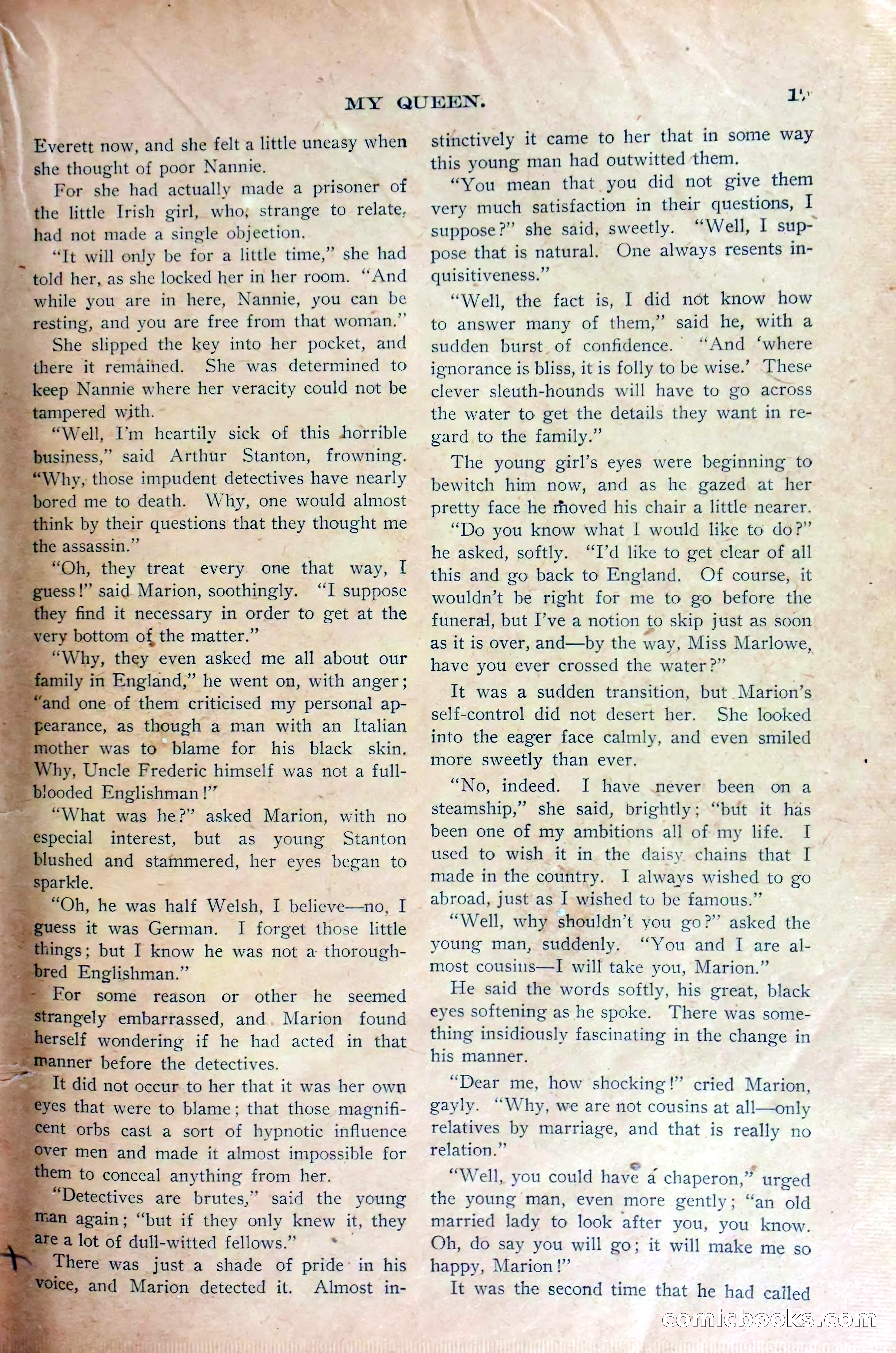
A restored page from Penny Dreadfuls, 1900. Page through the whole issue in the reader above.
📄 Transcribed text from this page (OCR, searchable)
Machine-transcribed from the original scan — historical spelling and the odd misread are preserved.
~ ; verett now, and she felt a little uneasy when she thought of poor Nannie. For she had actually made a prisoner of “te little Irish girl, who; strange to relate, 4 ad not made a single objection. _ “Tt will only be for a little time,” she had told her, as she locked her in her room. “And while you are in here, Nannie, you can be resting, and you are free from that woman.’ She slipped the key into her pocket, and the sre it remained. She was determined to eep Nannie where her veracity could not be / pered with. _ “Well, I’m heartily sick of this horrible usiness,” said Arthur Stanton, frowning. Why, those impudent detectives have nearly ored me to death. Why, one would almost ink by their questions that they thought me € assassin.” , they treat every one that way, I wot” said Marion, soothingly. “I suppose Gad it necessary in order to get at the ery bottom of the matter.” aa ay, they even asked me all about our mily England,” he went on, with anger; and one. of them criticised my personal ap- ear nce, as th ough a man with an Italian lo her was to~ blame for his black skin. fay, Uncle Frederic himself was not a full- a oded Englishman !’’ : “What was he?” asked Marion, with no especial interest, but as young Stanton lushed and stammered, her eyes began to parkle. ~ “Oh, he was half Welsh, I believe—no, I uess it was German. I forget those little ui gs; but I know he was not a thorough- ed Englishman.” : Hor some reason or other he seemed fangely embarrassed, and. Marion found erself wondering if he had acted in that =i “ nner before the detectives. It It did not occur to her that it was her own es that were to blame; that those magnifi- ay ‘orbs cast a sort of hypnotic influence r men ‘and made it almost impossible for lem to conceal anything from her. ~ ectives are brutes,’ said the young 1 again; “but if they only knew it, they a lot of dull-witted fellows.” * Th Here was just a shade of pride’ in his ced Marion detected it. Almost in- sae = ' eae “ wage > : ate 7 ; MY QUEEN. 1 stinctively it came to her that in some way this young man had outwitted them. “You mean that you did not give them very much satisfaction in their questions, if suppose?” she said, sweetly. “Well, I sup-. pose that is naresey One always resents in- quisitiveness.” “Well, the fact is, I did not Bhipw how to answer many of them,” said he, with a sudden burst. of confidence. Seon ‘where ignorance is bliss, it is folly to be wise.’ These clever sleuth-hounds will have to go across the water to get the details they want in re- gard to the family.” The young girl’s eyes were beginning to bewitch him now, and as he gazed at her pretty face he thoved his chair a little nearer. “Do you know what | would like to do?” he asked, softly. “I'd like to get clear of all this and go back to England. Of course, it wouldn’t be right for me to go before the funeral, but I’ve a notion to skip just as soon as it is over, and—by the way, Miss Marlowe, have you ever crossed the water?” It was a sudden transition, but Marion’s self-control did not desert her. She looked into the eager face calmly, and even | smiled more sweetly than ever. “No, indeed. I have never been on a steamship,” she said, brightly; “but it has been one of my ambitions all of my life. [ used to wish it in the daisy chains that I made in the country. I always wished to go abroad, just as I wished to be famous.” “Well, why shouldn’t you go?” asked the young man, suddenly. “You and [I are al- most cousins—I will take you, Marion.” He said the words softly, his great, black eyes softening as he spoke. There was some- thing insidiously fascinating in the change in his manner. “Dear me, how shocking!” cried Marion, gayly. “Why, we are not cousins at all—only relatives by marriage, and that is really no relation.” “Well, you could have a chaperon,” urged the young man, even more gently; “an old married lady to look after you, you know. Oh, do say you will go; it will make me so 49) happy, Marion! It was the second time that he had called EOMINIGIOOKS (CO) mn