
Penny Dreadfuls, 1900 · page 23 of 38
Marion Marlowe's Noble Work, or, The Tragedy at the Hospital — page 23: what you’re looking at
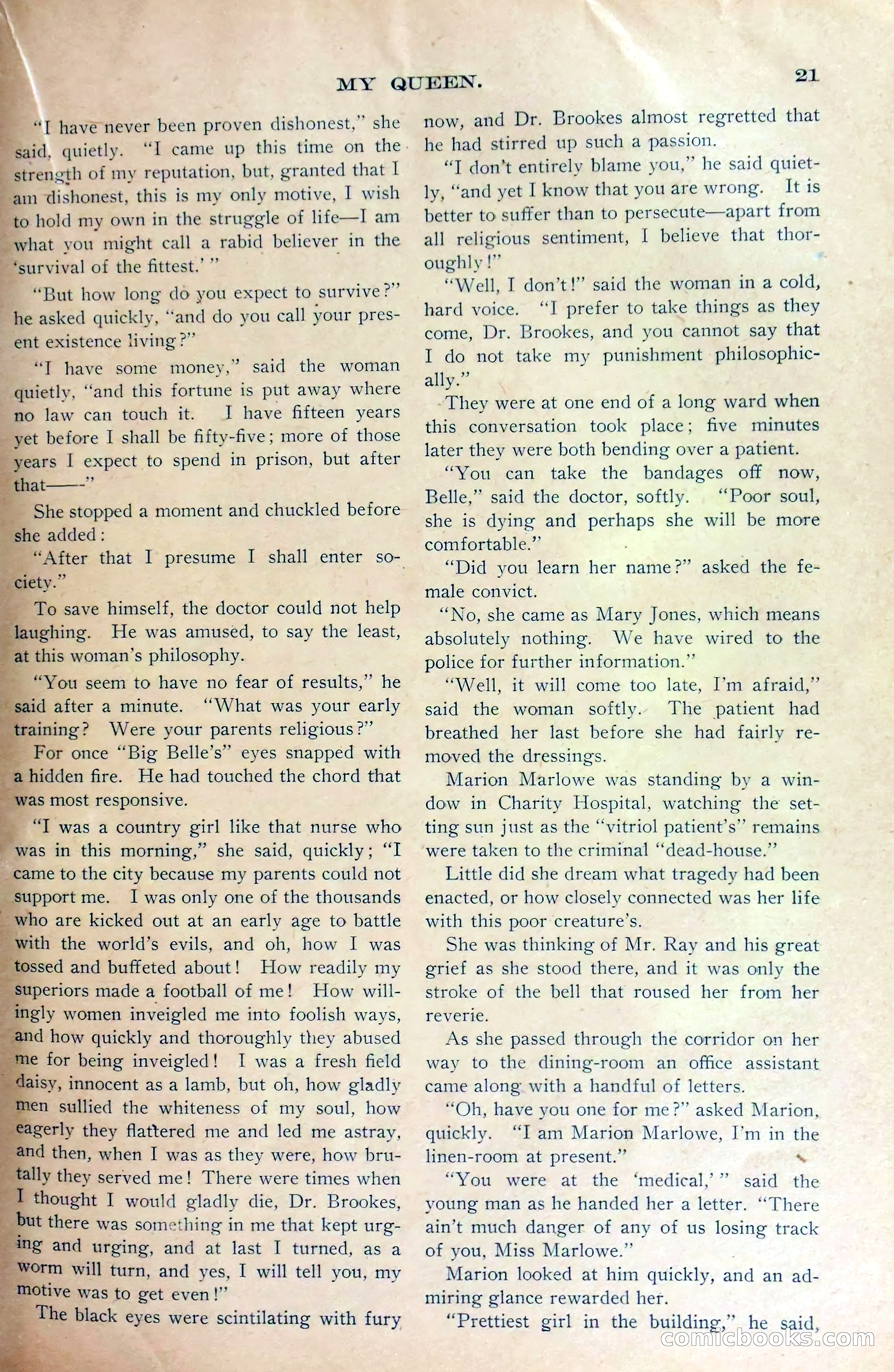
A restored page from Penny Dreadfuls, 1900. Page through the whole issue in the reader above.
📄 Transcribed text from this page (OCR, searchable)
Machine-transcribed from the original scan — historical spelling and the odd misread are preserved.
“I have never been proven dishonest,” she said, quietly. Birength of my reputation, but, granted that | am dishonest, this is my only motive, I wish to hold my own in the struggle of life—I am what you might call a rabid believer in the ‘survival of the fittest.’ ”’ ~ “But how long do you expect to survive 2 he asked quickly, ‘“‘and do you call your pres- ent existence living?” “T have some money,” said the woman - quietly, ‘‘and this fortune is put away where no law can touch it. I have fifteen years yet before I shall be fifty-five; more of those | “You: seem to have no fear of results,” he a after a minute. “What was your early rai Were your a religious ?” most responsive. _ “T was a country girl like that nurse who _was in this morning,” she said, quickly; “TI came to the city because my parents could not Support me. I was only one of the thousands who are kicked out at an early age to battle tossed and buffeted about! How readily my superiors made a football of me! How will- on and urging, and at last I turned, as a will turn, and yes, I will tell you, my MY QUEEN. “T came up this time on the. 21 now, and Dr. Brookes almost regretted that he had stirred up such a passion. “T don’t entirely blame you,” he said quiet- ly, “and yet I know that you are wrong. It is better to suffer than to persecute—apart from all religious sentiment, I believe that thor- oughly !” “Well, I don’t!” said the woman in a cold, hard voice. “I prefer to take things as they come, Dr. Brookes, and you cannot say that I do not take my punishment philosophic- ally.” -They were at one end of a long ward when this conversation took place; five minutes later they were both bending over a patient. “You can take the bandages off now, Belle,” said the doctor, softly. “Poor soul, she is dying and perhaps she will be more comfortable.” “Did you learn her name?” asked the fe- male convict. “No, she came as Mary Jones, which means absolutely nothing. We have wired to the police for further information.”’ “Well, it will come too late, I’m afraid,” said the woman softly. The patient had breathed her last before she had fairly re- moved the dressings. Marion Marlowe was standing by a win- dow in Charity Hospital, watching the set- ting sun just as the “vitriol patient’s” remains were taken to the criminal “dead-house.” Little did she dream what tragedy had been enacted, or how closely connected was her life with this poor creature’s. She was thinking of Mr. Ray and his great erief as she stood there, and it was only the stroke of the bell that roused her from her reverie. As she passed through the corridor on her way to the dining-room an office assistant came along with a handful of letters. “Oh, have you one for me?” asked Marion, quickly. “I am Marion Marlowe, I’m in the linen-room at present.” “. “You were at the ‘medical,’” said the voung man as he handed her a letter. “‘There ain't much danger of any of us losing track of you, Miss Marlowe.” Marion looked at him quickly, ae an ad- miring glance rewarded her. “Prettiest girl in the building, id, COnuiels ao KS. (CO)