
Penny Dreadfuls, 1900 · page 8 of 38
Marion Marlowe's Noble Work, or, The Tragedy at the Hospital — page 8: what you’re looking at
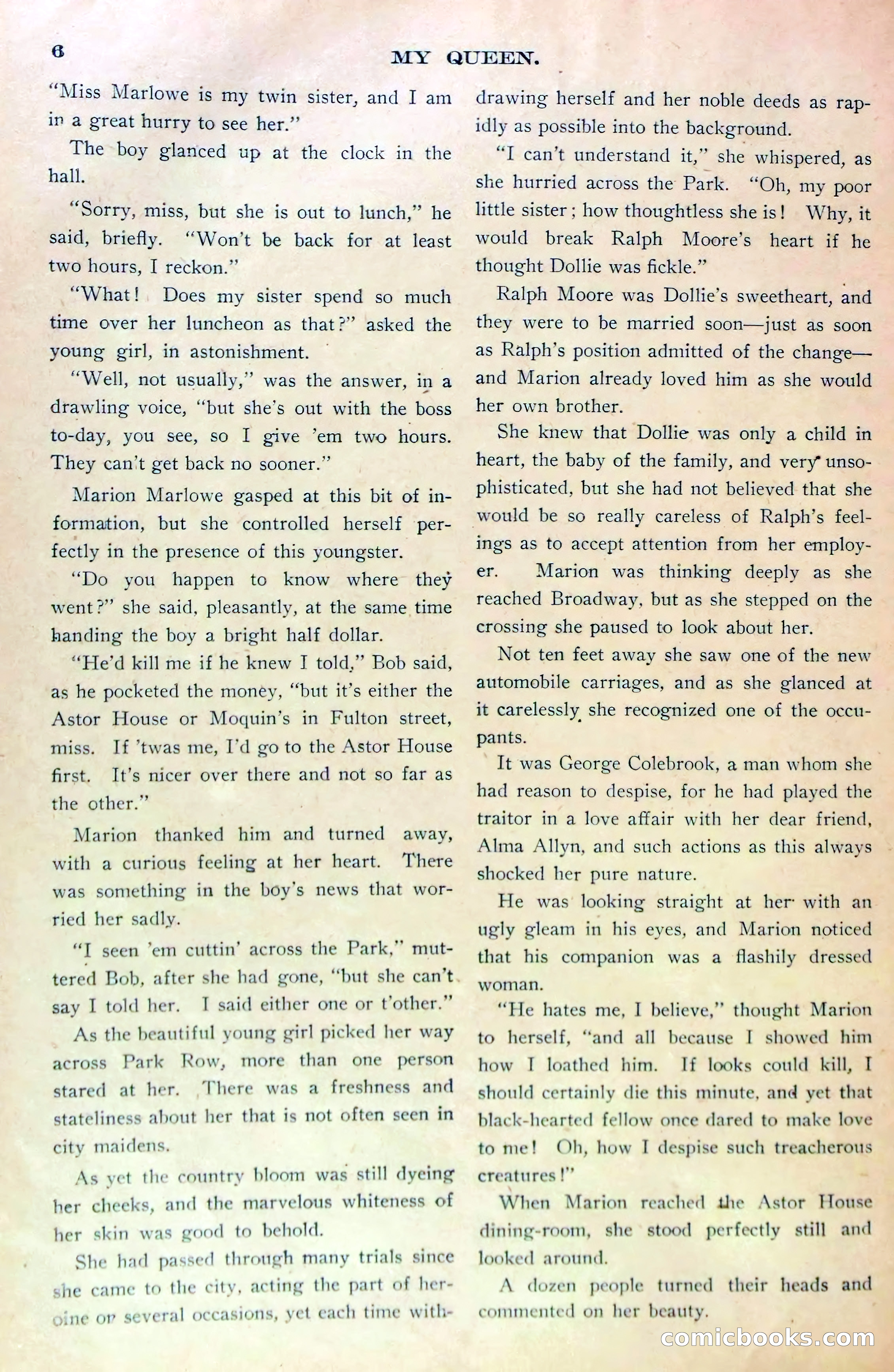
A restored page from Penny Dreadfuls, 1900. Page through the whole issue in the reader above.
📄 Transcribed text from this page (OCR, searchable)
Machine-transcribed from the original scan — historical spelling and the odd misread are preserved.
6 MY QUEEN. “Miss Marlowe is my twin sister, and I am in a great hurry to see her.” The boy glanced up at the clock in the hall. “Sorry, miss, but she is out to lunch,” he said, briefly. ‘“Won’t be back for at least two hours, I reckon.”’ “What! Does my sister spend so much time over her luncheon as that?” asked the young girl, in astonishment. “Well, not usually,” was the answer, in a drawling voice, ‘but she’s out with the boss to-day, you see, so I give ’em two hours. They can't get back no sooner.” Marion Marlowe gasped at this bit of in- formation, but she controlled herself per- fectly in the presence of this youngster. “Do you happen to know where they went?” she said, pleasantly, at the same time handing the boy a bright half dollar. “‘He’d kill me if he knew I told,” Bob said, as he pocketed the money, “but it’s either the Astor House or Moquin’s in Fulton street, miss. If ’twas me, I’d goto the Astor House first. the other.” It’s nicer over there and not so far as Marion thanked him and turned away, There was something in the boy’s news that wor- with a curious feeling at her heart. ried her sadly. “T seen ‘em cuttin’ across the Park,” mut- tered Bob, after she had gone, “but she can’t. say I told her. I said either one or t’other.” As the beautiful young girl picked her way Park at her. across Row, more than one person stared There was a freshness and stateliness about her that is not often seen in city maidens. As vet the country bloom was still dyeing her cheeks, and the marvelous whiteness of her skin was good to behold. She had passed through many trials since she came to the city, acting the part of her- ne op several occasions, yet each time with- drawing herself and her noble deeds as rap- idly as possible into the background. “I can’t understand it,” she whispered, as she hurried across the Park. “Oh, my poor little sister ; how thoughtless she is! Why, it would break Ralph Moore’s heart if he thought Dollie was fickle.” Ralph Moore was Dollie’s sweetheart, and they were to be married soon—just as soon as Ralph’s position admitted of the change— and Marion already loved him as she would her own brother. She knew that Dollie was only a child in heart, the baby of the family, and very’ unso- phisticated, but she had not believed that she would be so really careless of Ralph’s feel- ings as to accept attention from her employ- Cr. Marion was thinking deeply as she reached Broadway, but as she stepped on the crossing she paused to look about her. Not ten feet away she saw one of the new automobile carriages, and as she glanced at it carelessly she recognized one of the occu- pants. It was George Colebrook, a man whom she had reason to despise, for he had played the traitor in a love affair with her dear friend, Alma Allyn, and such actions as this always shocked her pure nature. He was looking straight at her with an ugly gleam in his eyes, and Marion noticed that his companion was a flashily dressed woman. “He hates me, I believe,” thought Marion to herself, “and all because I showed him If looks could kill, I should certainly die this minute, and yet that how I loathed him. black-hearted fellow once dared to make love to me! Oh, how I despise such treacherous creatures !” When dining-room, she stood perfectly still and Marion reached the Astor House looked around. A dozen people turned their heads and commented on her beauty, EOMMIE ICO <S,(EOn