
Penny Dreadfuls, 1900 · page 9 of 38
Marion Marlowe's Peril, or, A Mystery Unveiled — page 9: what you’re looking at
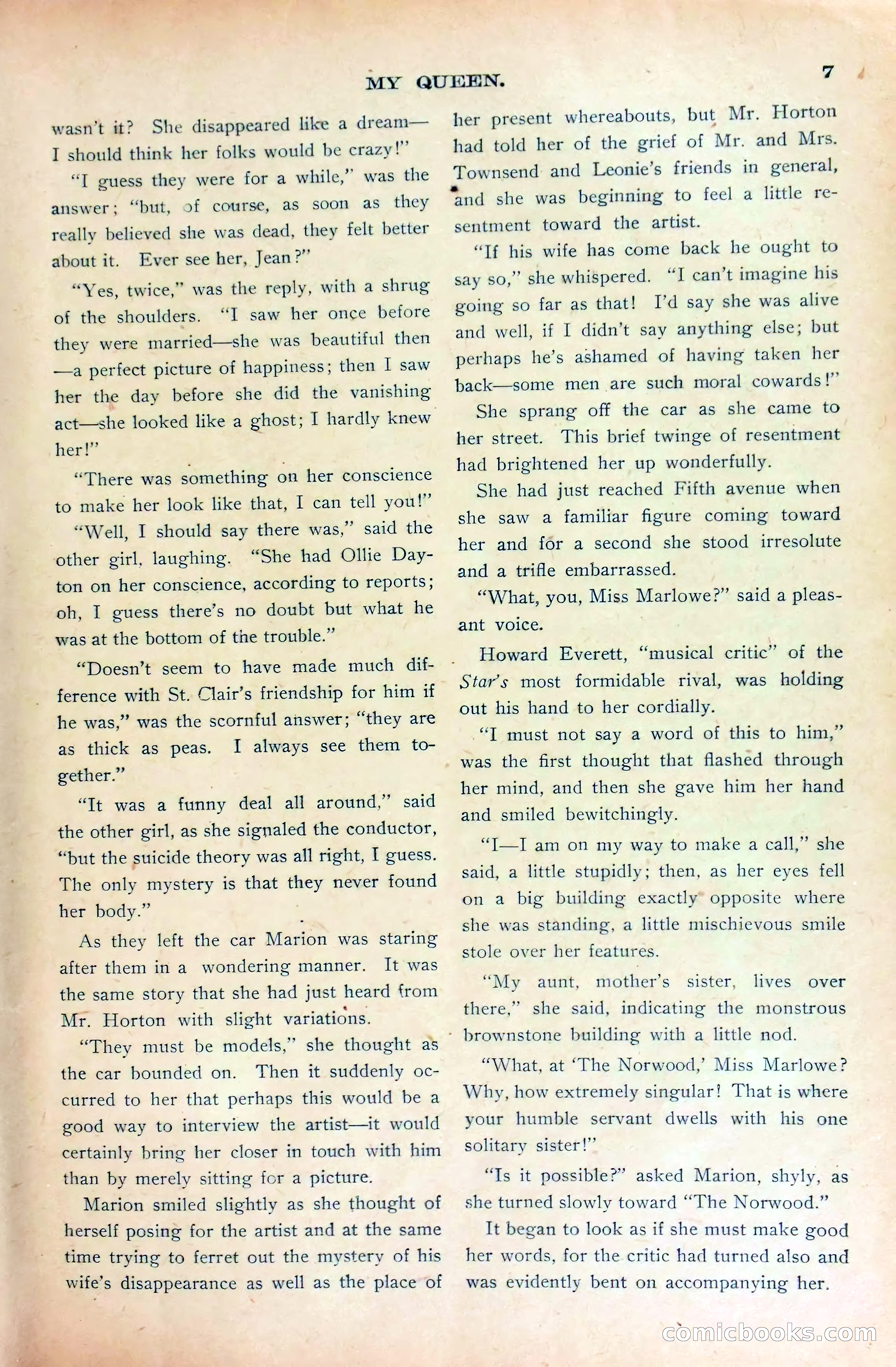
A restored page from Penny Dreadfuls, 1900. Page through the whole issue in the reader above.
📄 Transcribed text from this page (OCR, searchable)
Machine-transcribed from the original scan — historical spelling and the odd misread are preserved.
other girl, laughing. MY QUEEN. 7 wasn’t it? She disappeared like a dream— I should think her folks would be crazy!” “T guess they were for a while,’”’ was the answer: “but, of course, as soon as they really believed she was dead, they felt better about it. Ever see her, Jean?” “Ves, twice,” was the reply, with a shrug of the shoulders. they were married—she was beautiful then “T saw her once before —a perfect picture of happiness; then I saw her the day before she did the vanishing act—she looked like a ghost; I hardly knew her!” “There was something on her conscience to make her look like that, I can tell you!” “Well, I should say there was,” said the “She had Ollie Day- ton on her conscience, according to reports; oh, I guess there’s no doubt but what he was at the bottom of the trouble.” “Doesn’t seem to have made much dif- ference with St. Clair’s friendship for him if he was,” was the scornful answer; “they are as thick as peas. I always see them to- gether.” “It was a funny deal all around,” said the other girl, as she signaled the conductor, “but the suicide theory was all right, I guess. The only mystery is that they never found her body.” As they left the car Marion was staring after them in a wondering manner. It was the same story that she had just heard from Mr. Horton with slight variations. “They must be models,” she thought as the car bounded on. Then it suddenly oc- curred to her that perhaps this would be a good way to interview the artist—it would certainly bring her closer in touch with him than by merely sitting for a picture. Marion smiled slightly as she thought of herself posing for the artist and at the same time trying to ferret out the mystery of his wife’s disappearance as well as the place of her present whereabouts, but Mr. Horton had told her of the grief of Mr. and Mrs. Townsend and Leonie’s friends in general, “and she was beginning to feel a little re- sentment toward the artist. “Tf his wife has come back he ought to say so,” she whispered. “I can’t imagine his going so far as that! I’d say she was alive and well, if I didn’t say anything else; but perhaps he’s ashamed of having taken her back—-some men are such moral cowards!” She sprang off the car as she came to her street. This brief twinge of resentment had brightened her up wonderfully. She had just reached Fifth avenue when she saw a familiar figure coming toward her and for a second she stood irresolute and a trifle embarrassed. “What, you, Miss Marlowe?” said a pleas- ant voice. Howard Everett, “musical critic” of the Star’s most formidable rival, was holding out his hand to her cordially. “T must not say a word of this to him,” was the first thought that flashed through her mind, and then she gave him her hand and smiled bewitchingly. “T_T am on my way to make a call,” she said, a little stupidly; then, as her eyes fell on a big building exactly opposite where she was standing, a little mischievous smile stole over her features. “My . there,” she said, indicating the monstrous aunt, mother’s’ sister, lives Over - brownstone building with a little nod. “What, at ‘The Norwood,’ Miss Marlowe? Why, how extremely singular! That is where your humble servant dwells with his one solitary sister!” “Is it possible?” asked Marion, shyly, as she turned slowly toward “The Norwood.” It began to look as if she must make good her words, for the critic had turned also and was evidently bent on accompanying her. Conniclooolks (CO)