
Penny Dreadfuls, 1900 · page 34 of 38
Marion Marlowe's True Heart, or, How a Daughter Forgave — page 34: what you’re looking at
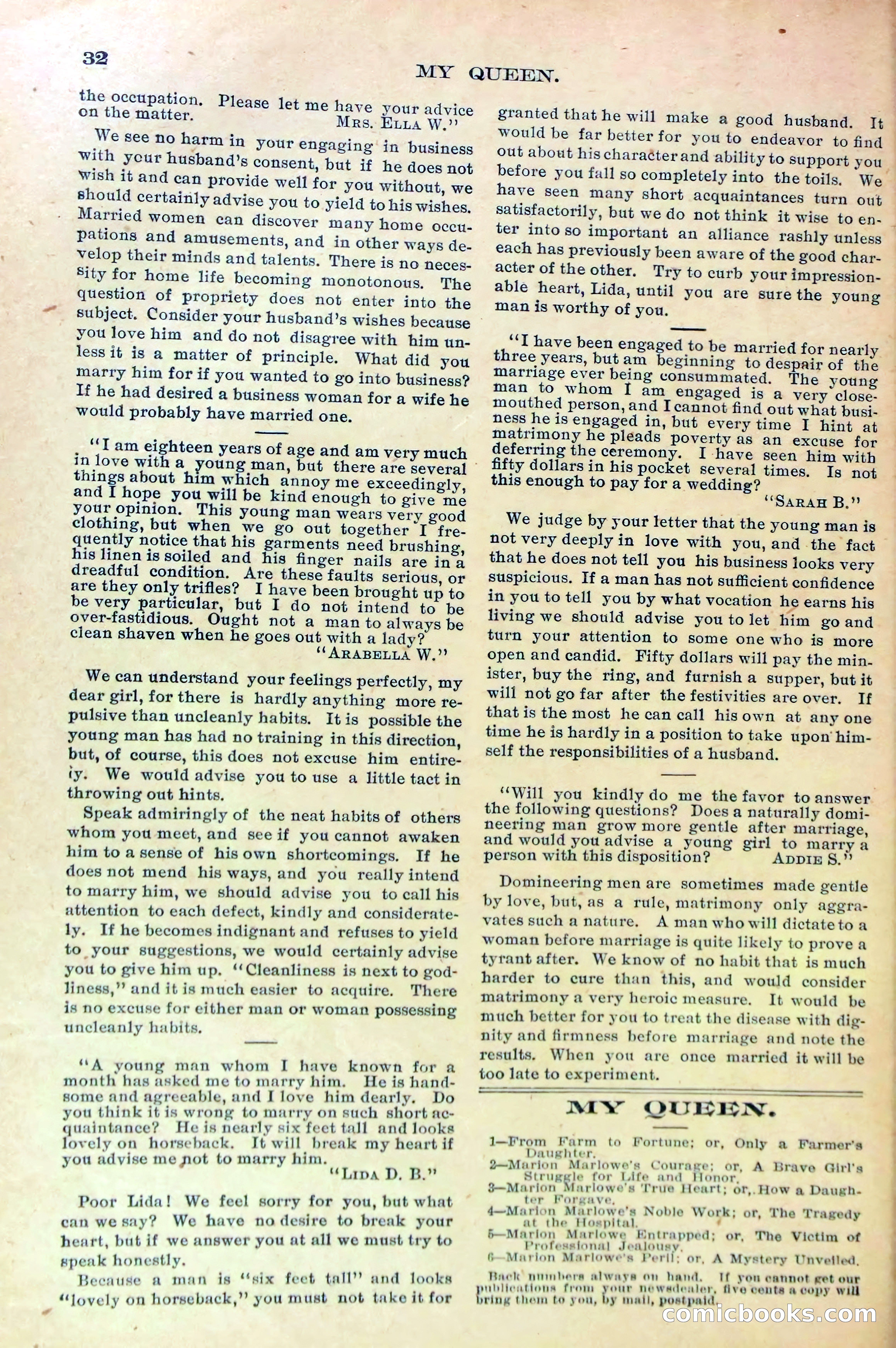
A restored page from Penny Dreadfuls, 1900. Page through the whole issue in the reader above.
📄 Transcribed text from this page (OCR, searchable)
Machine-transcribed from the original scan — historical spelling and the odd misread are preserved.
32 the occupation, Please let me have your advice on the matter, Mrs, Exua W.?? We see no harm in your engaging in business with your husband’s consent, but if he does not Wish it and can provide well for you without, we should certainly advise you to yield to his wishes, Married women can discover many home occu- pations and amusements, and in other ways de- velop their minds and talents. There is no neces- Sity for home life becoming monotonous, The question of propriety does not enter into the subject. Consider your husband’s wishes because © you love him and do not disagree with him un- less it is a matter of principle. What did you marry him for if you wanted to go into business? If he had desired a business woman for a wife he would probably have married one. “Tam eighteen years of age and am very much in love with a young man, ; things about him which annoy me exceedingly, and I hope you will be kind enough to give me your opinion. This young man wears very good clothing, but when we go out together I fre- quently notice that his garments need brushing, his linen is soiled and his finger nails are ina dreadful condition. Are these faults serious, or are they only trifles? I have been brought up to be very particular, but I do not intend to be over-fastidious. Ought not a man to always be clean shaven when he goes out with a lady? ‘(ARABELLA W,”? We can understand your feelings perfectly, my dear girl, for there is hardly anything more re- pulsive than uncleanly habits. It is possible the young man has had no training in this direction, but, of course, this does not excuse him entire- ty. We would advise you to use a little tact in throwing out hints. Speak admiringly of the neat habits of others whom you meet, and seeif you cannot awaken him to a sense of his own shortcomings. If he does not mend his ways, and you really intend to marry him, we should advise you to call his attention to each defect, kindly and considerate- ly. If he becomes indignant and refuses to yield to your suggestions, we would certainly advise you to give him up, ‘‘Cleanliness is next to god- liness,”’? and itis much easier to acquire. There is no excuse for either man or woman possessing uncleanly habits, “A young man whom I have known for a month has asked me to marry him, He is hand- some and agreeable, and I love him dearly. Do you think it is wrong to marry on such short ac- quaintance? He is nearly six feet tall and looks lovely on horseback. It we F break my heart if ise me narry him. you advise me not to1 y “Lia D, B.% Poor Lida! We feel sorry for you, but what can wesay? We have nodesire to break your heart, but if we answer you at all we must try to speak honestly, | Because a man is ‘six feet tall’ and looks . HULK it, ) “lovely on horseback,’’ you must not take it for ut there are several | _— — MY QUEEN. granted that he will make a good husband. It would be far better for you to endeavor to find — out about his charaéterand ability to support you before you fall so completely into the toils, We have seen many short acquaintances turn out satisfactorily, but we do not think it wise toen- _ ter into so important an alliance rashly unless each has previously been aware of the good char- acter of the other. Try to curb your impression- able heart, Lida, until you are sure the young man is worthy of you. “‘T have been engaged to be married for nearly three years, but am beginning to despair of the marriage ever being consummated. The young man to whom I am engaged is a very close- mouthed person, and Icannot find out what busi- ness he is engaged in, but every time I hint at matrimony he pleads poverty as an excuse for deferring the ceremony. I -have seen him with fifty dollars in his pocket several times. Is not this enough to pay fora wedding? ‘“SARAH B,” We judge by your letter that the young man is not very deeply in love with you, and the fact that he does not tell you his business looks very suspicious. If a man has not sufficient confidence in you to tell you by what vocation he earns his living we should advise you to let him go and turn your attention to some one who is more open and candid. Fifty dollars will pay the min- ister, buy the ring, and furnish a supper, but it will not go far after the festivities are over. If that is the most he can call hisown at any one time he is hardly in a position to take upon him- self the responsibilities of a husband. “Will you kindly do me the favor to answer the following questions? Doesa naturally domi- neering man grow more gentle after matriage, and would you advise a young girl to marry a person with this disposition? ADDIE §.”’ Domineering men are sometimes made gentle by love, but, as a rule, matrimony only aggra- vates such a nature. A man whowill dictateto a woman before marriage is quite likely to prove a tyrant after. We know of no habit that is much harder to cure than this, and would consider matrimony a very heroic measure. It would be much better for you to treat the disease with dig- nity and firmness before marriage and note the results. When you are once married it will be too late to experiment. eee = MY OUBEN. 1—From Farm to Fortune; or, Only a Farmer's Daughter, 2—Marion Marlowe's Courage; or, A Brave Girl's Struggle for Life and Honor, 3—Marion Marlowe's True Heart; or,,.How a Daugh- ter Forgave, ‘ ‘ 4—Marion Marlowe's Noble Work; or, The Tragedy at the Hospital. ’ 5'—Marion Marlowe Entrapped; or, The Victim of Professional Jealousy, f/—Marion Marlowe's Peril; or, A Mystery Unvetled. Back nimnbers alwaya on hand, Tf you cannot get our Al ge pad from iy NA ap five cents a copy will ring them to you, by mail, postpaid, | 3 | Eomichbooks: com