
Penny Dreadfuls, 1895 · page 132 of 150
The King of the School, or, Who will Win? — page 132: what you’re looking at
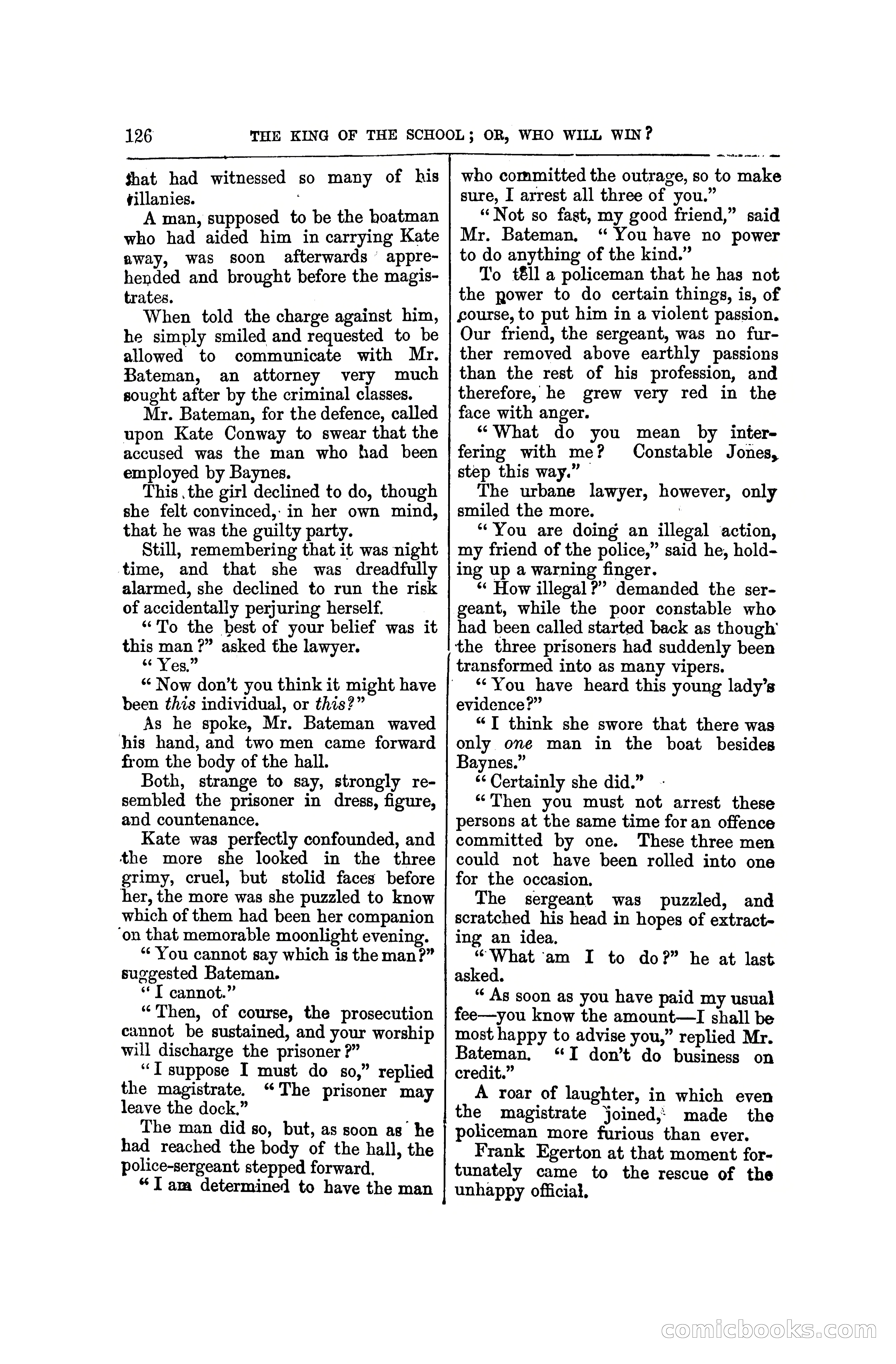
A restored page from Penny Dreadfuls, 1895. Page through the whole issue in the reader above.
📄 Transcribed text from this page (OCR, searchable)
Machine-transcribed from the original scan — historical spelling and the odd misread are preserved.
126 THE KING OF THE SCHOOL; OR, WHO WILL WIN? $hat had witnessed fillanies. A man, supposed to be the hoatman who had aided him in carrying Kate away, was soon afterwards ‘ appre- hended and brought before the magis- trates. . When told the charge against him, he simply smiled and requested to be allowed to communicate with Mr. Bateman, an attorney very much sought after by the criminal classes. Mr. Bateman, for the defence, called upon Kate Conway to swear that the accused was the man who had been employed by Baynes. This ,the girl declined to do, though she felt convinced, in her own mind, that he was the guilty party. Still, remembering that it was night time, and that she was dreadfully alarmed, she declined to run the risk of accidentally perjuring herself. | “To the best of your belief was it this man ?” asked the lawyer. “Yes,” so many of his “Now don’t you think it might have | been this individual, or this?” As he spoke, Mr. Bateman waved his hand, and two men came forward from the body of the hall. Both, strange to say, strongly re- sembled the prisoner in dress, figure, and countenance. Kate was perfectly confounded, and the more she looked in the three grimy, cruel, but stolid faces before her, the more was she puzzled to know > which of them had been her companion ‘on that memorable moonlight evening. ‘¢ You cannot say which is the man?” suggested Bateman. “ T cannot.” “Then, of course, the prosecution cannot be sustained, and your worship will discharge the prisoner ?” “IT suppose I must do so,” replied the magistrate. “The prisoner may leave the dock.” The man did so, but, as soon ag’ he had reached the body of the hall, the police-sergeant stepped forward. “Iam determined to have the man ie, ee MO rms 6 who committed the outrage, so to make sure, I arrest all three of you.” “Not so fast, my good friend,” said Mr. Bateman, “ You have no power to do anything of the kind.” To téll a policeman that he has not the power to do certain things, is, of course, to put him in a violent passion. Our friend, the sergeant, was no fur- ther removed above earthly passions than the rest of his profession, and therefore, he grew very red in the face with anger. “What do you mean by inter- fering with me? Constable Jones, step this way.” The urbane lawyer, however, only smiled the more. “You are doing an illegal action, my friend of the police,” said he, hold- ing up a warning finger. *“* How illegal ?” demanded the ser- geant, while the poor constable who had been called started back as though’ the three prisoners had suddenly been transformed into as many vipers. ‘You have heard this young lady’s evidence?” “JT think she swore that there was only one man in the boat besides Baynes.” ‘‘ Certainly she did.” “Then you must not arrest these persons at the same time for an offence committed by one. These three men could not have been rolled into one for the occasion, The sergeant was puzzled, and scratched his head in hopes of extract- ing an idea, “What ‘am I to do?” he at last asked. ““ As soon as you have paid my usual fee—you know the amount—I shall be most happy to advise you,” replied Mr. Bateman. “I don’t do business on credit.” A roar of laughter, in which even the magistrate joined, made the policeman more furious than ever. Frank Egerton at that moment for- tunately came to the rescue of the unhappy official. COMICLOe A) EO mn