
Penny Dreadfuls, 1895 · page 17 of 150
The King of the School, or, Who will Win? — page 17: what you’re looking at
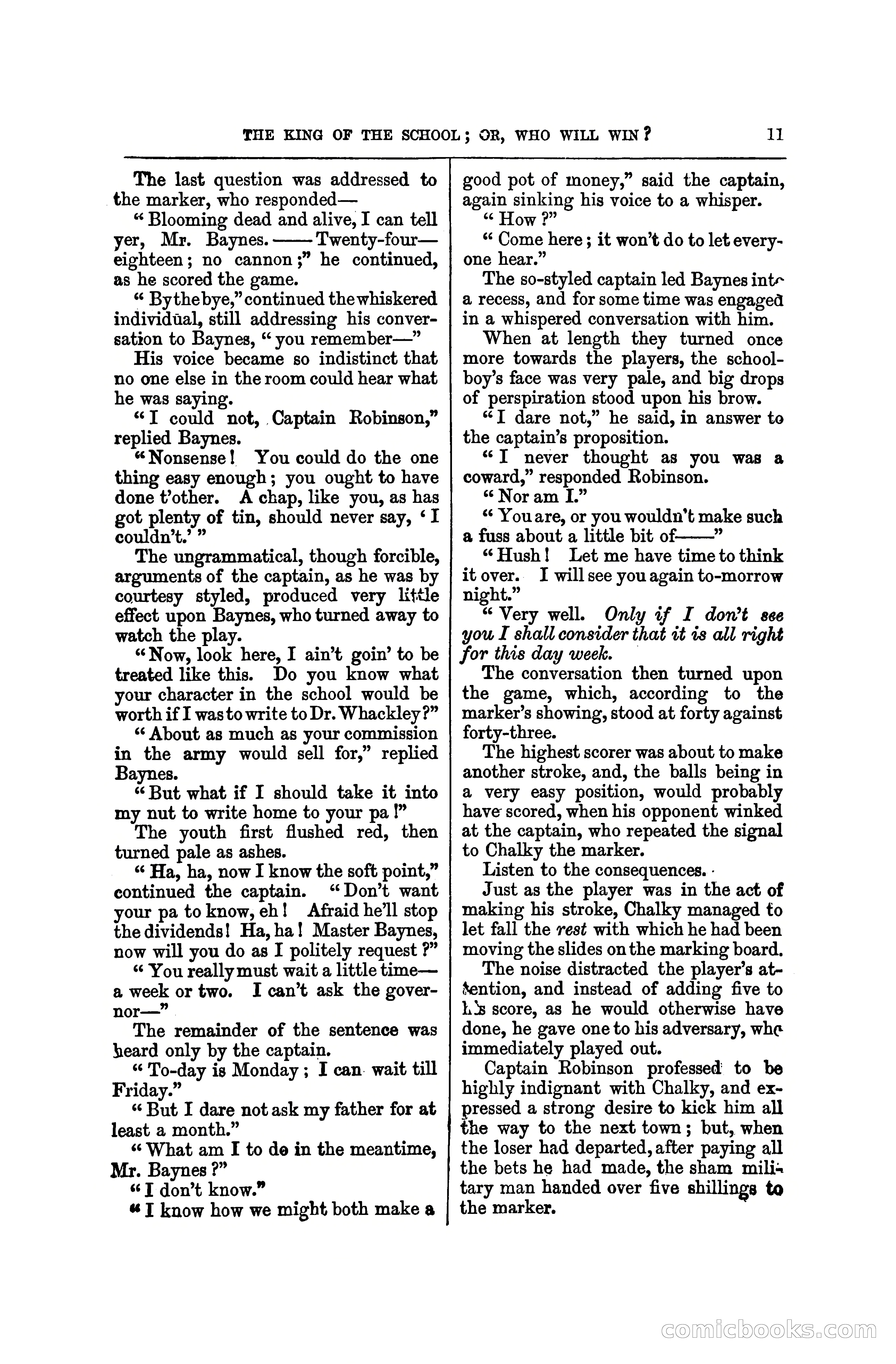
A restored page from Penny Dreadfuls, 1895. Page through the whole issue in the reader above.
📄 Transcribed text from this page (OCR, searchable)
Machine-transcribed from the original scan — historical spelling and the odd misread are preserved.
THE KING OF THE SCHOOL; OR, WHO WILL WIN? The last question was addressed to the marker, who responded— “ Blooming dead and alive, I can tell yer, Mr. Baynes. eighteen; no cannon ;” he continued, as he scored the game. “ Bythebye,” continued the whiskered individual, still addressing his conver- sation to Baynes, “ you remember—” His voice became so indistinct that no one else in the room could hear what he was saying. “T could not, Captain Robinson,” replied Baynes. “Nonsense! You could do the one thing easy enough; you ought to have done t’other. A chap, like you, as has got plenty of tin, should never say, ‘I couldn’t.’ ” The ungrammatical, though forcible, arguments of the captain, as he was by courtesy styled, produced very liftle effect upon Baynes, who turned away to watch the play. ‘Now, look here, I ain’t goin’ to be treated like this. Do you know what your character in the school would be worth if I wasto write to Dr. Whackley?” ‘¢ About as much as your commission in the army would sell for,” replied Baynes. “But what if I should take it into my nut to write home to your pa !” The youth first flushed red, then turned pale as ashes. “ Ha, ha, now I know the soft point,” continued the captain. “Don’t want your pa to know, eh! Afraid he'll stop the dividends! Ha, ha! Master Baynes, now will you do as I politely request ?” “ You really must wait a little time— a week or two. I can’t ask the gover- nor—” The remainder of the sentence was beard only by the captain. “To-day is Monday; I can. wait till Friday.” “But I dare not ask my father for at least a month.” ‘“‘ What am I to de in the meantime, Mr. Baynes ?” ‘JT don’t know.” « T know how we might both make a Twenty-four— Il good pot of money,” said the captain, again sinking his voice to a whisper. “© How ?” “‘ Come here ; it won’t do to let every- one hear.” The so-styled captain led Baynes int- a recess, and for some time was engaged in a whispered conversation with him. When at length they turned once more towards the players, the school- boy’s face was very pale, and big drops of perspiration stood upon his brow. “IT dare not,” he said, in answer to the captain’s proposition. “T never thought as you was a coward,” responded Robinson. “ Nor am I.” ‘“¢ Youare, or you wouldn’t make such a fuss about a little bit o ” “Hush! Let me have time to think it over. I willsee you again to-morrow night.” “ Very well. Only 1f I don’t see you I shall consider that tt is all right for this day week. — The conversation then turned upon the game, which, according to the marker’s showing, stood at forty against forty-three. The highest scorer was about to make another stroke, and, the balls being in a very easy position, would probably have scored, when his opponent winked at the captain, who repeated the signal to Chalky the marker. Listen to the consequences. - Just as the player was in the act of making his stroke, Chalky managed to let fall the rest with which he had been moving the slides on the marking board. The noise distracted the player’s at- | ‘ention, and instead of adding five to L’s score, as he would otherwise have done, he gave one to his adversary, whe immediately played out. Captain Robinson professed to be highly indignant with Chalky, and ex~ pressed a strong desire to kick him all the way to the next town; but, when the loser had departed, after paying all the bets he had made, the sham mili- tary man handed over five shillings to the marker. Go NOC EO mn