
Penny Dreadfuls, 1900 · page 141 of 398
Moths by Ouida — page 141: what you’re looking at
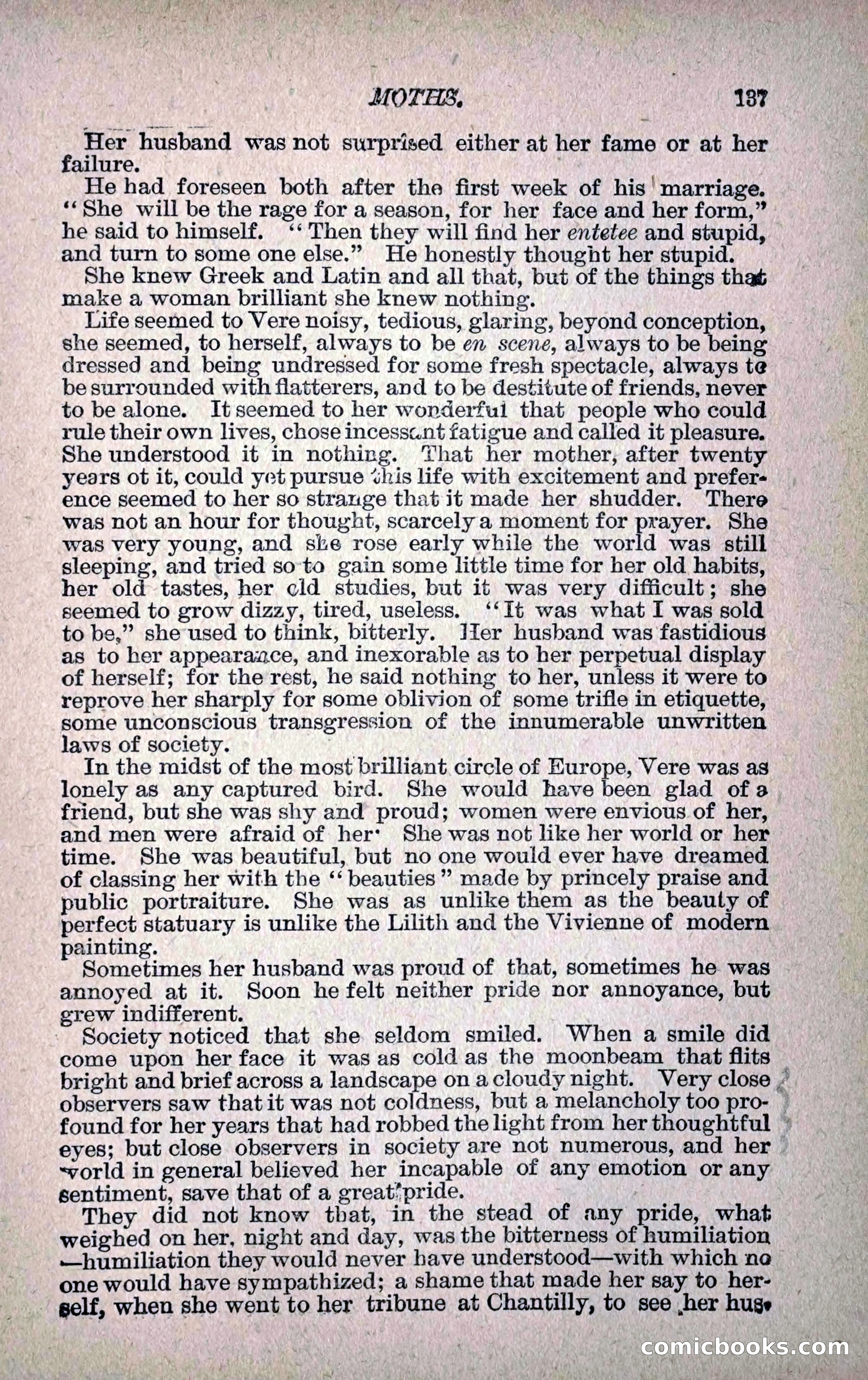
A restored page from Penny Dreadfuls, 1900. Page through the whole issue in the reader above.
📄 Transcribed text from this page (OCR, searchable)
Machine-transcribed from the original scan — historical spelling and the odd misread are preserved.
*% ~~ oe me mae 42 S ane af > ° i4fs - = 6=Cs@ 72 Jaen er y,) OP I 4 a fave Wh ; , V F Of , by aA Cor bp pe oF pA’ 4 i, Oe ; “ ’ ; hig.| das : ' . x . : f n ~~ : ; | MOTHS, 137 : ea husband was not surprised either at her fame or at her ailure. He had foreseen both after the first week of his ' marriage. ‘‘She will be the rage for a season, for her face and her form,” he said to himself. ‘‘ Then they will find her entetee and stupid, and turn to some one else.” He honestly thought her stupid. She knew Greek and Latin and all that, but of the things thaé make a woman brilliant she knew nothing. Life seemed to Vere noisy, tedious, glaring, beyond conception, she seemed, to herself, always to be en scene, always to be being dressed and being undressed for some fresh spectacle, always te be surrounded with flatterers, and to be destitute of friends, never to be alone. Itseemed to her wonderful that people who could rule their own lives, chose incess.nt fatigue and called it pleasure. She understood it in nothing. That her mother, after twenty years ot it, could yet pursue “this life with excitement and prefers ence seemed to her so strange that it made her shudder. There was not an hour for thought, scarcely a moment for prayer. She was very young, and ske rose early while the world was still sleeping, and tried so to gain some little time for her old habits, her old tastes, her cld studies, but it was very difficult; she seemed to grow dizzy, tired, useless. ‘‘It was what I was sold to be,” she used to think, bitterly. JIier husband was fastidious as to her appearazce, and inexorable as to her perpetual display of herself; for the rest, he said nothing to her, unless it were to reprove her sharply for some oblivion of some trifle in etiquette, some unconscious transgression of the innumerable unwritten laws of society. : In the midst of the most brilliant circle of Europe, Vere was as lonely as any captured bird. She would have been glad ofa friend, but she was shy and proud; women were envious of her, and men were afraid of her: She was not like her world or her time. She was beautiful, but no one would ever have dreamed of classing her with the ‘‘ beauties ” made by princely praise and public portraiture. She was as unlike them as the beauty of perfect statuary is unlike the Lilith and the Vivienne of modern painting. Sometimes her husband was proud of that, sometimes he was annoyed at it. Soon he felt neither pride nor annoyance, but erew indifferent. Society noticed that she seldom smiled. When a smile did come upon her face it was as cold as the moonbeam that flits bright and brief across a landscape on acloudy night. Very close observers saw that it was not coldness, but a melancholy too pro- — found for her years that had robbed the light from her thoughtful © <v eyes; but close observers in society are not numerous, and her — ~vorld in general believed her incapable of any emotion or any sentiment, save that of a great’pride. na They did not know tbat, in the stead of any pride, what weighed on her, night and day, was the bitterness of humiliation —humiliation they would never have understood—with which ne one would have sympathized; a shame that made her say to her- _. gelf, when she went to her tribune at Chantilly, to see ,her huge ol comicbooks.co - : ‘ » Res a pd . / etl e. Pie fy