
Penny Dreadfuls, 1900 · page 162 of 398
Moths by Ouida — page 162: what you’re looking at
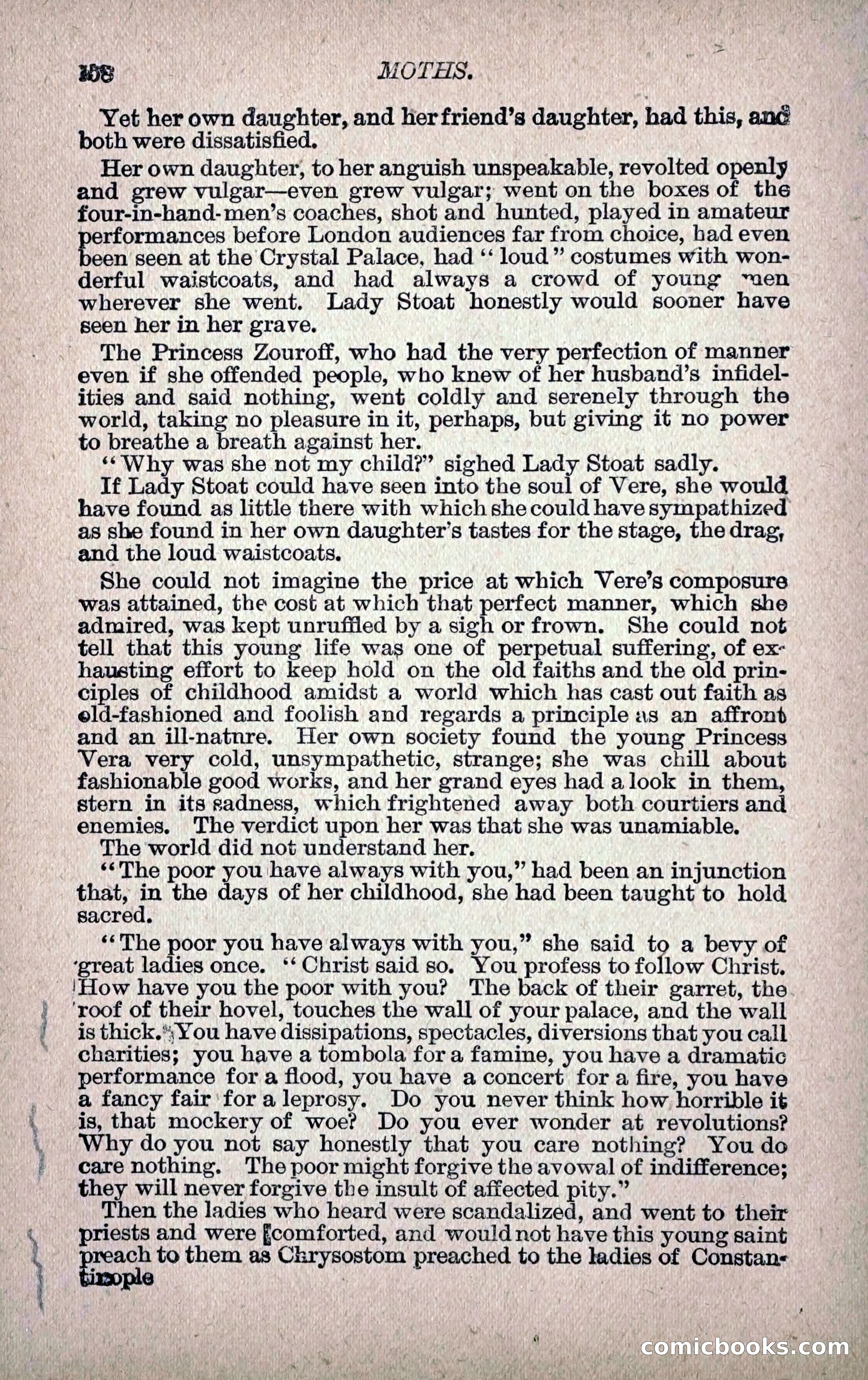
A restored page from Penny Dreadfuls, 1900. Page through the whole issue in the reader above.
📄 Transcribed text from this page (OCR, searchable)
Machine-transcribed from the original scan — historical spelling and the odd misread are preserved.
ses : be MOTHS. - Yet her own daughter, and herfriend’s daughter, had this, anc both were dissatisfied. Her own daughter, to her anguish unspeakable, revolted openly and grew vulgar—even grew vulgar; went on the boxes of the four-in-hand-men’s coaches, shot and hunted, played in amateur rformances before London audiences far from choice, had even tial seen at the Crystal Palace, had ‘‘ loud” costumes with won- derful waistcoats, and had always a crowd of young “en wherever she went. Lady Stoat honestly would sooner have seen her in her grave. The Princess Zouroff, who had the very perfection of manner even if she offended people, who knew of her husband’s infidel- ities and said nothing, went coldly and serenely through the world, taking no pleasure in it, perhaps, but giving it no power to breathe a breath against her. ‘*Why was she not my child?” sighed Lady Stoat sadly. If Lady Stoat could have seen into the soul of Vere, she would have found as little there with which she could have sympathized as she found in her own daughter’s tastes for the stage, the drag, and the loud waistcoats. She could not imagine the price at which Vere’s composure was attained, the cost at which that perfect manner, which she admired, was kept unrufiled by a sigh or frown. She could not tell that this young life was one of perpetual suffering, of ex- hausting effort to keep hold on the old faiths and the old prin- ciples of childhood amidst a world which has cast out faith as old-fashioned and foolish and regards a principle as an affront and an ill-natnre. Her own society found the young Princess Vera very cold, unsympathetic, strange; she was chill about fashionable good works, and her grand eyes had alook in them, stern in its sadness, which frightened away both courtiers and enemies. The verdict upon her was that she was unamiable. The world did not understand her. ‘‘The poor you have always with you,” had been an injunction that, a the days of her childhood, she had been taught to hold sacred. ‘*The poor you have always with you,” she said to a bevy of ‘great ladies once. ‘‘ Christ said so. You profess to follow Christ. _|How have you the poor with you? The back of their garret, the ‘roof of their hovel, touches the wall of your palace, and the wall is thick.*; You have dissipations, spectacles, diversions that you call charities; you have a tombola fora famine, you have a dramatic performance for a flood, you have a concert for a fire, you have a fancy fair for a leprosy. Do you never think how horrible it is, that mockery of woe? Do you ever wonder at revolutions? Why do you not say honestly that you care nothing? You do care nothing. The poor might forgive the avowal of indifference; they will never forgive the insult of affected pity.” Then the ladies who heard were scandalized, and went to their priests and were {comforted, and would not have this young saint castle to them as Chrysostom preached to the ladies of Constan- Ney