
Penny Dreadfuls, 1900 · page 165 of 398
Moths by Ouida — page 165: what you’re looking at
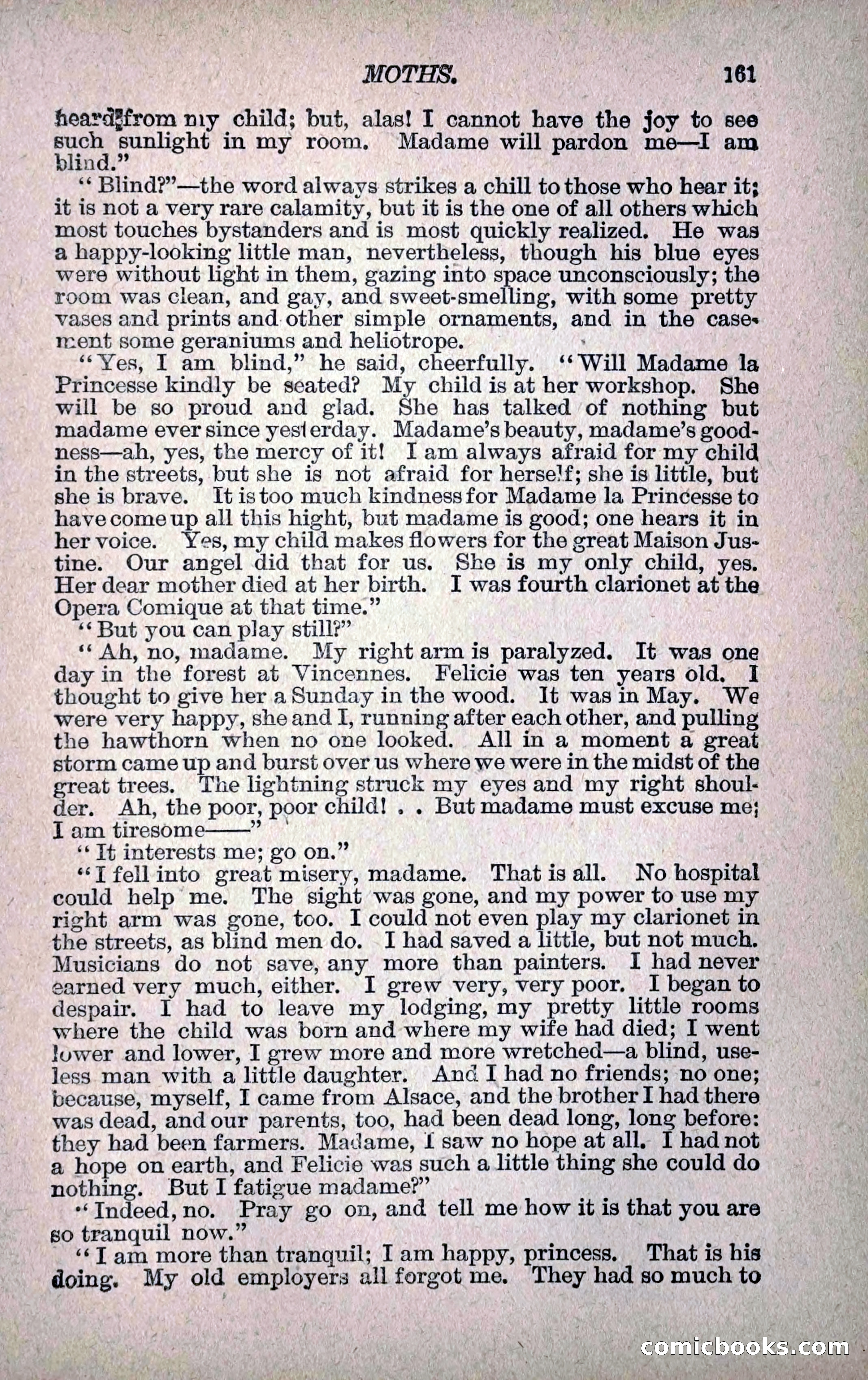
A restored page from Penny Dreadfuls, 1900. Page through the whole issue in the reader above.
📄 Transcribed text from this page (OCR, searchable)
Machine-transcribed from the original scan — historical spelling and the odd misread are preserved.
MOTHS. ; 161 hearadffrom ny child; but, alas! I cannot have the joy to see apie sunlight in my room, Madame will pardon me—I am ind. ‘* Blind?”—the word always strikes a chill to those who hear it; it is not a very rare calamity, but it is the one of all others which most touches bystanders and is most quickly realized. He was a happy-looking little man, nevertheless, though his blue eyes were without light in them, gazing into space unconsciously; the room was Clean, and gay, and sweet-smelling, with some pretty vases and prints and. other simple ornaments, and in the cases ment some geraniums and heliotrope. , ‘Yes, I am blind,” he said, cheerfully. ‘* Will Madame la Princesse kindly be seated? My childis at her workshop. She will be so proud and giad. She has talked of nothing but madame ever since yesterday. Madame’s beauty, madame’s good- ness—ah, yes, the mercy of it! lam always afraid for my child in the streets, but she is not afraid for herse!f; she is little, but she is brave. It istoo much kindnessfor Madame la Princesse to havecome up all this hight, but madame is good; one hears it in her voice. Yes, my child makes flowers for the great Maison Jus- tine. Our angel did that for us. She is my only child, yes. Her dear mother died at her birth. I was fourth clarionet at the Opera Comique at that time.” ‘*But you can play still?’ ‘Ah, no, madame. My right arm is paralyzed. It was one day in the forest at Vincennes. Felicie was ten years old, I thought to give her aSunday in the wood. It wasin May. We were very happy, she and I, running after each other, and pulling the hawthorn when no one looked. All in a moment a great storm came up and burst over us where we were in the midst of the great trees. The lightning struck my eyes and my right shoul- der. Ah, the poor, poor child! . . But madame must excuse me} I am tiresome——” | ‘‘ Tt interests me; go on.” “TT fellinto great misery, madame. Thatisall. No hospital could help me. The sight was gone, and my power to use my right arm was gone, too. I could not even play my clarionet in the streets, as blind men do. I had saved a little, but not much. Musicians do not save, any more than painters. I had never earned very much, either. I grew very, very poor. I began to despair. I had to leave my lodging, my pretty little rooms where the child was born and where my wife had died; I went lower and lower, I grew more and more wretched—a blind, use- less man with a little daughter. And I had no friends; no one; because, myself, I came from Alsace, and the brother I had there was dead, and our parents, too, had been dead long, long before: they had been farmers. Madame, I saw no hope at all, I had not a hope on earth, and Felicie was such a little thing she could do nothing. But I fatigue madame?’ Hon ‘‘TIndeed,no. Pray go on, and tell me how it is that you are so tranquil now.” / ‘¢T am more than tranquil; Iam happy, princess. That is his doing. My old employers all forgot me. They had so much to ) apt | ~ Eomicboo! a 4 eet { y cS