
Penny Dreadfuls, 1900 · page 168 of 398
Moths by Ouida — page 168: what you’re looking at
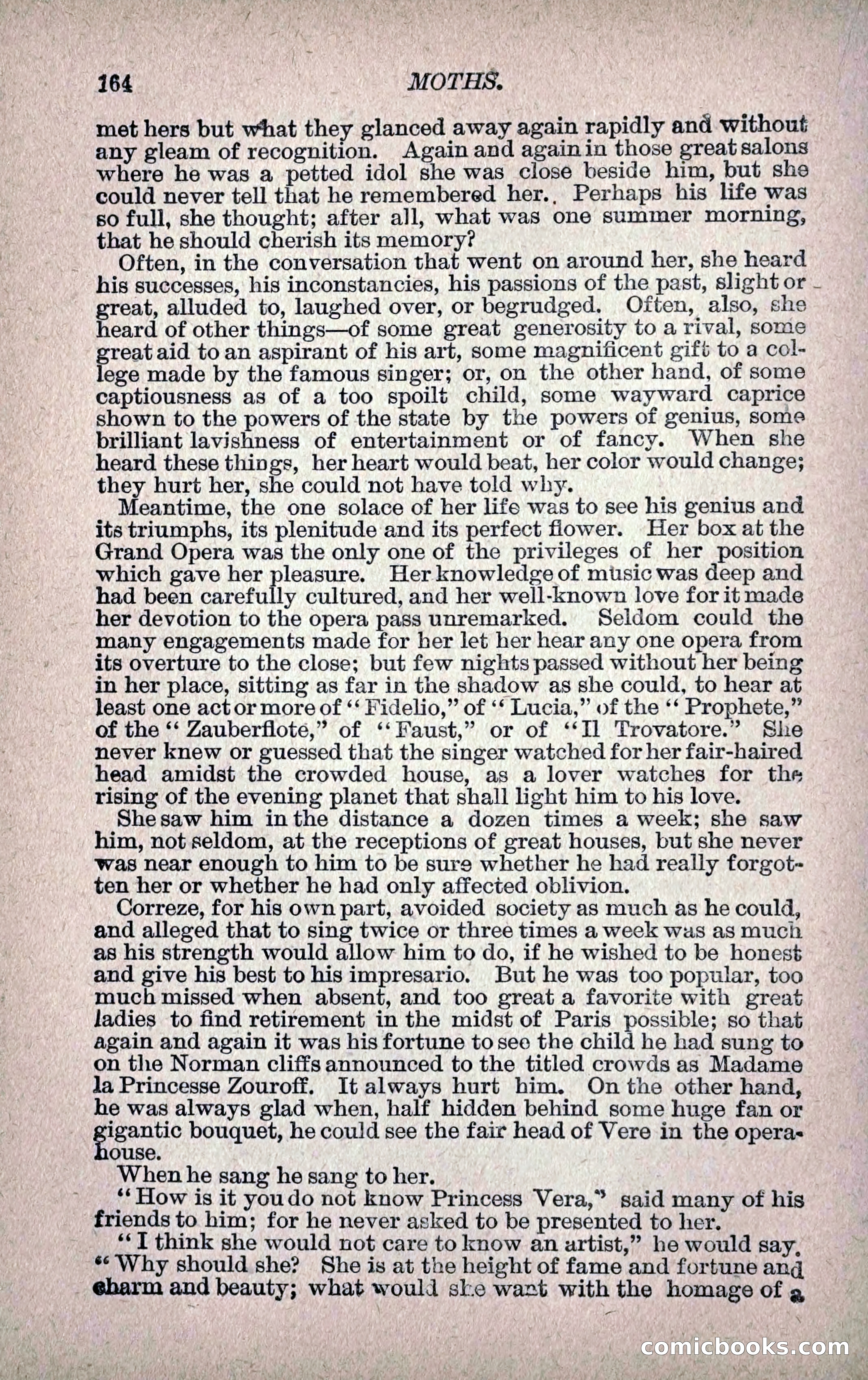
A restored page from Penny Dreadfuls, 1900. Page through the whole issue in the reader above.
📄 Transcribed text from this page (OCR, searchable)
Machine-transcribed from the original scan — historical spelling and the odd misread are preserved.
164 a, MOTHS. met hers but what they glanced away again rapidly and without any gleam of recognition. Again and againin those great salons where he was a petted idol she was close beside him, but she could never tell that he remembered her., Perhaps his life was so full, she thought; after all, what was one summer morning, that he should cherish its memory? Often, in the conversation that went on around her, she heard his successes, his inconstancies, his passions of the past, slight or _ great, alluded to, laughed over, or begrudged. Often, also, she heard of other things—of some great generosity to a rival, some great aid to an aspirant of his art, some magnificent gift to a col- lege made by the famous singer; or, on the other hand, of some captiousness as of a too spoilt child, some wayward caprice shown to the powers of the state by the powers of areas ies en she heard these things, her heart would beat, her color would change; brilliant lavishness of entertainment or of fancy. they hurt her, she could not have told why. Meantime, the one solace of her life was to see his genius and its triumphs, its plenitude and its perfect flower. Her box at the Grand Opera was the only one of the privileges of her position which gave her pleasure. Her knowledge of music was deep and had been carefully cultured, and her well-known love for it made her devotion to the opera pass unremarked. Seldom could the many engagements made for her let her hear any one opera from its overture to the close; but few nights passed without her being in her place, sitting as far in the shadow as she could, to hear at least one actor more of “‘ Fidelio,” of ‘‘ Lucia,” of the ‘*‘ Prophete,” of the ‘‘ Zauberflote,” of ‘‘ Faust,” or of ‘‘Il Trovatore.” never knew or guessed that the singer watched for her fair-haired head amidst the crowded house, as a lover watches for the rising of the evening planet that shall light him to his love. She saw him inthe distance a dozen times a week; she saw him, not seldom, at the receptions of great houses, but she never was near enough to him to be sure whether he had really forgot- ten her or whether he had only affected oblivion. She Correze, for his own part, avoided society as much as he could, and alleged that to sing twice or three times a week wus as much as his strength would allow him to do, if he wished to be hones¢ and give his best to his impresario. But he was too popular, too much missed when absent, and too great a favorite with great ladies to find retirement in the midst of Paris possible; so that again and again it was his fortune tosee the child he had sung to on the Norman cliffs announced to the titled crowds as Madame la Princesse Zouroff. It always hurt him. On the other hand, he was always glad when, half hidden behind some huge fan or igantic bouquet, he could see the fair head of Vere in the operas ouse. When he sang he sang to her. ‘* How is it youdo not know Princess Vera,” said many of his friends to him; for he never asked to be presented to her. ‘I think she would not care to know an artist,” he would say, ** Why should she? She is at the height of fame and fortune ang eharm and beauty; what would ske want with the homage of g N Col CS mn C 00 lad (E(0)