
Penny Dreadfuls, 1900 · page 175 of 398
Moths by Ouida — page 175: what you’re looking at
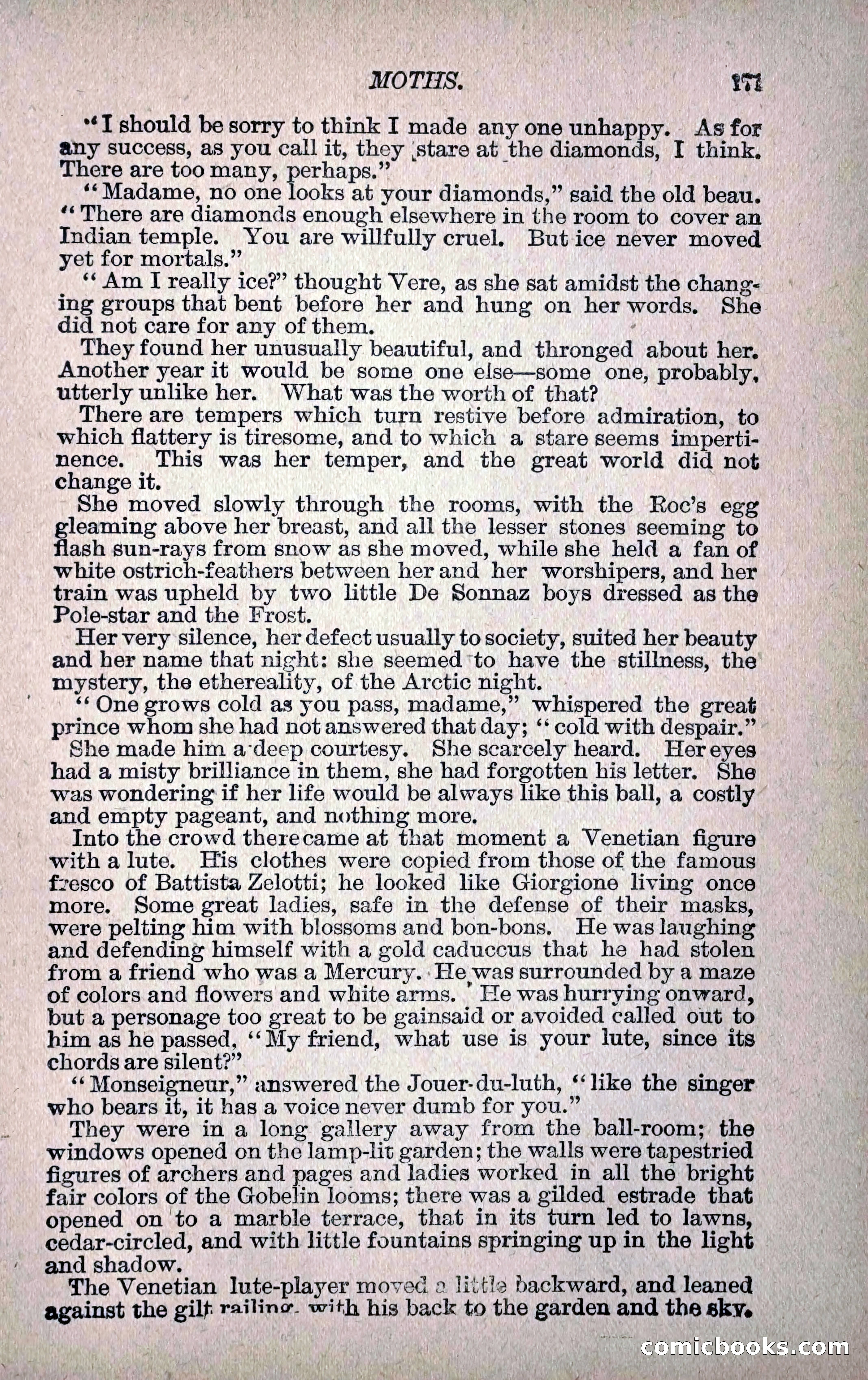
A restored page from Penny Dreadfuls, 1900. Page through the whole issue in the reader above.
📄 Transcribed text from this page (OCR, searchable)
Machine-transcribed from the original scan — historical spelling and the odd misread are preserved.
. MOTHS. vy **T should be sorry to think I made any one unhappy. As for any success, as you call it, they istare at the diamonds, I think. There are too many, perhaps.” ‘‘ Madame, no one looks at your diamonds,” said the old beau. ‘‘'There are diamonds enough elsewhere in the room to cover an Indian temple. You are willfully cruel. But ice never moved yet for mortals.” ‘*Am I really ice?’ thought Vere, as she sat amidst the chang- ing groups that bent before her and hung on her words. She did not care for any of them. ¢ They found her unusually beautiful, and thronged about her, Another year it would be some one else—some one, probably, utterly unlike her. What was the worth of that? There are tempers which turn restive before admiration, to which flattery is tiresome, and to which a stare seems imperti- nence. This was her temper, and the great world did not change it. She moved slowly through the rooms, with the Koce’s egg gleaming above her breast, and all the lesser stones seeming to flash sun-rays from snow as she moved, while she held a fan of white ostrich-feathers between her and her worshipers, and her train was upheld by two little De Sonnaz boys dressed as the Pole-star and the Frost. Her very silence, her defect usually to society, suited her beauty and her name that night: she seemed ‘to have the stillness, the mystery, the ethereality, of the Arctic night. ‘‘ One grows cold as you pass, madame,” whispered the great prince whom she had not answered that day; ‘‘ cold with despair.” She made him a-deep courtesy. She scarcely heard. Hereyes had a misty brilliance in them, she had forgotten his letter. She was wondering if her life would be always like this ball, a costly and empty pageant, and nothing more, Into the crowd therecame at that moment a Venetian figure with alute. His clothes were copied from those of the famous fresco of Battista Zelotti; he looked like Giorgione living once more. Some great ladies, safe in the defense of their masks, were pelting him with blossoms and bon-bons, He was laughing and defending himself with a gold caduccus that he had stolen from a friend who was a Mercury.: He was surrounded by a maze of colors and flowers and white arms. Hewas hurrying onward, but a personage too great to be gainsaid or avoided called out to him as he passed, ‘‘My friend, what use is your lute, since its chords are silent?” ‘‘ Monseigneur,” answered the Jouer-du-luth, ‘‘ like the singer who bears it, it has a voice never dumb for you.” They were in a long gallery away from the ball-room; the windows opened on the lamp-lit garden; the walls were tapestried figures of archers and pages and ladies worked in all the bright fair colors of the Gobelin looms; there was a gilded estrade that opened on to a marble terrace, that in its turn led to lawns, cedar-circled, and with little fountains springing up in the light and shadow. The Venetian lute-player moved a little backward, and leaned against the gilf railing. with his back to the garden and the sky. (Ee) iy EOomiCc 900