
Penny Dreadfuls, 1900 · page 177 of 398
Moths by Ouida — page 177: what you’re looking at
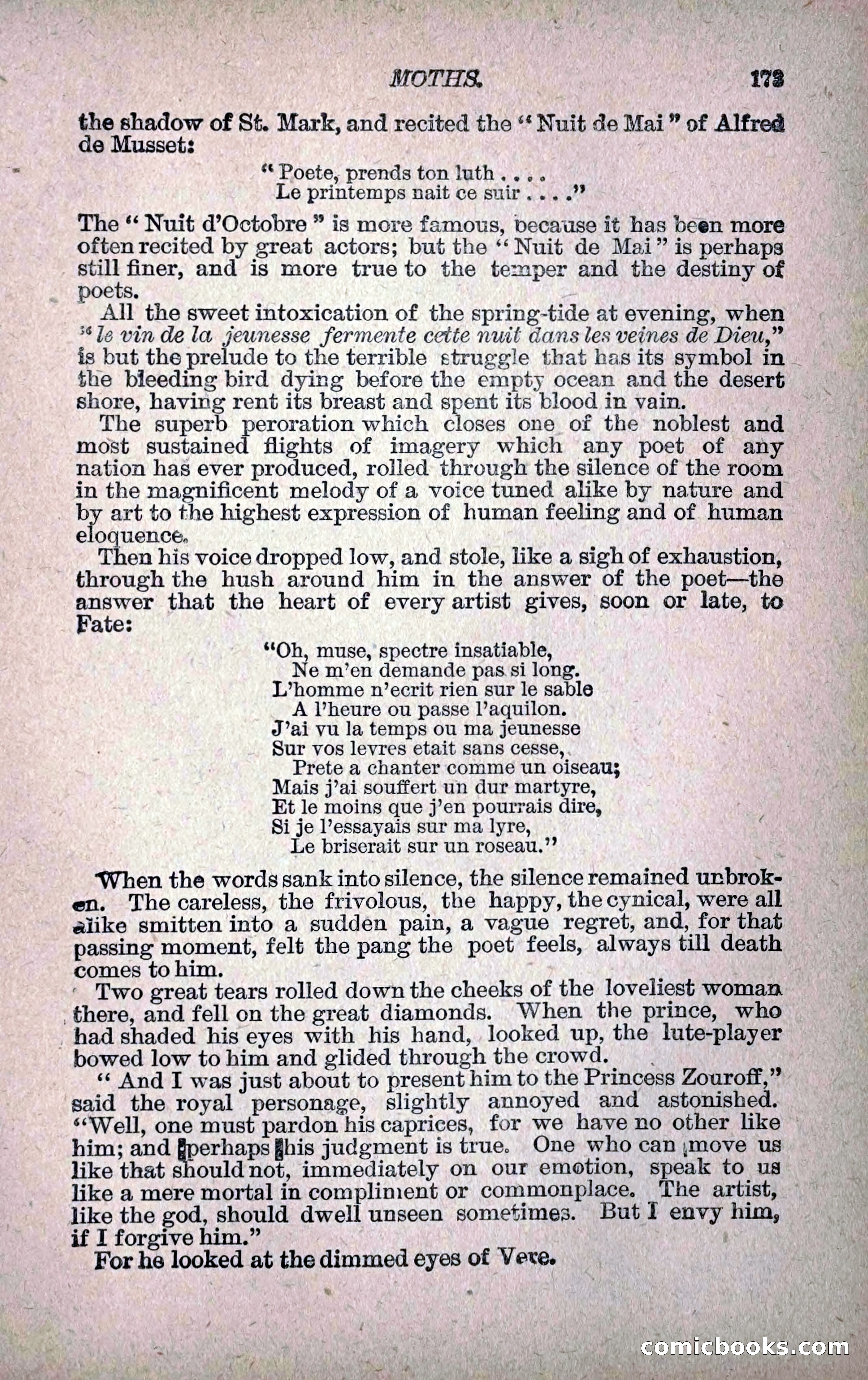
A restored page from Penny Dreadfuls, 1900. Page through the whole issue in the reader above.
📄 Transcribed text from this page (OCR, searchable)
Machine-transcribed from the original scan — historical spelling and the odd misread are preserved.
' MOTHS, 13 the shadow of St. Mark, and recited the “* Nuit de Mai” of Alfred de Mussets ** Poete, prends ton luth.... Le printemps nait ce snir....”? The ** Nuit d’Octobre ” is more famous, because it has been more often recited by great actors; but the ‘‘ Nuit de Mai” is perhaps still finer, and is more true to the temper and the destiny of oets. | All the sweet intoxication of the spring-tide at evening, when Sle vin de la jeunesse fermente cette nuit dans les veines de Dieu,” is but the prelude to the terrible struggle that has its symbol in ~ the bieeding bird dying before the empty ocean and the desert shore, having rent its breast and spent its blood in vain. The superb peroration which closes one of the noblest and - most sustained flights of imagery which any poet of any nation has ever produced, rolled through the silence of the room in the magnificent melody of a voice tuned alike by nature and | by art to the highest expression of human feeling and of human eloquence, Then his voice dropped low, and stole, like a sigh of exhaustion, through the hush around him in the answer of the poet—the answer that the heart of every artist gives, soon or late, to Fate: “Oh, muse, spectre insatiable, Ne m’en demande pas.si long. L’homme n’ecrit rien sur le sable A Vheure ou passe l’aquilon. J’ai vu la temps ou ma jeunesse Sur vos levres etait sans cesse, Prete a chanter comme un oiseauty Mais j’ai souffert un dur martyre, Et le moins que j’en pourrais dire, Si je l’essayais sur ma lyre, Le briserait sur un roseau.”’ When the words sank into silence, the silence remained unbrok- en. The careless, the frivolous, the happy, the cynical, were all alike smitten into a sudden pain, a vague regret, and, for that passing moment, felt the pang the poet feels, always till death comes to him. Two great tears rolled down the cheeks of the loveliest woman there, and fell on the great diamonds. When the prince, who had shaded his eyes with his hand, looked up, the lute-player bowed low to him and glided through the crowd. « And I was just about to present him to the Princess Zouroff,” said the royal personage, slightly annoyed and astonished. é ‘Well, one must pardon his caprices, for we have no other like © him; and fperhaps ghis judgment is true. One who can move us like that should not, immediately on our emotion, speak to us like a mere mortal in compliment or commonplace. The artist, like the god, should dwell unseen sometimes. But I envy him, if I forgive him.” For he looked at the dimmed eyes of Vere. Tt - -comicbooks.« ' a . fee SAR Aal i ead sf AD, 4 ‘t's: é in fa." er) * = ee Ny yy } RVR SY ra