
Penny Dreadfuls, 1900 · page 183 of 398
Moths by Ouida — page 183: what you’re looking at
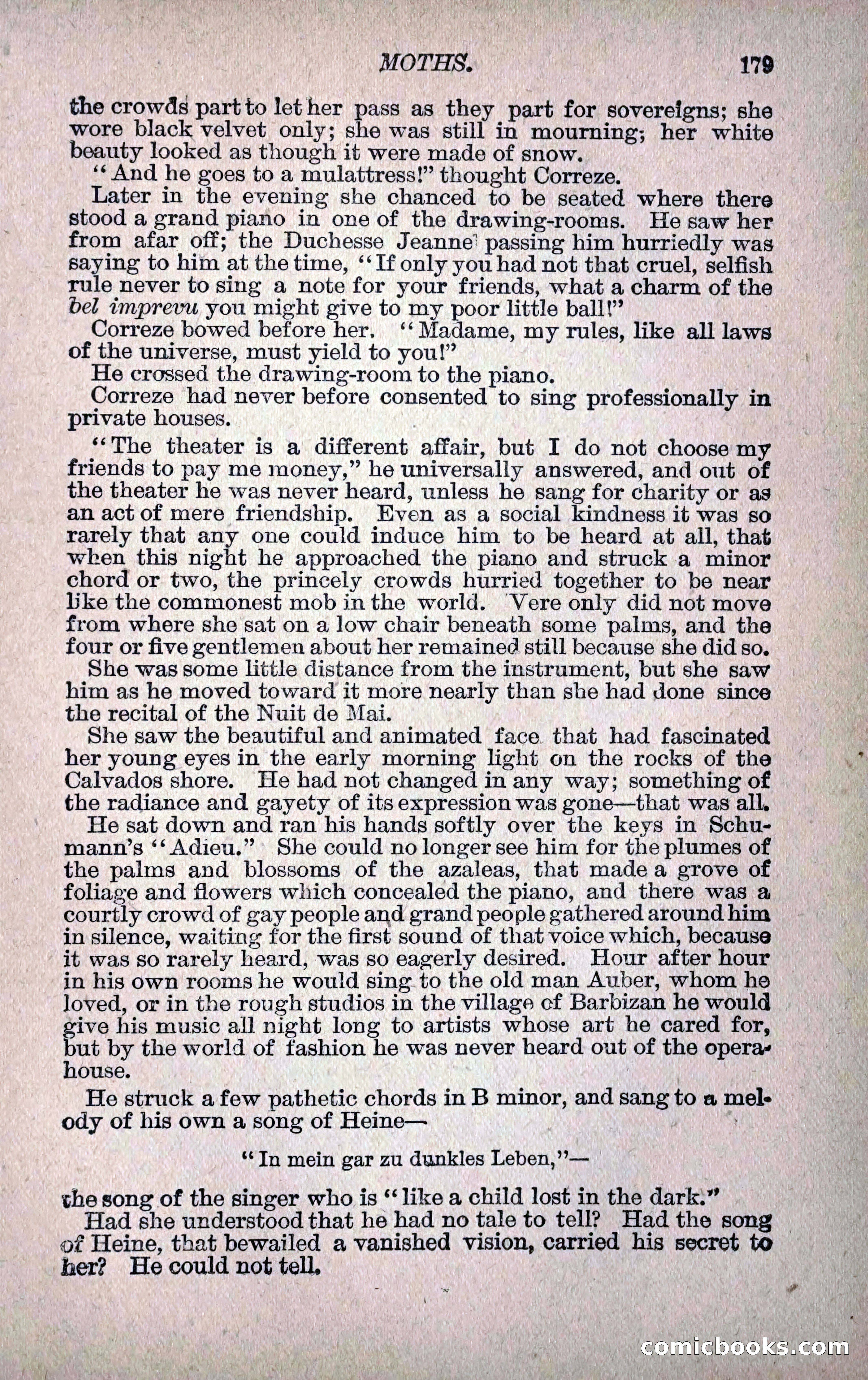
A restored page from Penny Dreadfuls, 1900. Page through the whole issue in the reader above.
📄 Transcribed text from this page (OCR, searchable)
Machine-transcribed from the original scan — historical spelling and the odd misread are preserved.
MOTHS. 179 the crowds partto let her pass as they part for soverelgns; she wore black velvet only; she was still in mourning; her white beauty looked as though it were made of snow. ‘‘ And he goes to a mulattress!” thought Correze. Later in the evening she chanced to be seated where there stood a grand piano in one of the drawing-rooms. He saw her from afar off; the Duchesse Jeanne’ passing him hurriedly was saying to him at the time, ‘‘If only you had not that cruel, selfish rule never to sing a note for your friends, what a charm of the bel imprevu you might give to my poor little ball!” Correze bowed before her, ‘‘ Madame, my rules, like all laws of the universe, must yield to you!” He crossed the drawing-room to the piano. Correze had never before consented to sing professionally in private houses. ‘‘The theater is a different affair, but I do not choose my friends to pay me money,” he universally answered, and out of the theater he was never heard, unless he sang for charity or as an act of mere friendship. Even as a social kindness it was so rarely that any one could induce him to be heard at all, that when this night he approached the piano and struck a minor chord or two, the princely crowds hurried together to be near bke the commonest mob in the world. ‘Vere only did not move from where she sat on a low chair beneath some palms, and the four or five gentlemen about her remained still because she did so. She was some little distance from the instrument, but she saw him as he moved toward it more nearly than she had done since the recital of the Nuit de Mai. She saw the beautiful and animated face. that had fascinated her young eyes in the early morning light on the rocks of the Calvados shore. He had not changed in any way; something of the radiance and gayety of its expression was gone—that was all, He sat down and ran his hands softly over the keys in Schu- mann’s *‘ Adieu.” She could no longer see him for the plumes of the palms and blossoms of the azaleas, that made a grove of foliage and flowers which concealed the piano, and there was a courtly crowd of gay people and grand people gathered around him in silence, waiting for the first sound of that voice which, because it was so rarely heard, was so eagerly desired. Hour after hour in his own rooms he would sing to the old man Auber, whom he loved, or in the rough studios in the village cf Barbizan he would give his music all night long to artists whose art he cared for, but by the world of fashion he was never beard out of the operas house. | He struck afew pathetic chords in B minor, and sang to a mele ody of his own a song of Heine— ‘Tn mein gar zu dunkles Leben,’”’— the song of the singer who is ‘like a child lost in the dark.” Had she understood that he had no tale to tell? Had the song © of Heine, that bewailed a vanished vision, carried his secret to her? He could not tell, (E(e) aa c ,00 gS (E(@)