
Penny Dreadfuls, 1900 · page 195 of 398
Moths by Ouida — page 195: what you’re looking at
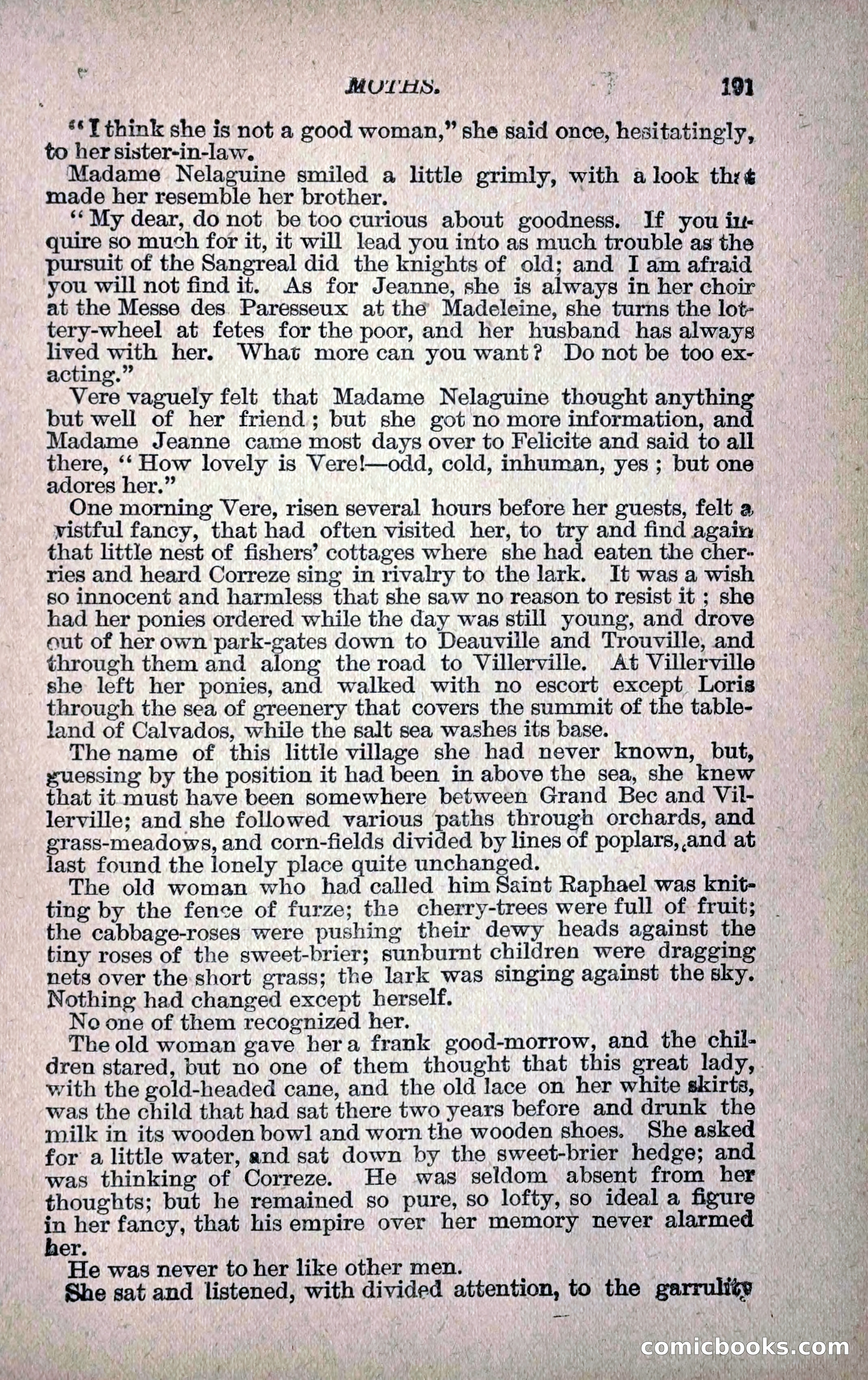
A restored page from Penny Dreadfuls, 1900. Page through the whole issue in the reader above.
📄 Transcribed text from this page (OCR, searchable)
Machine-transcribed from the original scan — historical spelling and the odd misread are preserved.
~, MUTHS. es 191 **¥ think she is not a good woman,” she said once, hesitatingly, to her sister-in-law. Madame Nelaguine smiled a little grimly, with a look thr¢ made her resemble her brother. | ** My dear, do not be too curious about goodness. If you it quire so much for it, it will lead you into as much trouble as the pursuit of the Sangreal did the knights of old; and I am afraid you will not find it. As for Jeanne, she is always in her choir at the Messe des. Paresseux at the Madeleine, she turns the lot- tery-wheel at fetes for the poor, and her husband has always ihe with her. What more can you want? Do not be too ex- acting.” Vere vaguely felt that Madame Nelaguine thought anythin but well of her friend; but she got no more information, and Madame Jeanne came most days over to Felicite and said to all there, ‘‘ How lovely is Vere!—odd, cold, inhuman, yes ; but one adores her.” One morning Vere, risen several hours before her guests, felt a vistful fancy, that had often visited her, to try and find again that little nest of fishers’ cottages where she had eaten the cher- ries and heard Correze sing in rivalry to the lark. It was a wish so innocent and harmless that she saw no reason to resist it ; she had her ponies ordered while the day was still young, and drove out of her own park-gates down to Deauville and Trouville, and through them and along the road to Villerville. At Villerville _ she left her ponies, and walked with no escort except Loris through the sea of greenery that covers the summit of the table- land of Calvados, while the salt sea washes its base. The name of this little village she had never known, but, suessing by the position it had been in above the sea, she knew that it must have been somewhere between Grand Bec and Vil- lerville; and she followed various paths through orchards, and gerass-meadows, and corn-fields divided by lines of poplars, and at last found the lonely place quite unchanged. The old woman who had called him Saint Raphael was knit- ting by the fence of furze; the cherry-trees were full of fruit; the cabbage-roses were pushing their dewy heads against the tiny roses of the sweet-brier; sunburnt children were dragging nets over the short grass; the lark was singing against the sky. Nothing had changed except herself. No one of them recognized her. 4 The old woman gave hera frank good-morrow, and the chil- dren stared, but no one of them thought that this great lady, . with the gold-headed cane, and the old lace on her white skirts, was the child that had sat there two years before and drunk the milk in its wooden bow] and worn the wooden shoes. She asked for a little water, and sat down by the sweet-brier hedge; and was thinking of Correze. He was seldom absent from her thoughts; but he remained so pure, so lofty, so ideal a figure — in her fancy, that his empire over her memory never alarmed her. ~ He was never to her like other men. She sat and listened, with divided attention, to the garrulity ‘ Men ee m choo : } S / f : \t ‘ * AN vj 4 ’ t 7 ¥ » len? rl