
Penny Dreadfuls, 1900 · page 219 of 398
Moths by Ouida — page 219: what you’re looking at
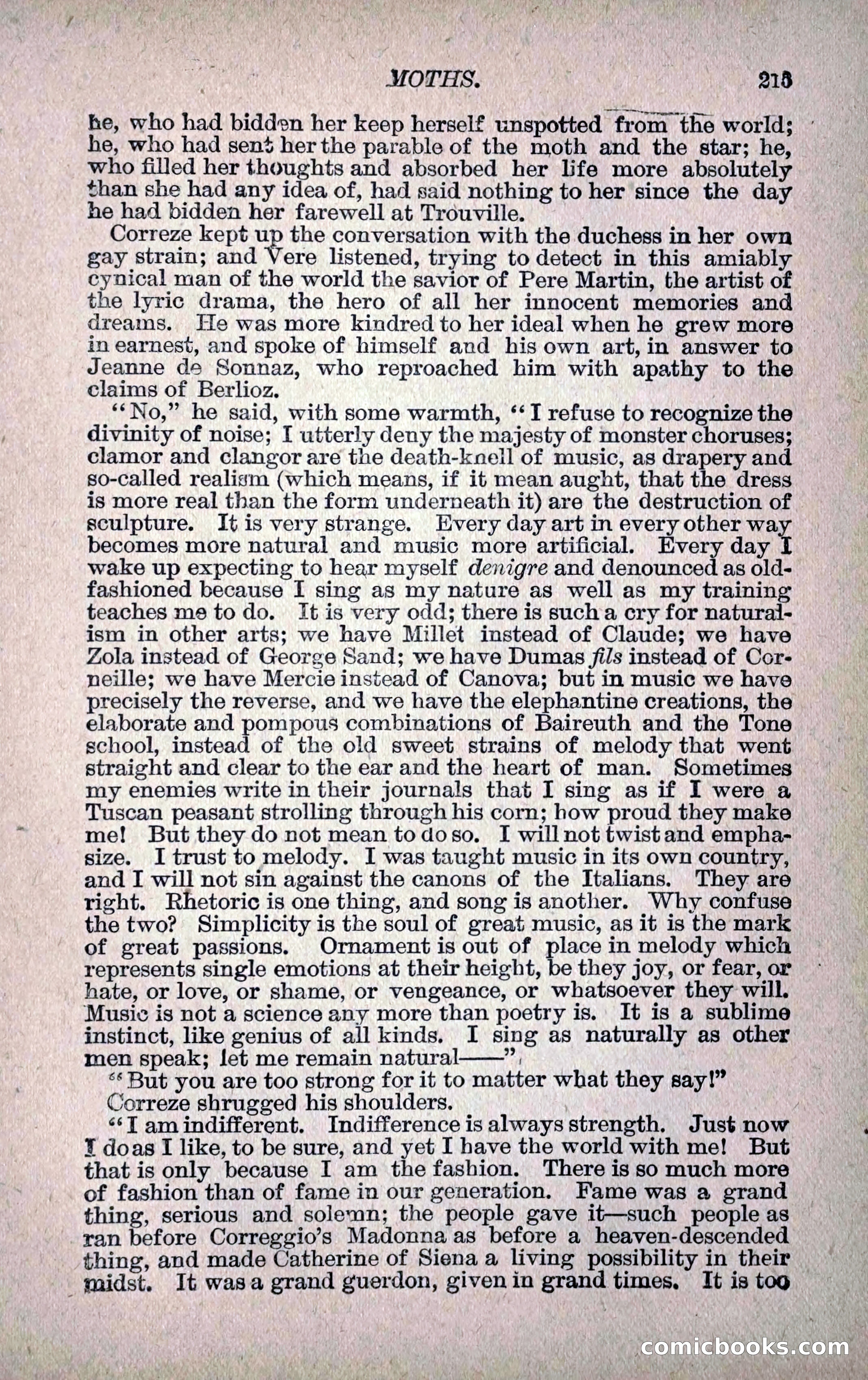
A restored page from Penny Dreadfuls, 1900. Page through the whole issue in the reader above.
📄 Transcribed text from this page (OCR, searchable)
Machine-transcribed from the original scan — historical spelling and the odd misread are preserved.
MOTHS. 1 | 218 he, who had bidden her keep herself unspotted from the world; - he, who had sent her the parable of the moth and the star; he, who filled her thoughts and absorbed her life more absolutely than she had any idea of, had said nothing to her since the day he had bidden her farewell at Trouville. Correze kept up the conversation with the duchess in her own gay strain; and Vere listened, trying to detect in this amiably cynical man of the world the savior of Pere Martin, the artist of the lyric drama, the hero of all her innocent memories and dreams. He was more kindred to her ideal when he grew more in earnest, and spoke of himself and his own art, in answer to Jeanne de Sonnaz, who reproached him with apathy to the claims of Berlioz. ‘*No,” he said, with some warmth, ‘‘I refuse to recognize the divinity of noise; I utterly deny the majesty of monster choruses; clamor and clangor are the death-knell of music, as drapery and so-called realism (which means, if it mean aught, that the dress is more real than the form underneath it) are the destruction of sculpture. Itis very strange. Every day art in every other way becomes more natural and music more artificial. Every day I wake up expecting to hear myself denigre and denounced as old- fashioned because I sing as my nature as well as my training teaches me todo. It is very odd; there is sucha cry for naturai- ism in other arts; we have Millet instead of Claude; we have Zola instead of George Sand; we have Dumas fils instead of Cor- neille; we have Mercie instead of Canova; but in music we have precisely the reverse, and we have the elephantine creations, the elaborate and pompous combinations of Baireuth and the Tone school, instead of the old sweet strains of melody that went straight and clear to the ear and the heart of man. Sometimes my enemies write in their journals that I sing as if I were a Tuscan peasant strolling through his corn; how proud they make me! But they do not mean todoso. I willnot twistand empha- size. I trust to melody. I was taught music in its own country, and I will not sin against the canons of the Italians. They are right. Rhetoric is one thing, and song is another. Why confuse the two? Simplicity is the soul of great music, as it is the mark of great passions. Ornament is out of place in melody which represents single emotions at their height, be they joy, or fear, or hate, or love, or shame, or vengeance, or whatsoever they will. Music is not a science any more than poetry is. It is a sublime instinct, like genius of all kinds. I sing as naturally as other men speak; let me remain natural ee ‘* But you are too strong for it to matter what they say!” Correze shrugged his shoulders. ‘‘T amindifferent. Indifference is always strength. Just now t doas I like, to be sure, and yet I have the world with me! But that is only because I am the fashion. There is so much more of fashion than of fame in our generation. Fame was a grand thing, serious and solemn; the people gave it—such people as ran before Correggio’s Madonna as before a heaven-descended thing, and made Catherine of Siena a living possibility in their | midst. It wasa grand guerdon, given in grand times, It is too Vv J ‘comicbooks.co {i = 7 — = 2 ~ a *< ey