
Penny Dreadfuls, 1900 · page 221 of 398
Moths by Ouida — page 221: what you’re looking at
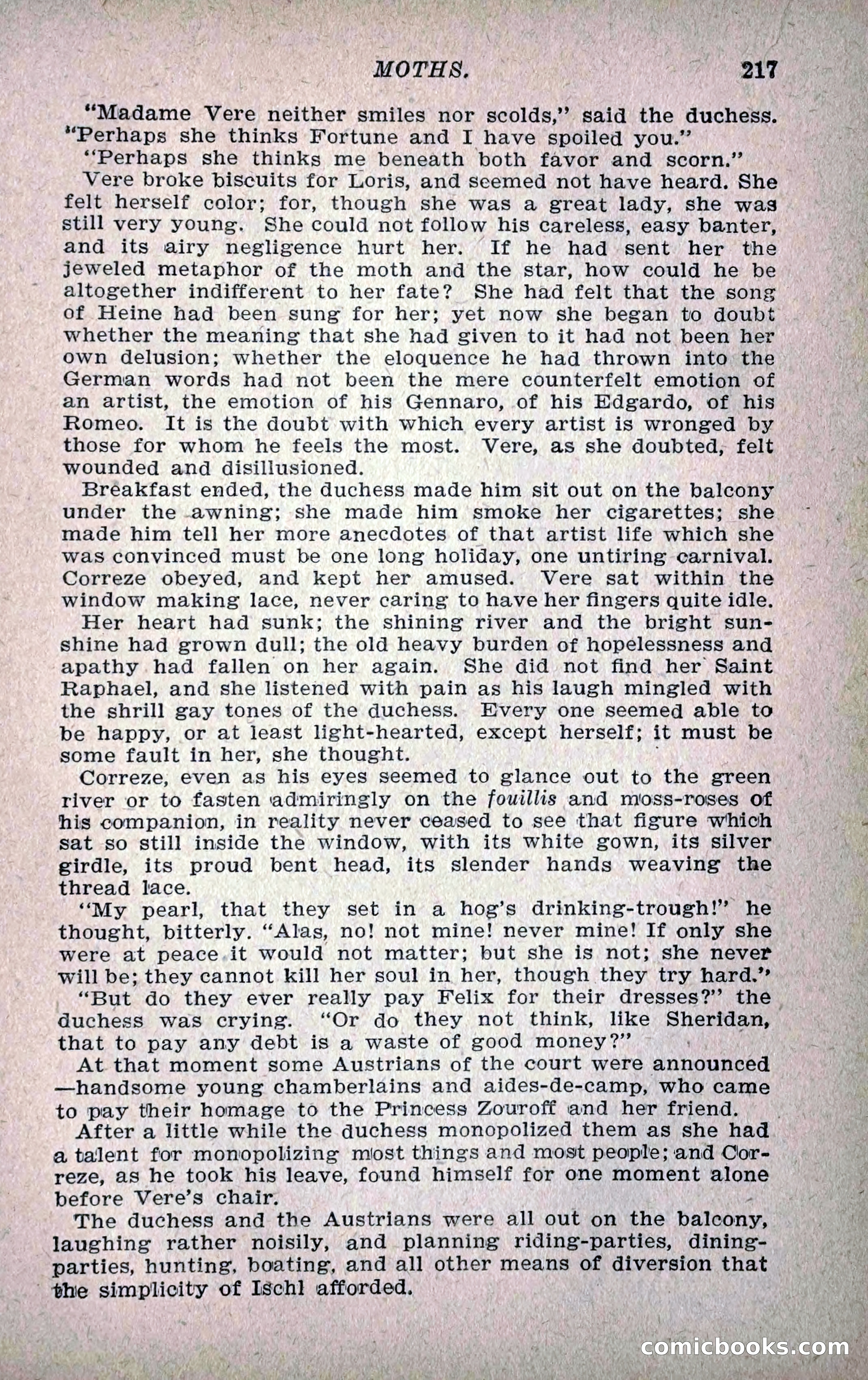
A restored page from Penny Dreadfuls, 1900. Page through the whole issue in the reader above.
📄 Transcribed text from this page (OCR, searchable)
Machine-transcribed from the original scan — historical spelling and the odd misread are preserved.
MOTHS. ana 5 “Madame Vere neither smiles nor scolds,” said the duchess. “Perhaps she thinks Fortune and I have spoiled you.” ‘Perhaps she thinks me beneath both favor and scorn.” Vere broke biscuits for Loris, and seemed not have heard. She felt herself color; for, though she was a great lady, she wag still very young. She could not follow his careless, easy banter, and its airy negligence hurt her. If he had sent her the jeweled metaphor of the moth and the star, how could he be altogether indifferent to her fate? She had felt that the song of Heine had been sung for her; yet now she began to doubt whether the meaning that she had given to it had not been her own delusion; whether the eloquence he had thrown into the German words had not been the mere counterfelt emotion of an artist, the emotion of his Gennaro, of his Edgardo, of his Romeo. It is the doubt with which every artist is wronged by those for whom he feels the most. Vere, as she doubted, felt wounded and disillusioned. Breakfast ended, the duchess made him sit out on the balcony under the awning; she made him smoke her cigarettes; she made him tell her more anecdotes of that artist life which she was convinced must be one long holiday, one untiring carnival. Correze obeyed, and kept her amused. Vere sat within the window making lace, never caring to have her fingers quite idle. Her heart had sunk; the shining river and the bright sun- shine had grown dull; the old heavy burden of hopelessness and apathy had fallen on her again. She did not find her Saint Raphael, and she listened with pain as his laugh mingled with the shrill gay tones of the duchess. Every one seemed able to be happy, or at least light-hearted, except herself; it must be some fault in her, she thought. Correze, even as his eyes seemed to glance out to the green river or to fasten admiringly on the fouillis and mioss-roses of his companion, in reality never ceased to see that figure which sat so still inside the window, with its white gown, its silver girdle, its proud bent head, its slender hands weaving the thread lace. | “My pearl, that they set in a hog’s drinking-trough!” he thought, bitterly. “Alas, no! not mine! never mine! If only she were at peace.it would not matter; but she is not; she never will be; they cannot kill her soul in her, though they try hard.” “But do they ever really pay Felix for their dresses?” the. duchess was crying. “Or do they not think, like Sheridan, that to pay any debt is a waste of good money?” At that moment some Austrians of the court were announced —handsome young chamberlains and aides-de-camp, who came to pay their homage to the Princess Zouroff and her friend. After a little while the duchess monopolized them as she had a talent for monopolizing miost things and most people; and Cor- reze, as he took his leave, found himself for one moment alone before Vere’s chair. | : The duchess and the Austrians were all out on the balcony, laughing rather noisily, and planning riding-parties, dining- parties, hunting, boating, and all other means of diversion that thie simplicity of Ischl afforded. 7 <i comicboo