
Penny Dreadfuls, 1900 · page 232 of 398
Moths by Ouida — page 232: what you’re looking at
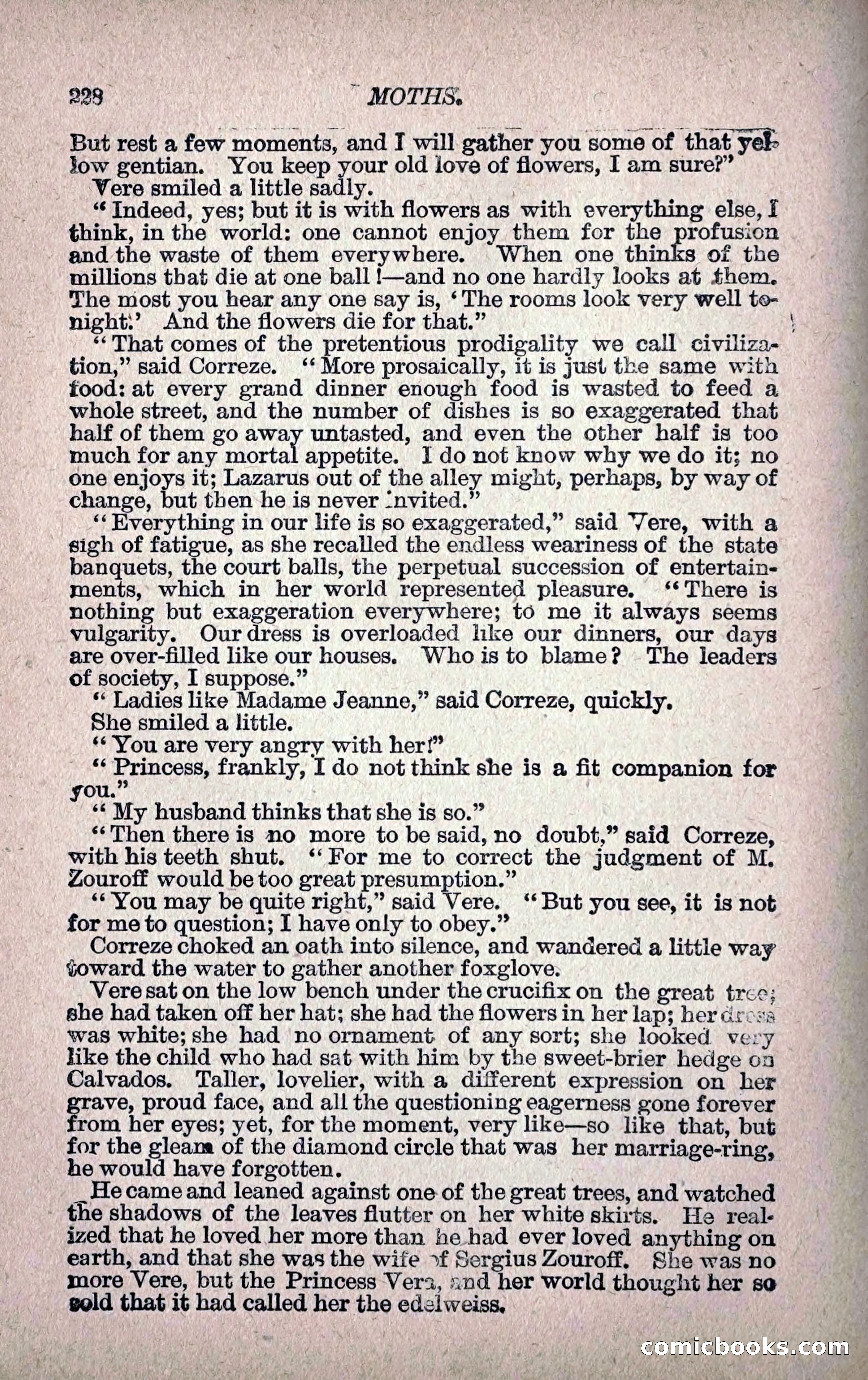
A restored page from Penny Dreadfuls, 1900. Page through the whole issue in the reader above.
📄 Transcribed text from this page (OCR, searchable)
Machine-transcribed from the original scan — historical spelling and the odd misread are preserved.
999 ~ MOTHS. But rest a few moments, and I will gather you some of that yek: Jow gentian. You keep your old love of flowers, I am sure?” ‘Vere smiled a little sadly. | ‘“‘ Indeed, yes; but it is with flowers as with everything else, f think, in the world: one cannot enjoy them for the profusion and the waste of them everywhere. When one thinks of the millions that die at one ball !—and no one hardly looks at fhem. The most you hear any one say is, ‘The rooms look very well to- night;’ And the flowers die for that.” ‘‘That comes of the pretentious prodigality we call civiliza- ) tion,” said Correze. ‘‘ More prosaically, it is just tre same with food: at every grand dinner enough food is wasted to feed a whole street, and the number of dishes is so exaggerated that half of them go away untasted, and even the other half is too much for any acetal ditties 1 do not know why we do it; no one enjoys it; Lazarus out of the alley might, perhaps, by way of change, but then he is never _nvited.” ‘‘EKverything in our life is so exaggerated,” said Yere, with a sigh of fatigue, as she recalled the endless weariness of the state banquets, the court balls, the perpetual succession of entertain- ments, which in her world represented pleasure. ‘* There is nothing but exaggeration everywhere; to me it always seems vulgarity. Ourdress is overloaded lke our dinners, our days are over-filled like our houses. Whoisto blame? The leaders of society, I suppose.” *‘ Ladies like Madame Jeanne,” said Correze, quickly, She smiled a little. | ‘You are very angry with her!” v Princess, frankly, I do not think she is a fit companion for you. ‘* My husband thinks that she is so.” ‘*Then there is no more to be said, no doubt,” said Correze, with his teeth shut. ‘‘ For me to correct the judgment of M. Zouroff would be too great presumption.” ‘*' You may be quite right,” said Vere. ‘* But you see, it is not for me to question; I have only to obey.” Correze choked an oath into silence, and wandered a little way goward the water to gather another foxglove. Vere sat on the low bench under the crucifix on the great tree; she had taken off her hat; she had the flowers in her lap; her dresa was white; she had no ornament of any sort; she looked very like the child who had sat with him by the sweet-brier hedge on Calvados. Taller, lovelier, with a different expression on her ave, proud face, and all the questioning eagerness gone forever rom her eyes; yet, for the moment, very like—so like that, but for the gleama of the diamond circle that was her marriage-ring, he would have forgotten. | | _Hecameand leaned against one of the great trees, and watched _ the shadows of the leaves flutter on her white skirts. He real- ized that he loved her more than he had ever loved anything on earth, and that she was the wife >f Sergius Zouroff. She was no more Vere, but the Princess Vera, ind her world thought her se gold that it had called her the edelweiss, } ae | ‘ . com G 900 cS