
Penny Dreadfuls, 1900 · page 253 of 398
Moths by Ouida — page 253: what you’re looking at
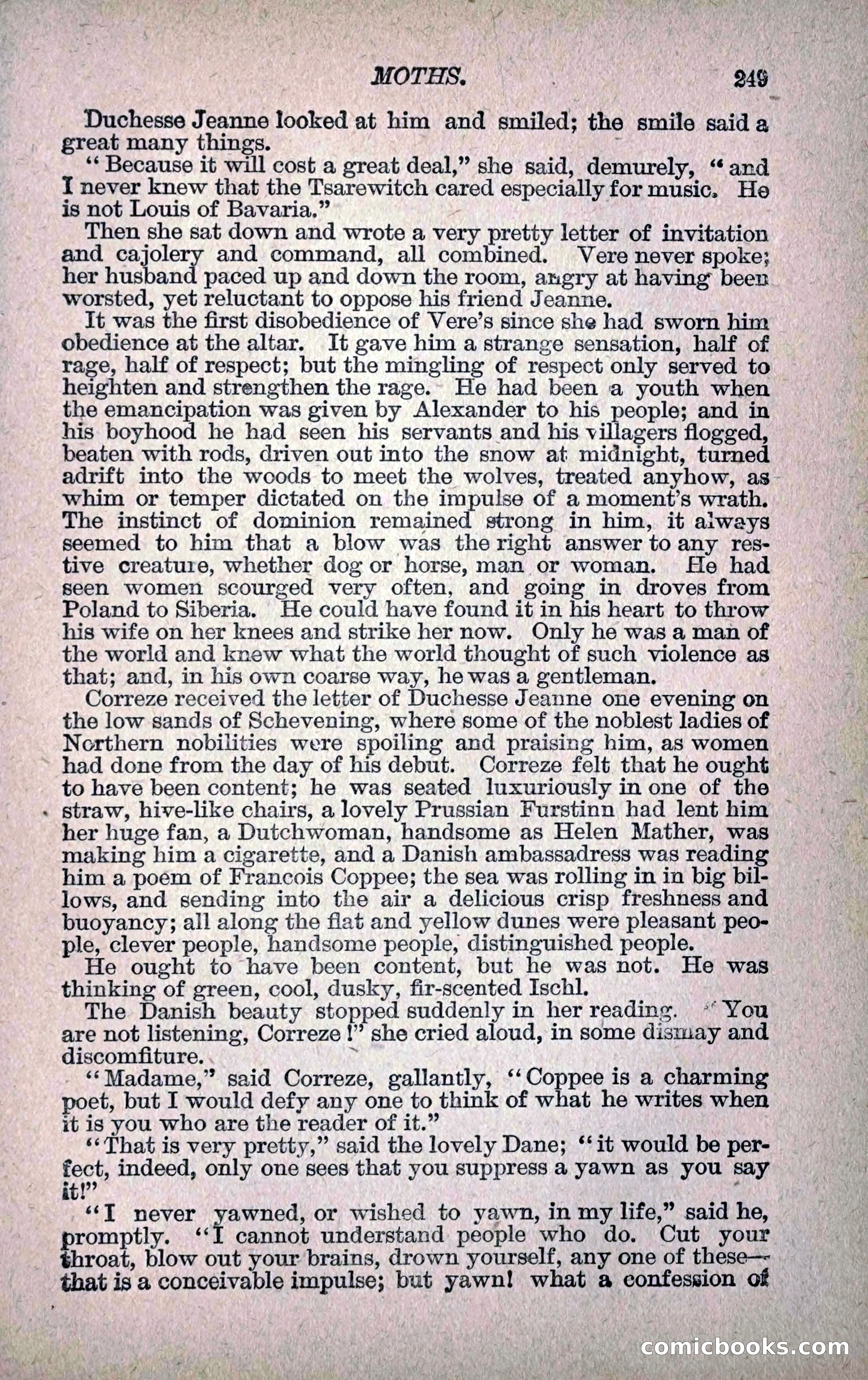
A restored page from Penny Dreadfuls, 1900. Page through the whole issue in the reader above.
📄 Transcribed text from this page (OCR, searchable)
Machine-transcribed from the original scan — historical spelling and the odd misread are preserved.
MOTHS. 949 me Duchesse Jeanne looked at him and smiled; the smile said a great many things. E ‘* Because it will cost a great deal,” she said, demurely, ‘‘ and I never knew that the Tsarewitch cared especially for music. He is not Louis of Bavaria.” | Then she sat down and wrote a very pretty letter of invitation and cajolery and command, all combined. Vere never spoke; her husband paced up and down the room, angry at having been worsted, yet reluctant to oppose his friend Jeanne. it was the first disobedience of Vere’s since she had sworn him obedience at the altar. It gave him a strange sensation, half of rage, half of respect; but the mingling of respect only served to heighten and strengthen the rage. He had been a youth when the emancipation was given by Alexander to his people; and in his boyhood he had seen his servants and his villagers flogged, beaten with rods, driven out into the snow at midnight, turned adrift into the woods to meet the wolves, treated anyhow, as- whim or temper dictated on the impulse of a moment’s wrath. The instinct of dominion remained strong in him, it aiways seemed to him that a blow was theright answer to any res- tive creature, whether dog or horse, man or woman. He had seen women scourged very often, and going in droves from Poland to Siberia. He could have found it in his heart to throw his wife on her knees and strike her now. Only he was a man of the world and knew what the world thought of such violence as that; and, in his own coarse way, he was a gentleman. | Correze received the letter of Duchesse Jeanne one evening on the low sands of Schevening, where some of the noblest ladies of Northern nobilities were spoiling and praising him, as women had done from the day of his debut. Correze felt that he ought to have been content; he was seated luxuriously in one of the . straw, hive-like chairs, a lovely Prussian Furstinn had lent him — her huge fan, a Dutchwoman, handsome as Helen Mather, was making him a cigarette, and a Danish ambassadress was reading him a poem of Francois Coppee; the sea was rolling in in big bil- lows, and sending into the air a delicious crisp freshness and buoyancy; all along the flat and yellow dunes were pleasant peo- ple, clever people, handsome people, distinguished people. He ought to have been content, but he was not. He was thinking of green, cool, dusky, fir-scented Ischl. The Danish beauty stopped suddenly in her reading. °° You are not listening, Correze !” she cried aloud, in some dismay and discomfiture. y . “Madame,” said Correze, gallantly, ‘‘Coppee is a charming poet, but I would defy any one to think of what he writes when it is you who are the reader of it.” ‘‘That is very pretty,” said the lovely Dane; ‘‘it would be per- fect, indeed, only one sees that you suppress @ yawn as you say it!’ ; ‘‘T never yawned, or wished to yawn, in my life,” said he, promptly. ‘‘I cannot understand people who do. Cut your throat, blow out your brains, drown yourself, any one of these—- that is a conceivable impulse; but yawn! what a confession of ‘ ¥ 5) . i we f A’, Aare) aes eee, Tee Ww ‘comicbooks.com — ¢ i ‘ 7 cX >)"