
Penny Dreadfuls, 1900 · page 274 of 398
Moths by Ouida — page 274: what you’re looking at
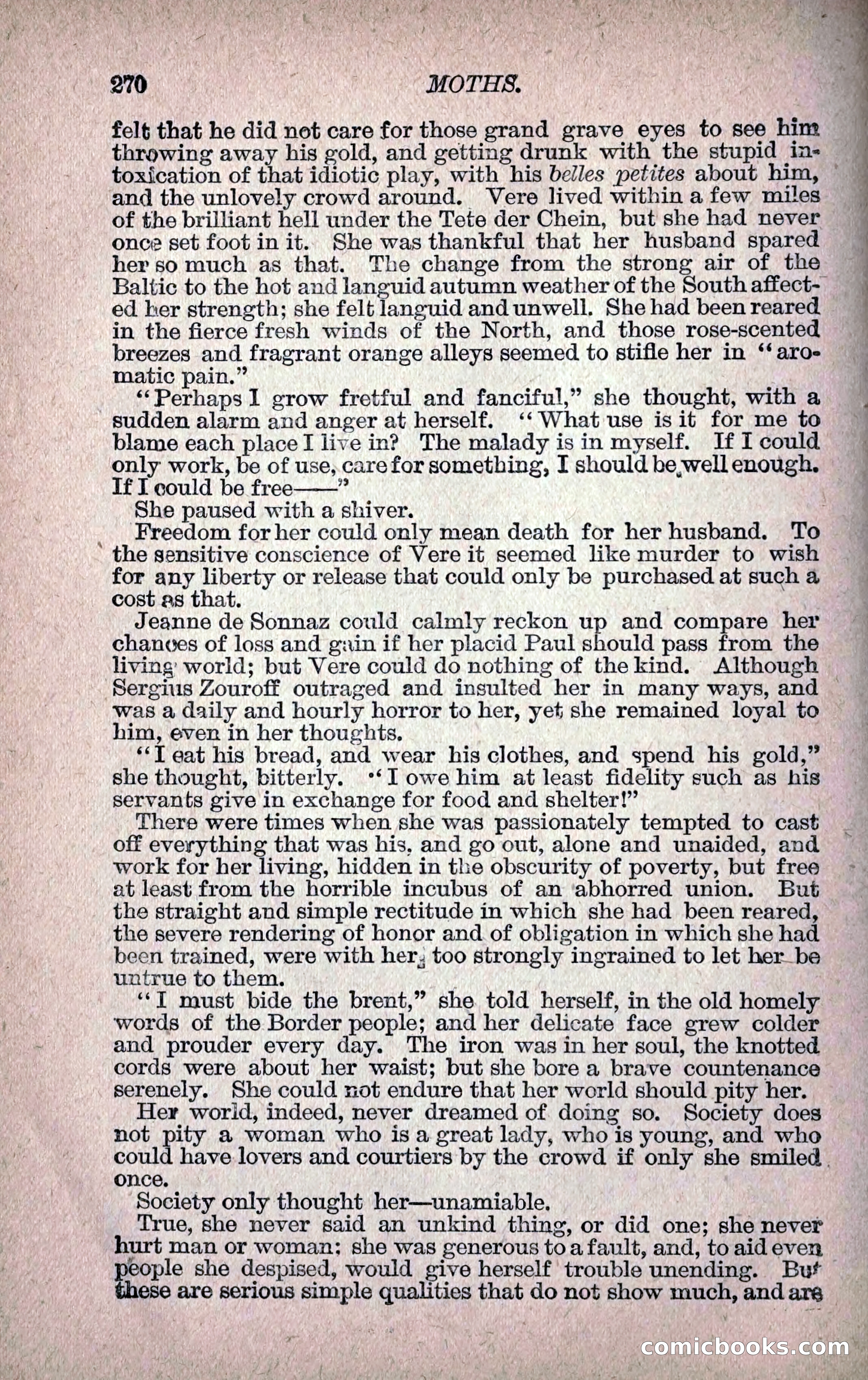
A restored page from Penny Dreadfuls, 1900. Page through the whole issue in the reader above.
📄 Transcribed text from this page (OCR, searchable)
Machine-transcribed from the original scan — historical spelling and the odd misread are preserved.
270 rae ay MOTHS. i"? felt that he did not care for those grand grave eyes to see him throwing away his gold, and getting drunk with the stupid in- toxication of that idiotic play, with his belles petites about him, and the unlovely crowd around. Vere lived within a few miles of the brilliant hell under the Tete der Chein, but she had never once set foot in it.. She was thankful that her husband spared her so much as that. The change from the strong air of the Baltic to the hot and languid autumn weather of the South affect- ed her strength; she felt languid and unwell. She had been reared. in the fierce fresh winds of the North, and those rose-scented breezes and fragrant orange alleys seemed to stifle her in ‘‘ aroe matic pain.” ‘‘Perhaps 1 grow fretful and fanciful,” she thought, with a sudden alarm and anger at herself. ‘‘Whatuse isit for me to blame each placeI live in? The malady isin myself. If I could only work, be of use, care for something, I should be,well enough. If I could be free——” She paused with a shiver. | Freedom for her could only mean death for her husband. To ‘ the sensitive conscience of Vere it seemed like murder to wish for any liberty or release that could only be purchased at such a cost as that. Jeanne de Sonnaz could calmly reckon up and compare her chanves of loss and gain if her placid Paul should pass from the living’ world; but Vere could do nothing of the kind. Although Sergius Zouroff outraged and insulted her in many ways, and was a daily and hourly horror to her, yet; she remained loyal to him, even in her thoughts, ‘‘T eat his bread, and wear his clothes, and spend his gold,” she thought, bitterly. °‘I owe him at least fidelity such as his servants give in exchange for food and shelter!” There were times when she was passionately tempted to cast off everything that was his, and go out, alone and unaided, and work for her living, hidden in the obscurity of poverty, but free at least from the horrible incubus of an ‘abhorred union. But the straight and simple rectitude in which she had been reared, the severe rendering of honor and of obligation in which she had been trained, were with her, too strongly ingrained to let her_be untrue to them. ‘‘T must bide the brent,” she told herself, in the old homely words of the Border people; and her delicate face grew colder and prouder every day. The iron was in her soul, the knotted cords were about her waist; but she bore a brave countenance serenely. She could not endure that her world should pity her. Her world, indeed, never dreamed of doing so. Society does not pity a woman who is a great lady, who is young, and who could have lovers and courtiers by the crowd if only she smiled. once. Society only thought her—unamiable, e, she never said an unkind thing, or did one; she never hurt man or woman; she was generous toa fault, and, to aid even at MAS 2 a Phe a4 ."F * > | 7 Pi ol 7" Fy ¥ a - c —_ ‘a4 ~ Zs A ae | ae ota a” 4 ea vp ae AK Ah poe s ; 4 - Wis . “ éix “¥> wy . ° 7 yee . ‘oe . ¢ ‘ 5 : a : . ia i, ' 7 dry fs : st ; > sh | rm ‘y re. an y Jat : PS : ee - is? ' < . ® . { ' } P » . : aN « ’ i 6 4 P = pn people she despised, would give herself trouble unending. But these are serious simple qualities that do not show much, and are | -comicbooks.co