
Penny Dreadfuls, 1900 · page 277 of 398
Moths by Ouida — page 277: what you’re looking at
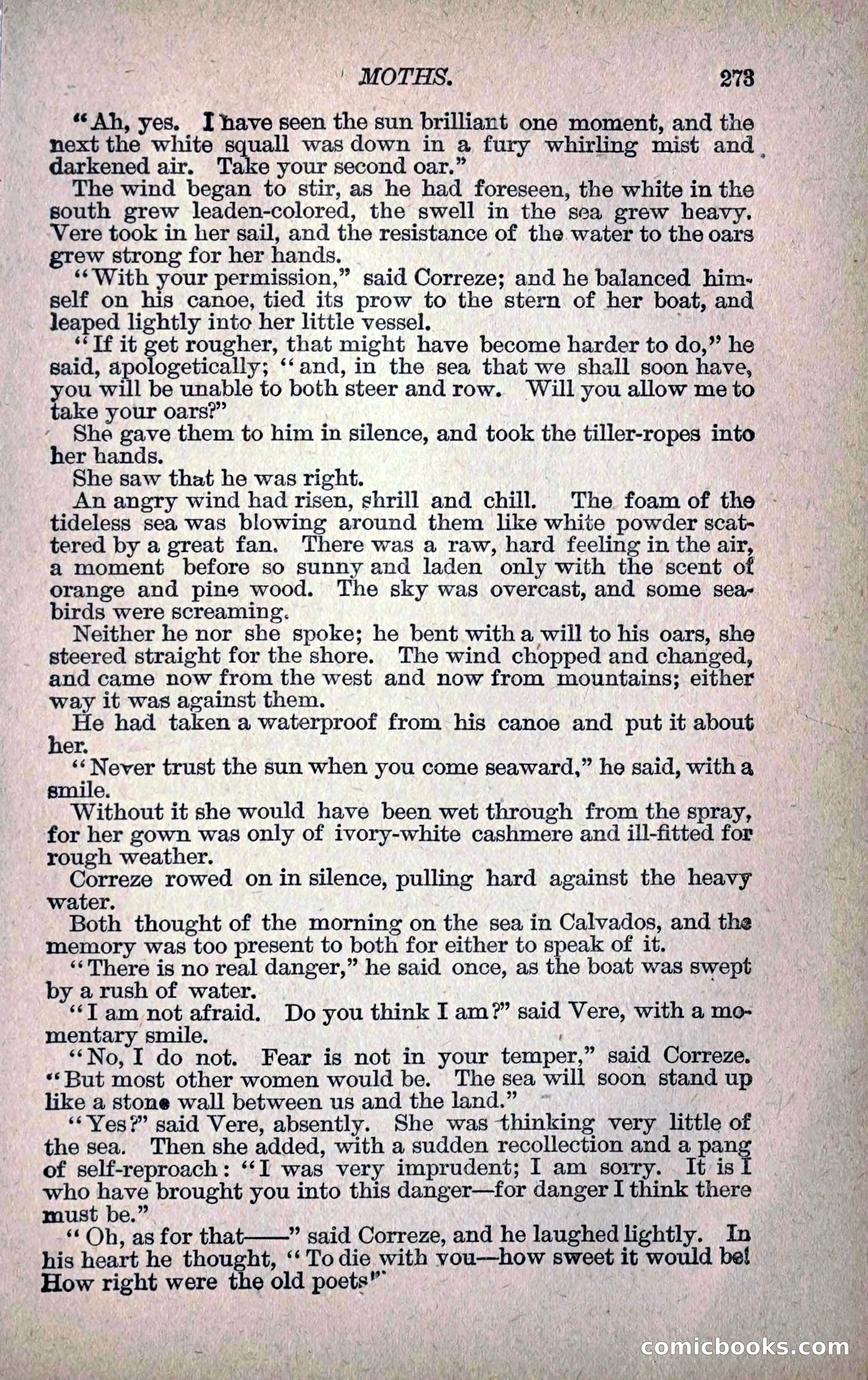
A restored page from Penny Dreadfuls, 1900. Page through the whole issue in the reader above.
📄 Transcribed text from this page (OCR, searchable)
Machine-transcribed from the original scan — historical spelling and the odd misread are preserved.
‘ ; ) | MOTHS. 978 “Ah, yes. I have seen the sun brilliant one moment, and the next the white squall was down in a fury whirling mist and. darkened air. Take your second oar.” The wind began to stir, as he had foreseen, the white in the south grew leaden-colored, the swell in the sea grew heavy. Vere took in her sail, and the resistance of the water to the oars grew strong for her hands. ‘With your permission,” said Correze; and he balanced him- self on his canoe, tied its prow to the stern of her boat, and leaped lightly into her littie vessel. Tf it get rougher, that might have become harder to do,” he said, apologetically; ‘‘and, in the sea that we shall soon have, you will be unable to both steer and row. ‘Will you allow me to take your oars?” She gave them to him in silence, and took the tiller-ropes into her hands. She saw that he was right. An angry wind had risen, shrill and chill. The foam of the - tideless sea was blowing around them like white powder scat- tered by a great fan. There was a raw, hard feeling in the air, a moment before so sunny and laden only with the scent of orange and pine wood. The sky was overcast, and some sea- birds were screaming. Neither he nor she spoke; he bent with a will to his oars, she steered straight for the shore. The wind chopped and changed, and came now from the west and now from mountains; either way it was against them. : He had taken a waterproof from his canoe and put it about er, a ever trust the sun when you come seaward,” he said, witha 8 e. Without it she would have been wet through from the spray, for her gown was only of ivory-white cashmere and ill-fitted for rough weather. Correze rowed on in silence, pulling hard against the heavy water. Both thought of the morning on the sea in Calvados, and the — memory was too present to both for either to speak of it. ‘‘There is no real danger,” he said once, as the boat was swept by a rush of water. ‘‘T am not afraid. Do you think I am?” said Vere, with a mo- mentary smile. ‘‘No, I do not. Fear is not in your temper,” said Correze. «But most other women would be. The sea will soon stand up like a stone wall between us and the land.” ‘‘ Yes?” said Vere, absently. She was thinking very little of the sea. Then she added, with a sudden recollection and a pan of self-reproach: ‘‘I was very imprudent; I am sorry. It is who have brought you into this danger—for danger I think there must be.” ‘¢ Oh, as for that——” said Correze, and he laughed lightly. In his heart he thought, ‘‘ To die with yvou—how sweet it would bet How right were the old poets” é ae } comicbooks.col t ee AR Met t , ' (i od} v becvaeay Ry 4 wt