
Penny Dreadfuls, 1900 · page 290 of 398
Moths by Ouida — page 290: what you’re looking at
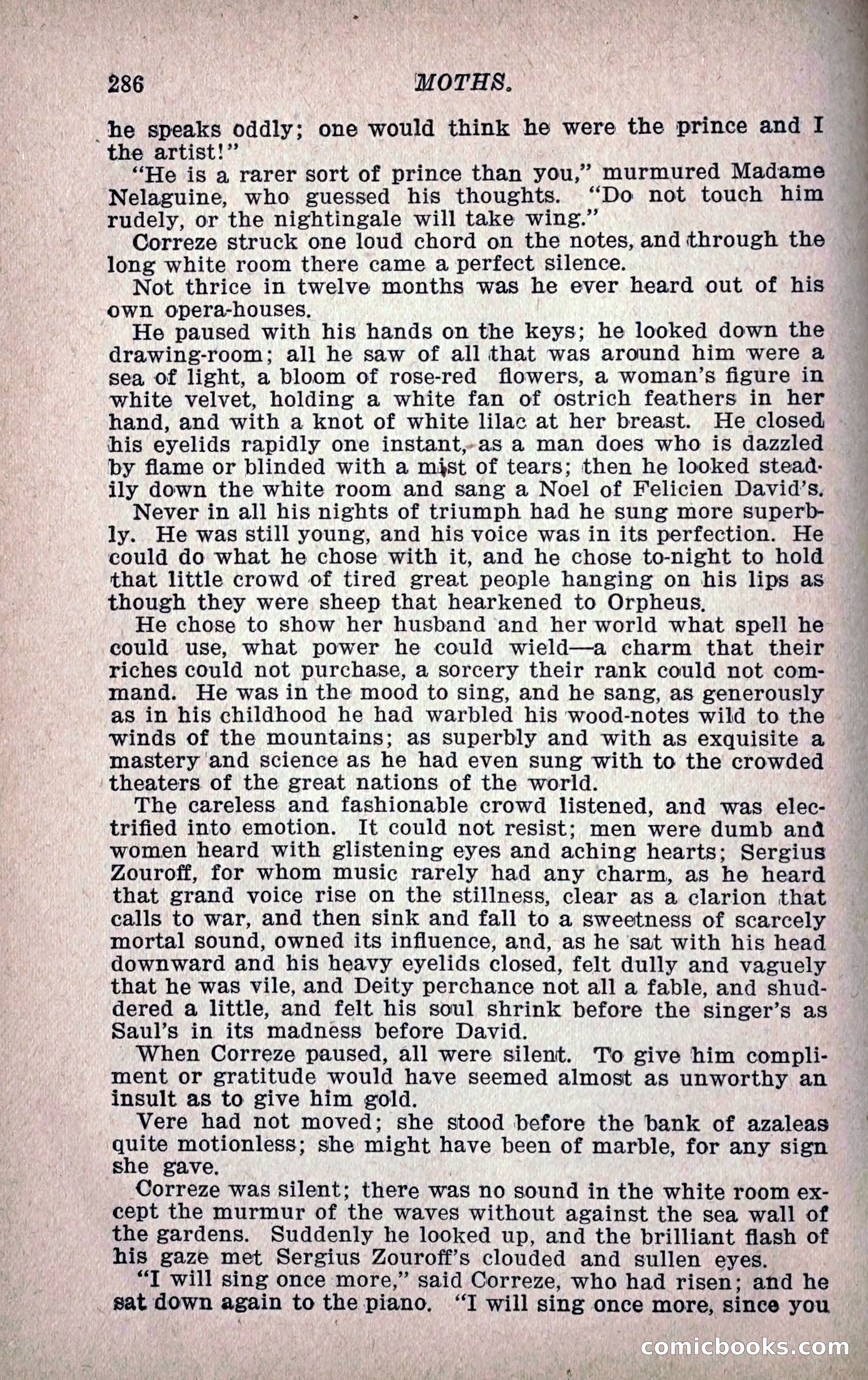
A restored page from Penny Dreadfuls, 1900. Page through the whole issue in the reader above.
📄 Transcribed text from this page (OCR, searchable)
Machine-transcribed from the original scan — historical spelling and the odd misread are preserved.
286 } MOTHS. he speaks oddly; one would think he were the prince and I the artist!” “He is a rarer sort of prince than you,’ murmured Madame Nelaguine, who guessed his thoughts. “Do not touch him rudely, or the nightingale will take wing.” Correze struck one loud chord on the notes, and through the long white room there came a perfect silence. Not thrice in twelve months was he ever heard out of his own opera-houses, He paused with his hands on the keys; he looked down the drawing-room; all he saw of all that was around him were a sea, of light, a bloom of rose-red flowers, a woman’s figure in white velvet, holding a white fan of ostrich feathers in her hand, and with a knot of white lilac at her breast. He closed his eyelids rapidly one instant,-as a man does who is dazzled by flame or blinded with a mist of tears; then he looked steaa- ily down the white room and sang a Noel of Felicien David’s, Never in all his nights of triumph had he sung more superb- ly. He was still young, and his voice was in its perfection. He could do what he chose with it, and he chose to-night to hold that little crowd of tired great people hanging on his lips as though they were sheep that hearkened to Orpheus, He chose to show her husband and her world what spell he could use, what power he could wield—a charm that their riches could not purchase, a sorcery their rank could not com- mand. He was in the mood to sing, and he sang, as generously as in his childhood he had warbled his wood-notes wild to the winds of the mountains; as superbly and with as exquisite a mastery and science as he had even sung with to the crowded theaters of the great nations of the world. The careless and fashionable crowd listened, and was elec- trified into emotion. It could not resist; men were dumb and women heard with glistening eyes and aching hearts; Sergius Zouroff, for whom music rarely had any charm, as he heard that grand voice rise on the stillness, clear as a clarion that calls to war, and then sink and fall to a sweetness of scarcely mortal sound, owned its influence, and, as he sat with his head downward and his heavy eyelids closed, felt dully and vaguely that he was vile, and Deity perchance not all a fable, and shud- dered a little, and felt his soul shrink before the singer’s as Saul’s in its madness before David. When Correze paused, all were silent. To give him compli- ment or gratitude would have seemed almost as unworthy an insult as to give him gold. Vere had not moved; she stood before the bank of azaleas quite motionless; she might have been of marble, for any sign she gave. Correze was silent; there was no sound in the white room ex- cept the murmur of the waves without against the sea wall of the gardens. Suddenly he looked up, and the brilliant flash of his gaze met Sergius Zouroff’s clouded and sullen eyes. “T will sing once more,” said Correze, who had risen; and he sat down again to the piano. “I will sing once more, since you Eom G 700 55 (E(@)