
Penny Dreadfuls, 1900 · page 319 of 398
Moths by Ouida — page 319: what you’re looking at
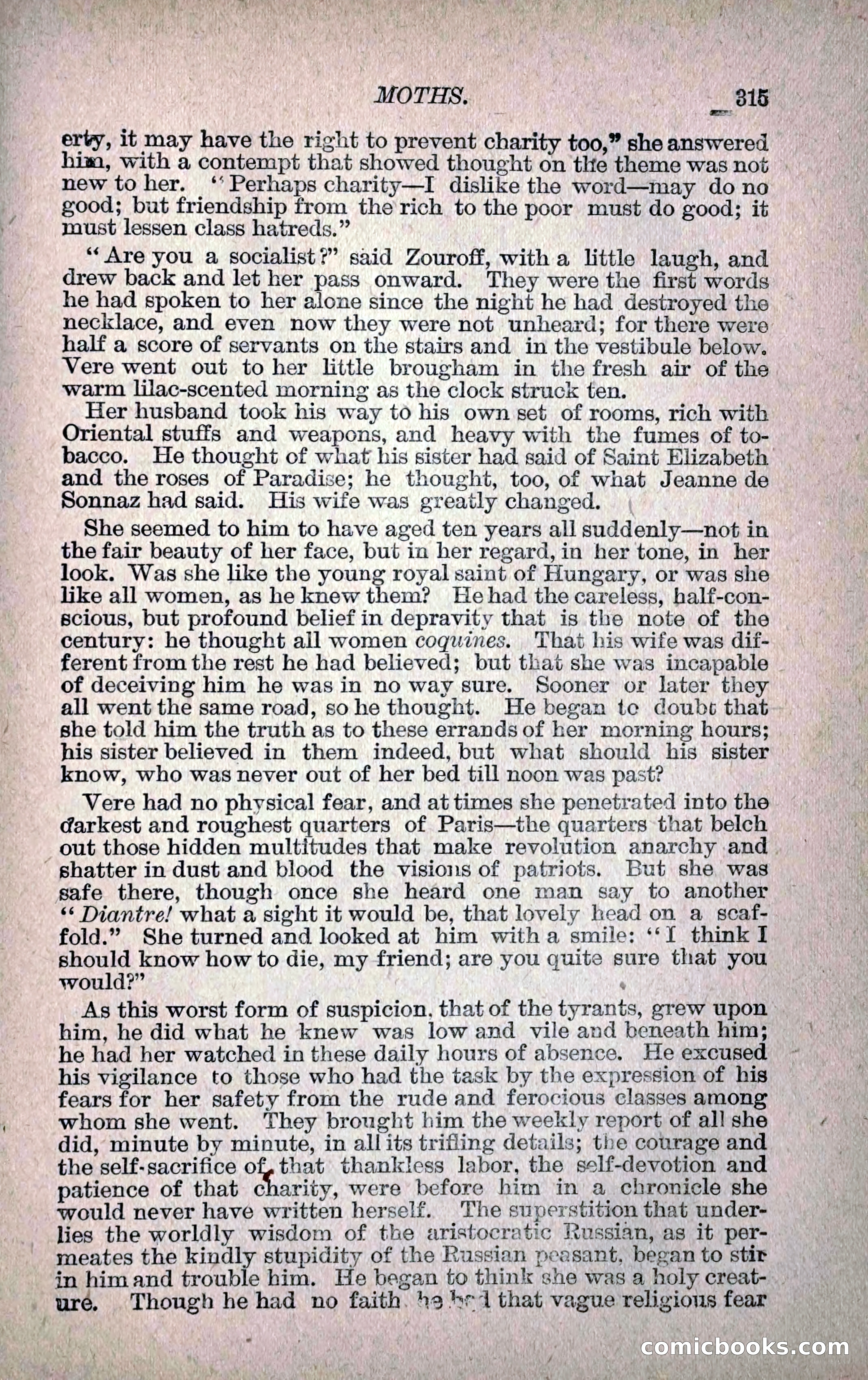
A restored page from Penny Dreadfuls, 1900. Page through the whole issue in the reader above.
📄 Transcribed text from this page (OCR, searchable)
Machine-transcribed from the original scan — historical spelling and the odd misread are preserved.
MOTHS. — . 815 aE: erty, it may have the right to prevent charity too,” she answered him, with a contempt that showed thought on tle theme was not > new toher. ‘’ Perhaps charity—I dislike the word—may do no good; but friendship from the rich to the poor must do good; it must lessen class hatreds.” ‘Are you a socialist?” said Zouroff, with a little laugh, and drew back and let her pass onward. They were the first words he had spoken to her alone since the night he had destroyed the necklace, and even now they were not unheard; for there were half a score of servants on the stairs and in the vestibule below. Vere went out to her little brougham in the fresh air of the warm lilac-scented morning as the clock struck ten. Her husband took his way to his own set of rooms, rich with Oriental stuffs and weapons, and heavy with the fumes of to- bacco. He thought of what his sister had said of Saint Elizabeth and the roses of Paradise; he thought, too, of what Jeanne de Sonnaz had said. His wife was greaily changed. She seemed to him to have aged ten years all suddenly—not in the fair beauty of her face, but in her regard, in her tone, in her look. Was she like the young royal saint of Hungary, or was she like all women, as he knew them? Hehad the careless, half-con- scious, but profound belief in depravity that is the note of the century: he thought all women coguines. That his wife was dif- ferent from the rest he had believed; but that she was incapable | of deceiving him he was in no way sure. Sooner or later they all went the same road, so he thought. He began te doubt that she told him the truth as to these errands of her morning hours; his sister believed in them indeed, but what should his sister know, who was never out of her bed till noon was past? Vere had no physical fear, and at times she penetrated into the darkest and roughest quarters of Paris—the quarters that belch out those hidden multitudes that make revolution anarchy and. - shatter in dust and blood the visions of patriots. But she was safe there, though once she heard one man say to another ‘ Diantre! what a sight it would be, that lovely head on a scaf- fold.” She turned and looked at him witha smile: ‘‘I think I should know how to die, my friend; are you quite sure that you would?” ‘ As this worst form of suspicion, that of the tyrants, grew upon him, he did what he knew was low and vile and beneath him; he had her watched in these daily hours of absence. He excused his vigilance to those who had the task by the expression of his fears for her safety from the rude and ferocious classes among whom she went. They brought him the weekly report of all she did, minute by minute, in allits trifling details; the courage and the self-sacrifice of, that thankless labor, the self-devotion and patience of that charity, were before him in a chronicle she would never have written herself. The superstition that under- lies the worldly wisdom of the aristocratic Russian, as it per- meates the kindly stupidity of the Russian peasant, began to stir in himand trouble him. He began to think she was a holy creat-. uré, Though he had no faith. ho hrd that vague religions fear comicboo . | e, v : J, jf ‘ y iA ' ‘S m4 - » se Ne ‘ ft A aa Ly Be ’ fe Veta “