
Penny Dreadfuls, 1900 · page 321 of 398
Moths by Ouida — page 321: what you’re looking at
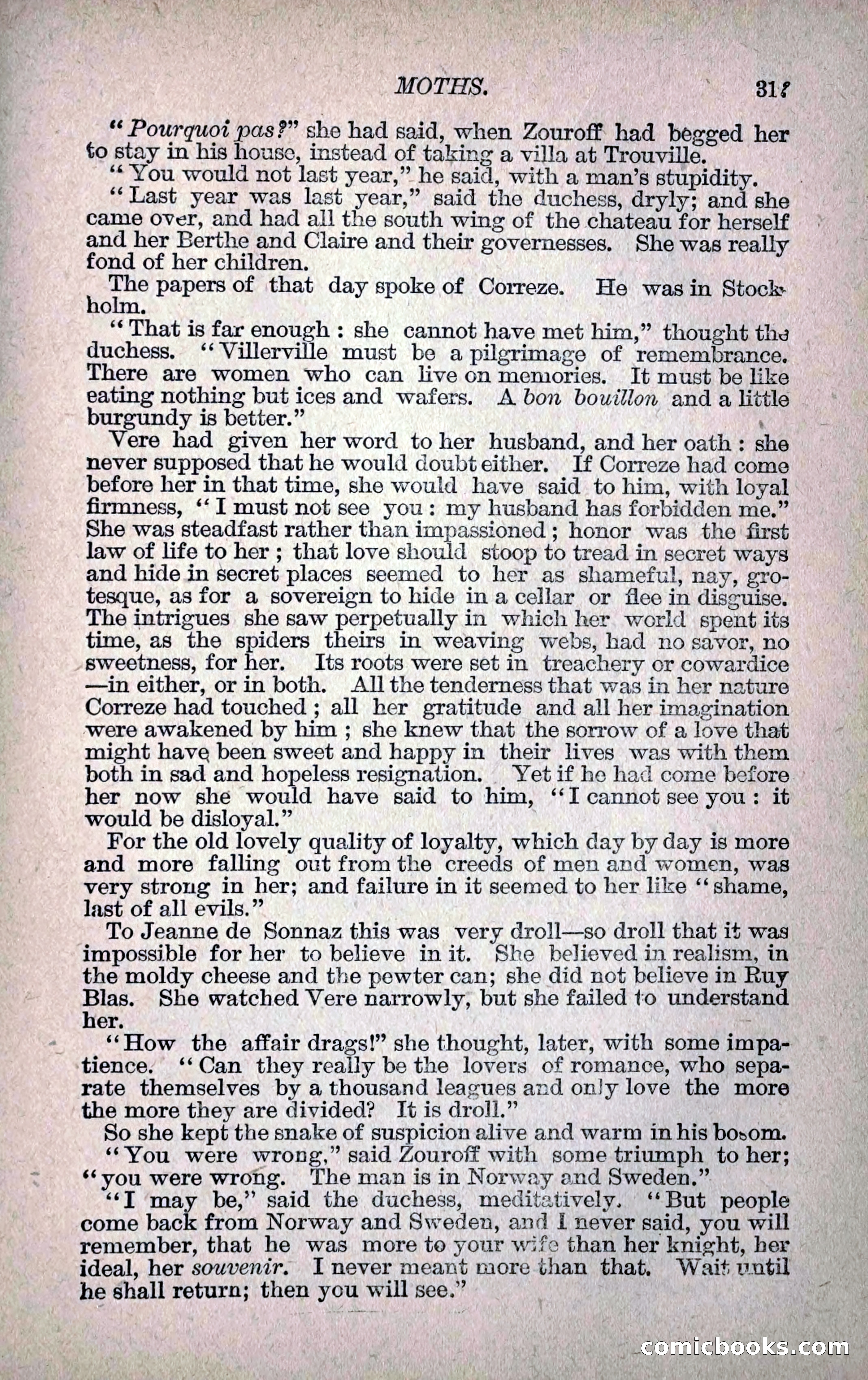
A restored page from Penny Dreadfuls, 1900. Page through the whole issue in the reader above.
📄 Transcribed text from this page (OCR, searchable)
Machine-transcribed from the original scan — historical spelling and the odd misread are preserved.
MOTHS. ge ** Pourquoi pas?” she had said, when Zouroff had begged her fo stay in his house, instead of taking a villa at Trouville. “You would not last year,” he said, with a man’s stupidity. ‘Last year was last year,” said the duchess, dryly; and she came Over, and had all the south wing of the chateau for herself and her Berthe and Claire and their governesses. She was really fond of her children. i ‘Sa papers of that day spoke of Correze. He wasin Stock olm. ‘That is far enough: she cannot have met him,” thought the duchess, ‘‘ Villerville must be a pilgrimage of remembrance. There are women who can live on memories. It must be like eating nothing but ices and wafers. A bon bouillon and a little burgundy is better.” ' Vere had given her word to her husband, and her oath: she never supposed that he would doubteither. If Correze had come before her in that time, she would have said to him, with loyal firmness, ‘‘[ must not see you: my husband has forbidden me.” She was steadfast rather than impassioned; honor was the first law of life to her ; that love should stoop to tread in secret ways and hide in secret places seemed to her as shameful, nay, gro- tesque, asfor a sovereign to hide inacellar or flee in disguise. The intrigues. she saw perpetually in which her world spent its time, as the spiders theirs in weaving webs, had no savor, no sweetness, for her. Its roots were set in treachery or cowardice —in either, orin both. All the tenderness that was in her nature Correze had touched ; all her gratitude and all her imagination were awakened by him ; she knew that the sorrow of a love that might have been sweet and happy in their lives was with them both in sad and hopeless resignation. Yetif he had come before — her now she would have said to him, ‘‘I cannot see you: it would be disloyal.” For the old lovely quality of loyalty, which day by day is more and more falling out from the creeds of men and women, was very strong in her; and failure in it seemed to her like ‘‘ shame, last of all evils.” To Jeanne de Sonnaz this was very droll—so droll that it was impossible for her to believe init. She believed in realism, in the moldy cheese and the pewter can; she did not believe in Ruy Blas. She watched Vere narrowly, but she failed to understand her. : : ‘‘How the affair drags!” she thought, later, with some impa- tience. ‘‘Can they really be the lovers of romance, who sepa- rate themselves by a thousand leagues and only love the more the more they are divided? It is droll.” | So she kept the snake of suspicion alive and warm in his bosom. ‘You were wrong,” said Zourofi with some triumph to her; ‘vou were wrong. The man is in Norway and Sweden.” ‘‘T may be,” said the duchess, meditatively. ‘But people come back from Norway and Sweden, and I never said, you will remember, that he was more te your wife than her knight, her ideal, her souvenir. I never meant more than that. Wait vutil he shall return; then you will see.” wf, ‘ -comicbooks com